

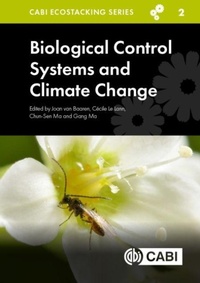
Biological Control Systems and Climate Change
Published on 3. November 2025
Book
Hardback
400 pages
978-1-80062-507-5 (ISBN)
Description
Biological control (or Biocontrol) is the use of natural enemies (predators, parasitoids or pathogens) for the control of pests in crops. In classical biological control, a natural enemy is introduced as a new predator to a range where it is not native. In augmentative biological control, a large number of natural enemies are introduced, either in an area with no natural enemies like glasshouses, or to augment natural populations, to ensure a rapid pest suppression. In conservation biological control, habitats surrounding and within crops are managed to favour an increase in natural enemy populations while suppressing pest populations. These agroecological systems can be complex, and are affected by climate change, both negatively and positively. The object of this book is to synthesize and summarize current knowledge of the many ways climate change can influence the effectiveness of biological control systems. The book introduces the reader to general concepts and then describes climate change effects on the large diversity of macro- and microorganisms involved in biocontrol, and the possible increase or decrease in pest outbreaks following changes in characteristics (morphology, physiology, behaviour....), distribution or phenology. It then outlines methods for mitigating the effects of climate change through the adaptation of biological control strategies, including integrated pest management case studies from diverse continents and cultural contexts. Finally, it explores the economic and societal impacts of climate change on biological control systems. This is the second book in the CABI Ecostacking Series. Biological control is a major component of the ecostacking approach to cropping systems. It is intended for students, researchers, lecturers, and stakeholders engaged in biological control worldwide. It is also essential reading for research personnel and managers in companies that produce biological control agents for field application.
More details
Series
Language
English
Place of publication
Wallingford
United Kingdom
Target group
College/higher education
Professional and scholarly
Dimensions
Height: 252 mm
Width: 178 mm
Thickness: 27 mm
Weight
950 gr
ISBN-13
978-1-80062-507-5 (9781800625075)
Copyright in bibliographic data and cover images is held by Nielsen Book Services Limited or by the publishers or by their respective licensors: all rights reserved.
Schweitzer Classification
Other editions
Additional editions
Joan van Baaren | Cecile Le Lann | Chun-Sen Ma
Biological Control Systems and Climate Change
E-Book
11/2025
CABI Publishing
€156.99
Available for download
Persons
Joan van Baaren (Edited By)
Joan van Baaren is a full Professor at the University of Rennes where she teaches evolutionary ecology and biological conservation. She has been the head of the Ecobio department since 2018. Her main research interests are the study of the impact of climate change in insect communities, Conservation Biological control, and Behavioural Ecology.
Cecile Le Lann (Edited By)
Cecile Le Lann is an Associate Professor at the University of Rennes where she teaches evolutionary ecology, community ecology and biological conservation. Her main research interests are to assess the impact of climate change and landscape in insect communities and associated ecosystem services (pollination and biological control).
Chun-Sen Ma (Edited By)
Ma Chun-Sen is a distinguished professor at Hebei University and and a research scientist at the Chinese Academy of Agricultural Sciences. He is a climate change biologist. He studies pest physiology, population dynamics, interspecific interactions and modelling under climate change, adaptations of pests to extreme climates through thermoregulation, phenotypic plasticity and evolution. His focused insects include cereal aphids and drosophila (tiny insects), diamondback moth (non-diapause and long-distance migration) and fruit moths (overwinter in diapause).
Gang Ma (Edited By)
Gang Ma is an Associate Professor at the Institute of Plant Protection, Chinese Academy of Agricultural Sciences. He has been a main member of the climate change biology research group in the department of agricultural entomology for more than 10 years. His research interests mainly focus on how climate change will affect insects, species interactions and the consequences of biological control.
Heikki M.T. Hokkanen (Series Edited By)
Heikki MT Hokkanen is currently an Adjunct Professor at the Stockbridge School of Agriculture, University of Massachusetts, Amherst, USA. He is professor Emeritus of agricultural zoology at the Faculty of Agriculture and Forestry, University of Helsinki. He holds a Lic. Phil. degree in ecology and natural resource management (1978. Univ. Jyvaeskylae, Finland), and a PhD in applied entomology (1983, Cornell University, Ithaca, NY, USA). His main interest and focus of work has been on integrated control of pests, including trap cropping and all aspects of biological control. In recent years his interests have covered pollinators, and plant-derived bioactive compounds for plant protection applications.
Ingeborg Menzler-Hokkanen (Series Edited By)
Ingeborg Menzler-Hokkanen is at the Stockbridge School of Agriculture, University of Massachusetts, Amherst, USA. Previously she worked over 20 years as researcher at the Department of Agricultural Sciences, University of Helsinki. She has an MSc-degree in agricultural economics from Goettingen University, Germany; MSc-degree in agricultural economics from Cornell University, USA; and a PhD from the Helsinki School of Economics. After a solid research and publication record within economics, she has focused on the socioeconomic and ecological aspects of plant biotechnology, and of pest and pollinator management.
Joan van Baaren is a full Professor at the University of Rennes where she teaches evolutionary ecology and biological conservation. She has been the head of the Ecobio department since 2018. Her main research interests are the study of the impact of climate change in insect communities, Conservation Biological control, and Behavioural Ecology.
Cecile Le Lann (Edited By)
Cecile Le Lann is an Associate Professor at the University of Rennes where she teaches evolutionary ecology, community ecology and biological conservation. Her main research interests are to assess the impact of climate change and landscape in insect communities and associated ecosystem services (pollination and biological control).
Chun-Sen Ma (Edited By)
Ma Chun-Sen is a distinguished professor at Hebei University and and a research scientist at the Chinese Academy of Agricultural Sciences. He is a climate change biologist. He studies pest physiology, population dynamics, interspecific interactions and modelling under climate change, adaptations of pests to extreme climates through thermoregulation, phenotypic plasticity and evolution. His focused insects include cereal aphids and drosophila (tiny insects), diamondback moth (non-diapause and long-distance migration) and fruit moths (overwinter in diapause).
Gang Ma (Edited By)
Gang Ma is an Associate Professor at the Institute of Plant Protection, Chinese Academy of Agricultural Sciences. He has been a main member of the climate change biology research group in the department of agricultural entomology for more than 10 years. His research interests mainly focus on how climate change will affect insects, species interactions and the consequences of biological control.
Heikki M.T. Hokkanen (Series Edited By)
Heikki MT Hokkanen is currently an Adjunct Professor at the Stockbridge School of Agriculture, University of Massachusetts, Amherst, USA. He is professor Emeritus of agricultural zoology at the Faculty of Agriculture and Forestry, University of Helsinki. He holds a Lic. Phil. degree in ecology and natural resource management (1978. Univ. Jyvaeskylae, Finland), and a PhD in applied entomology (1983, Cornell University, Ithaca, NY, USA). His main interest and focus of work has been on integrated control of pests, including trap cropping and all aspects of biological control. In recent years his interests have covered pollinators, and plant-derived bioactive compounds for plant protection applications.
Ingeborg Menzler-Hokkanen (Series Edited By)
Ingeborg Menzler-Hokkanen is at the Stockbridge School of Agriculture, University of Massachusetts, Amherst, USA. Previously she worked over 20 years as researcher at the Department of Agricultural Sciences, University of Helsinki. She has an MSc-degree in agricultural economics from Goettingen University, Germany; MSc-degree in agricultural economics from Cornell University, USA; and a PhD from the Helsinki School of Economics. After a solid research and publication record within economics, she has focused on the socioeconomic and ecological aspects of plant biotechnology, and of pest and pollinator management.
Content
Section 1: Climate change and biocontrol of macro-organisms Chapter 1: Impact of climate change on macro-organisms used in biological control. Philippe Vernon, Francois Renoz & Thierry Hance Chapter 2: Change in diapause strategy in insects and impacts on pest populations. Kevin Tougeron & Jacques Brodeur Chapter 3: Biocontrol, climate change and population dynamics: Why is an increase of pest outbreaks and plant diseases transmitted by vectors expected following climate changes? Gang Ma & Chun-Sen Ma Chapter 4: Weed biocontrol with introduced insects under climate change. Yan Sun, SN Huang, Suzanne TE Lommen, Evan Siemann, Jianqing Ding & Heinz Mueller-Schaerer Chapter 5: Effects of climate change on plant defenses and its consequences for biocontrol. Paul Ode & Enakshi Ghosh Chapter 6: What do we know about the role of spiders in biological control under climate change? A bibliometric approach with insights on the Neotropical region. Luis Fernando Garcia, Luis Quijano & Julien Petillon Chapter 7: Bird-mediated effects of biological control under climate change: opportunities and challenges. Blas Lavandero, Pablo Diaz-Siefer, Natalia Olmos-Moya, Francisco E. Fonturbel & Juan L. Celis-Diez Chapter 8: Impact of climate change on bats involved in biological control. Danilo Russo, Adria Lopez-Baucells, Carles Flaquer, Vanessa Mata, Orly Razgour, Carme Tuneu Corral, Xavier Puig-Montserrat & Hugo Rebelo Chapter 9: Community change and genetic differentiation in a small but contrasted area: insight from Trichogramma in south-eastern France. Ion Scotta Michela, Warot Sylvie, Vercken Elodie & Ris Nicolas Section 2: Impact of Climate change on plant pathogens and micro-organisms involved in biocontrol Chapter 10: Dynamics and evolution of fungal and oomycete plant pathogens and biological control agents under climate change. Ireneo B. Pangga, John Bethany M. Macasero & Romnick A. Latina Chapter 11: Impact of climate change on bacteria and viruses in Biocontrol. Clara Lago & Piotr Trebicki Chapter 12: Bacterial-insect symbiosis in a context of climate change: implications for parasitoidism and biological control. Thierry Hance, Francois Gilbert, Stefan Brandl, Maxence Jacquet & Francois Renoz Section 3: Adaptation of biocontrol to climate change Chapter 13: Challenges of aflatoxin biocontrol in maize under a scenario of climate change. Maria Silvina Alaniz-Zanon, Maria Laura Chiotta, Marianela Bossa, Paloma Rhein & Sofia N. Chulze Chapter 14: Adapting Integrated Pest Management to Climate Change. Joffrey Moiroux, Marie Perrin & Myriam Siegwart Chapter 15: Biological control and Integrated Pest Management in greenhouse crops and adaption to climate change. Carmelo Peter Bonsignore Chapter 16: Population growth of biocontrol agents and prey under climate change: A case study with acarine species. Matthew L. Meehan & Carlos Barreto Chapter 17: Controlling plant disease with plant growth promoting endophyte in the context of climate change. Lorena Barra-Bucarei, Javiera Ortiz-Campos & Hanna Caceres Iparraguirre Chapter 18: Challenges and opportunities for conservation biological control of arthropods under climate change. Armando Alfaro-Tapia, Kevin Tougeron, Enrique Maldonado, Cecile Le Lann, Jacques Brodeur, Joan van Baaren & Blas Lavandero Chapter 19: Emerging insect invasions and climate change: Which biocontrol strategies for an effective prediction and early detection of invaders? Marie-Anne Rozenberg & Alain Roques Chapter 20: The influence of microclimates on the success of biological control. Sylvain Pincebourde Chapter 21: Advanced Crop Protection Strategies in Response to Climate Change: Integrating Technology and Innovation for Sustainable Agriculture. Darija Lemic, Ivana Pajac Zivkovic, Sandra Skendzic & Helena Viric Gasparic Chapter 22: How could digital tools help IPM and biocontrol methods to mitigate the impacts of climate change? Yelitza Colmenarez, Carlos Vasquez, Steve Edgington & Bryony Taylor Chapter 23: Involvement of companies in Biocontrol in the context of climate change. Joan van Baaren Chapter 24: Looking for methods to value ecosystem services? An economic toolkit with a focus on biocontrol. Julie Ing & Marie-Helene Hubert Chapter 25: Biocontrol seen from innovation management: a diversity of living technologies facing global change. Aura Parmentier-Cajaiba, Manuel Boutet & Thibaut Malausa