

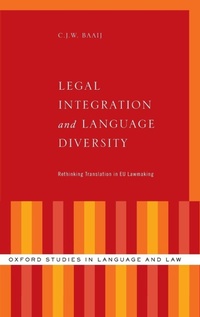
Legal Integration and Language Diversity
Rethinking Translation in EU Lawmaking
Published on 5. April 2018
Book
Hardback
312 pages
978-0-19-068078-7 (ISBN)
Description
How can the European Union create laws that are uniform in a multitude of languages? Specifically, how can it attain both legal integration and language diversity simultaneously, without the latter compromising the former? C.J.W. Baaij argues that the answer lies in the domain of translation. A uniform interpretation and application of EU law begins with the ways in which translators and jurist-linguists of the EU legislative bodies translate the original legislative draft texts into the various language versions.
In the European Union, law and language are inherently connected. The EU pursues legal integration, i.e. the incremental harmonization and unification of its Member States' laws, for the purpose of reducing national regulatory differences between Member States. However, in its commitment to the diversity of European languages, its legislative institutions enact legislative instruments in 24 languages. Language Diversity and Legal Integration assesses these seemingly incompatible policy objectives and contemporary translation practices in the EU legislative procedure, and proposes an alternative, source-oriented approach that better serves EU policy objectives. Contrary to the orthodox view in academic literature and to the current policies of the EU, this book suggests that the English language version should serve as the original and only authentic legislative text. Translation into the other language versions should furthermore avoid prioritizing clarity and fluency over syntactic correspondence and employ neologisms for distinctly EU legal concepts.
Ultimately, Baaij provides practical solutions to the conflict between the equality of all language versions, and the need for uniform interpretation and application of EU law.
In the European Union, law and language are inherently connected. The EU pursues legal integration, i.e. the incremental harmonization and unification of its Member States' laws, for the purpose of reducing national regulatory differences between Member States. However, in its commitment to the diversity of European languages, its legislative institutions enact legislative instruments in 24 languages. Language Diversity and Legal Integration assesses these seemingly incompatible policy objectives and contemporary translation practices in the EU legislative procedure, and proposes an alternative, source-oriented approach that better serves EU policy objectives. Contrary to the orthodox view in academic literature and to the current policies of the EU, this book suggests that the English language version should serve as the original and only authentic legislative text. Translation into the other language versions should furthermore avoid prioritizing clarity and fluency over syntactic correspondence and employ neologisms for distinctly EU legal concepts.
Ultimately, Baaij provides practical solutions to the conflict between the equality of all language versions, and the need for uniform interpretation and application of EU law.
Reviews / Votes
C.J.W. Baaij offers a clear overview of the challenges entailed by multilingual law-making in the EU, and presents and argues persuasively for a novel (and provocative) solution. This is an important text for everyone who works on EU law. * Brian H. Bix, Frederick W. Thomas Professor of Law and Philosophy, University of Minnesota * C.J.W. Baaij addresses a highly topical issue in contemporary research on law and language in the European Union and does so in a convincingly interdisciplinary manner. By highlighting source-oriented translation as the best strategic choice to be made by EU translators, Baaij breaks with the dominant contemporary paradigm within translation studies, which almost exclusively favors target-oriented translation. It is welcome to search for alternative strategies to cope both practically and theoretically with the conflict between formal EU multilingualism and the equality of all language versions on the one hand and the need for uniform interpretation and application of EU law on the other hand. * Anne Lise Kjaer, Professor, Faculty of Law, University of Copenhagen * I find this book refreshing, thoroughly innovative, and original. Concisely written, it is a stimulating and important contribution to the current literature on both institutional translation and EU institutions. * Karen McAuliffe, Reader in Law and Birmingham Fellow, University of Birmingham *More details
Series
Language
English
Place of publication
New York
United States
Target group
Professional and scholarly
Dimensions
Height: 240 mm
Width: 161 mm
Thickness: 21 mm
Weight
637 gr
ISBN-13
978-0-19-068078-7 (9780190680787)
Copyright in bibliographic data and cover images is held by Nielsen Book Services Limited or by the publishers or by their respective licensors: all rights reserved.
Schweitzer Classification
Other editions
Additional editions
E-Book
02/2018
1st Edition
OUP eBook
€63.49
Available for download
E-Book
02/2018
1st Edition
OUP eBook
€49.99
Available for download
Person
C.J.W. Baaij is a J.S.D. candidate at Yale Law School. Previously, he was Assistant Professor at Amsterdam Law School, where he taught contract law, civil procedure, and legal theory. There, he also obtained his Ph.D. degree, cum laude, for his research on legal integration and language diversity, parts of which he conducted as a Fulbright Scholar at Columbia Law School.
Content
1 Introduction
2 Articulating the Task of EU Translation
3 Formalizing the Primacy of English
4 The Mixed Approach of Current EU Translation
5 Considering a Source-Oriented Alternative
6 The Implementation and Its Challenges
7 Summary and Conclusions
Annex I: Language Cases (1960-2010)
Annex II: Anonymized Table of Interviews
2 Articulating the Task of EU Translation
3 Formalizing the Primacy of English
4 The Mixed Approach of Current EU Translation
5 Considering a Source-Oriented Alternative
6 The Implementation and Its Challenges
7 Summary and Conclusions
Annex I: Language Cases (1960-2010)
Annex II: Anonymized Table of Interviews