

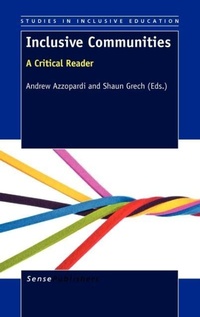
Inclusive Communities
A Critical Reader
Published on 1. January 2012
Book
Hardback
244 pages
978-94-6091-848-3 (ISBN)
Description
The term "Inclusive Communities" has increasingly featured in recent years, at policy, practice and theoretical levels, drawing from different disciplinary standpoints. Much of this has been spurred by efforts at understanding the exclusions confronted by certain populations, to develop the notion of and mechanisms by which communities can include those who are marginalised and/or oppressed, and in some contexts to 'bring back' community as something real or imagined. In spite of this, this deceptive term remains shrouded in epistemological darkness, conveniently endorsed but often little theorised and less understood.
This text provides an exciting introductory textbook, drawing academics, policy makers and activists from various fields to theorise, create new and innovative conceptual platforms and develop further the hybrid idea of inclusive communities.
This text provides an exciting introductory textbook, drawing academics, policy makers and activists from various fields to theorise, create new and innovative conceptual platforms and develop further the hybrid idea of inclusive communities.
More details
Series
Language
English
Place of publication
Rotterdam
Netherlands
Target group
Professional and scholarly
Product notice
sewn/stitched
Cloth over boards
Dimensions
Height: 234 mm
Width: 156 mm
Thickness: 16 mm
Weight
522 gr
ISBN-13
978-94-6091-848-3 (9789460918483)
Copyright in bibliographic data and cover images is held by Nielsen Book Services Limited or by the publishers or by their respective licensors: all rights reserved.
Schweitzer Classification
Other editions
Additional editions
E-Book
09/2012
Sense Publishers
€37.45
Available for download
Book
01/2012
Sense Publishers
€46.00
Shipment within 15-20 days
Content
Understanding Communities
Community Development's Radical Agenda: Social Justice and Environmental Sustainability
Spaces for Inclusive Communities: Reflections on Contemporary Society
People Like Us: Queering Inclusion, Rethinking Community
Disability, Communities of Poverty and the Global South: Debating through Social Capital
Negotiating Stigmatized Identities and Overcoming Barriers to Inclusion in the Transition to Adulthood
Latin American Women and Inclusion in Public and Private Communities
Economics, Game Theory and Disability Studies: Towards a Fertile Dialogue
Female Asylum Seekers Living in Malta: Approaches to Fostering 'Inclusive Communities'
The Value of Mutual Support through Client Communities in the Design of Psychiatric Treatment and Rehabilitation Programs
Beyond Networked Individualism and Trivial Pursuit: Putting Disruptive Technologies to Good Use
Please, Just Call Us Parents: Engaging with Inclusive Approaches to Researching Marginalised Communities
New Frontiers in Research: Using Visual Methods with Marginalised Communities
Decolonizing Methodology: Disabled Children as Research Managers and Participant Ethnographers
Community Development's Radical Agenda: Social Justice and Environmental Sustainability
Spaces for Inclusive Communities: Reflections on Contemporary Society
People Like Us: Queering Inclusion, Rethinking Community
Disability, Communities of Poverty and the Global South: Debating through Social Capital
Negotiating Stigmatized Identities and Overcoming Barriers to Inclusion in the Transition to Adulthood
Latin American Women and Inclusion in Public and Private Communities
Economics, Game Theory and Disability Studies: Towards a Fertile Dialogue
Female Asylum Seekers Living in Malta: Approaches to Fostering 'Inclusive Communities'
The Value of Mutual Support through Client Communities in the Design of Psychiatric Treatment and Rehabilitation Programs
Beyond Networked Individualism and Trivial Pursuit: Putting Disruptive Technologies to Good Use
Please, Just Call Us Parents: Engaging with Inclusive Approaches to Researching Marginalised Communities
New Frontiers in Research: Using Visual Methods with Marginalised Communities
Decolonizing Methodology: Disabled Children as Research Managers and Participant Ethnographers