

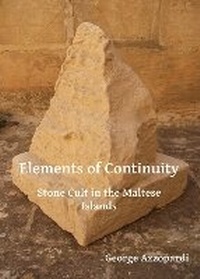
Elements of Continuity
Stone Cult in the Maltese Islands
Published on 31. December 2017
Book
Paperback/Softback
104 pages
978-1-78491-695-4 (ISBN)
Description
Stones can serve an infinite array of functions both when they are worked and when they are left in a 'raw' state. Depending on their function, stones can also be meaningful objects especially when they act as vehicles of ideas or instruments of representation. And it is, therefore, in their functional context, that the meaning of stones can be best grasped. The stones dealt with in this study are non-figural (or aniconic) or, sometimes, semi-figural. They come from ritual contexts and, as such, act as a material representation of divine presence in their role as betyls. But it is not mainly the representational aspect of these stones that this study seeks to highlight. As material representations of divine presence that are also worshipped, these particular stones form part of a phenomenon that seems to know no geographical or temporal boundaries. They are of a universal character. It is this universal character of theirs that seems to qualify these stones as elements forming part of the phenomenon of continuity: continuity across different cultures and in different places along several centuries. It is this phenomenon which this study seeks to highlight through a study of these stones. The Maltese islands are presented as a case study to demonstrate the phenomenon of continuity through a study of these stones. Worship of stones in representation of divine presence is found on the Maltese islands since prehistoric times. But the practice survived several centuries under different cultures represented by unknown communities during the islands' prehistory and the Phoenicians / Carthaginians and the Romans in early historic times.
More details
Language
English
Place of publication
Oxford
United Kingdom
Publishing group
Archaeopress
Target group
Professional and scholarly
College/higher education
Illustrations
41 figs. in black & white
Dimensions
Height: 210 mm
Width: 148 mm
Thickness: 4 mm
Weight
210 gr
ISBN-13
978-1-78491-695-4 (9781784916954)
Copyright in bibliographic data and cover images is held by Nielsen Book Services Limited or by the publishers or by their respective licensors: all rights reserved.
Schweitzer Classification
Person
George Azzopardi is a practising archaeologist hailing from the island of Gozo and is quite familiar with the site. His main research interests focus on the Classical period with the phenomenon of continuity as a marked backdrop. In line with this view, he directed his recent research on religious activity in Classical times as being often in continuity from earlier - sometimes, even prehistoric - traditions or inspired from earlier sources. To this effect, human history is seen as a continuum with hardly any identifiable beginnings or intervals.
Content
Preface; 1.0 Introduction; 1.1 Aims and methodology; 1.2 Defining and identifying sacred stones; 1.3 Earliest known literary and iconographic evidence; 2.0 Stone cult in prehistoric Malta and Gozo; 2.1 Aniconic cults in relation to figurine-based cults in prehistoric Malta; 3.0 Tripillar shrines or altars; 4.0 Betyl amulets?; 5.0 More betyls from Tas-Silg; 6.0 Stone worship at Ras il-Wardija, in Gozo; 7.0 A pair of 'twin' betyls; 8.0 A gilded betyl in the temple of Proserpina at Mtarfa; 9.0 Conclusion; Appendix I; Appendix II; Appendix III; Appendix IV; Bibliography; General Index