

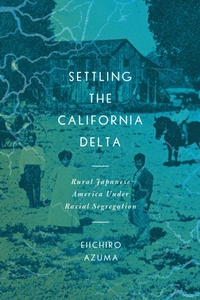
Settling the California Delta
Rural Japanese America Under Racial Segregation
Will be published approx. on 5. January 2027
Book
Hardback
320 pages
978-1-5036-4733-6 (ISBN)
Description
This book traces the forgotten history of a Japanese farm settlement in the Sacramento River delta. Before the wartime removal and incarceration, most West Coast Japanese Americans, including immigrant Issei and US-born Nisei generations, resided in rural agricultural areas. Existing histories of Japanese America have often overlooked this farming aspect of their experience, focusing instead on urban narratives. Centered on the town of Walnut Grove, the "downriver" (kawashimo) settlement was home to Issei farmers, merchants, and laborers who lived alongside their Nisei children in a society characterized by strict racial segregation and landlessness. In the delta basin, a small group of white landowning settlers and corporate interests held power and wealth, shaping social relations and economic opportunities for mostly Asian immigrant settlers and fieldhands.
Combining theories of settler colonialism, racial capitalism, and immigrant transnationalism with the techniques of microhistory, Eiichiro Azuma reveals the intricate dynamics of paternalistic interdependency between white landlords and Japanese tenants, as well as the complex interethnic relations among marginalized immigrant groups in the local segregated society and agricultural economy. Through his careful analysis of heretofore overlooked immigrant vernacular sources and oral histories, Azuma sheds important light on a lesser-known aspect of rural Asian American history through the lens of multiracial entanglements on the ground.
Combining theories of settler colonialism, racial capitalism, and immigrant transnationalism with the techniques of microhistory, Eiichiro Azuma reveals the intricate dynamics of paternalistic interdependency between white landlords and Japanese tenants, as well as the complex interethnic relations among marginalized immigrant groups in the local segregated society and agricultural economy. Through his careful analysis of heretofore overlooked immigrant vernacular sources and oral histories, Azuma sheds important light on a lesser-known aspect of rural Asian American history through the lens of multiracial entanglements on the ground.
More details
Series
Language
English
Place of publication
Palo Alto
United States
Target group
Professional and scholarly
Product notice
Cloth
Illustrations
18 illustrations - 10 tables, 15 halftones, 3 maps
Dimensions
Height: 229 mm
Width: 152 mm
ISBN-13
978-1-5036-4733-6 (9781503647336)
Copyright in bibliographic data and cover images is held by Nielsen Book Services Limited or by the publishers or by their respective licensors: all rights reserved.
Schweitzer Classification
Person
Eiichiro Azuma is the Roy F. and Jeannette P. Nichols Professor of American History at the University of Pennsylvania. He is the author of several books, including Brokering a Race War: Japanese Americans in the Pacific War and the Occupation of Japan (2026) and In Search of Our Frontier: Japanese America and Settler Colonialism in the Construction of Japan's Borderless Empire (2019).