

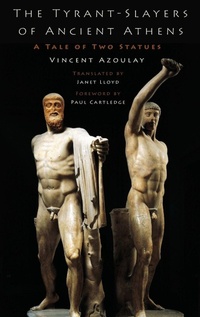
The Tyrant-Slayers of Ancient Athens
A Tale of Two Statues
Published on 16. November 2017
Book
Hardback
300 pages
978-0-19-066356-8 (ISBN)
Description
This investigation relies on a rash bet: to write the biography of two of the most famous statues in Antiquity, the Tyrannicides. Representing the murderers of the tyrant Hipparchus in full action, these statues erected on the Agora of Athens have been in turn worshipped, outraged, and imitated. They have known hours of glory and moments of hardships, which have transformed them into true icons of Athenian democracy.
The subject of this book is the remarkable story of this group statue and the ever-changing significance of its tyrant-slaying subjects. The first part of this book, in six chapters, tells the story of the murder of Hipparchus and of the statues of the two tyrannicides from the end of the sixth century to the aftermath of the restoration of democracy in 403. The second part, in three chapters, chronicles the fate and influence of the statues from the fourth century to the end of the Roman Empire. These chapters are followed by an epilogue that reveals new life for the statues in modern art and culture, including how Nazi Germany and the Soviet Union made use of their iconography. By tracing the long trajectory of the tyrannicides -- in deed and art -- Azoulay provides a rich and fascinating microhistory that will be of interest to readers of classical art and history.
The subject of this book is the remarkable story of this group statue and the ever-changing significance of its tyrant-slaying subjects. The first part of this book, in six chapters, tells the story of the murder of Hipparchus and of the statues of the two tyrannicides from the end of the sixth century to the aftermath of the restoration of democracy in 403. The second part, in three chapters, chronicles the fate and influence of the statues from the fourth century to the end of the Roman Empire. These chapters are followed by an epilogue that reveals new life for the statues in modern art and culture, including how Nazi Germany and the Soviet Union made use of their iconography. By tracing the long trajectory of the tyrannicides -- in deed and art -- Azoulay provides a rich and fascinating microhistory that will be of interest to readers of classical art and history.
Reviews / Votes
Such an innovative treatment of a seemingly well-worn subject inspires fresh ways of thinking about the past in the present. * Tyler Jo Smith, Religious Studies Review * This is an original and fascinating study that shows how the statues of Harmodius and Aristogiton and their story have reverberated down the centuries. * Brian A. Sparkes, Classics for All * Azoulay's book is a pleasure to read -thanks also to the translator- as he travels with Harmodius and Aristogiton through the Athenian Agora, down unexpected Roman colonnades, and Syrian alleys. Although, as he confesses, the topic is familiar from political history and art history ('a torrent of specialist studies' 4; cf. 13), Azoulay presents good observations on the ambivalent ideologies of this statuefied pairing and unexpected viewpoints on changing 'strategies of celebration. * Donald Lateiner, Ohio Wesleyan University, in Bryn Mawr Classical Review * The overall design of [Azoulay's] microhistory is ingenious. By focusing on a single object originally found at the center of Athens, he conveys us meaningfully through seven centuries of political evolution: Harmodius and Aristogiton become the fixed points around which all of Greek history revolves. * New York Review of Books * This exhilarating study unpacks the multifaceted life and afterlife of two statues in Naples, known jointly as the Tyrannicides, depicting Athenian heroes Harmodius and Aristogeiton about to strike down Hipparchus, the brother of the Athenian tyrant Hippias, in 514 BCE. * CHOICE * Vincent Azoulay's work builds on his predecessors ... He offers a comprehensive account of the sources, whether literary, iconographic, historical, or epigraphic ... Paul Cartledge offers a stimulating and sympathetic foreword, and the concluding notes and bibliography are exceptionally full and detailed. * Lucilla Burn, Times Literary Supplement *More details
Language
English
Place of publication
New York
United States
Target group
College/higher education
Professional and scholarly
Product notice
sewn/stitched
Cloth over boards
Illustrations
10 b&w line art, 32 b&w halftone
Dimensions
Height: 236 mm
Width: 163 mm
Thickness: 28 mm
Weight
567 gr
ISBN-13
978-0-19-066356-8 (9780190663568)
Copyright in bibliographic data and cover images is held by Nielsen Book Services Limited or by the publishers or by their respective licensors: all rights reserved.
Schweitzer Classification
Other editions
Additional editions
E-Book
10/2017
1st Edition
OUP eBook
€21.99
Available for download
E-Book
10/2017
1st Edition
OUP eBook
€16.99
Available for download
Persons
Vincent Azoulay is Professor of Ancient Greek History at Paris-Est Marne-la-Vallee University.
Content
Acknowledgements
Foreword by Paul Cartledge
Introduction
PART ONE
Chapter 1
First scene
The murder of Hipparchus
BIRTHS AND GROWING PAINS
The Tyrannicides between glory and outrage
Chapter 2
Date of birth unknown
Antenor's Tyrannicides
Chapter 3
A second birth
The statuary group produced by Critius and Nesiotes
Chapter 4
The artist's studio as a playground
Iconographic variations based on the Tyrannicides (c. 470-411 B.C.)
Chapter 5
The disorders of a thankless age
The oligarchic revolution of 411 B.C. and its consequences
Chapter 6
Their finest hour
The revived glory of the statuary group in the restored democracy (403 B.C.)
PART 2
THE AGE OF REASON?
The incomplete normalisation of the Tyrannicides
Chapter 7
The age of honours
New meanings for the monument in the fourth century
Chapter 8
Model "notables"
The Tyrannicides in the Hellenistic period
Chapter 9
Forever young
The uses of the statuary group in the Roman period
Epilogue
Born Again.
The statuary group's belated rebirth in the West
Conclusion
Appendix
Iconographic allusions to the Tyrannicides group
Bibliography
Foreword by Paul Cartledge
Introduction
PART ONE
Chapter 1
First scene
The murder of Hipparchus
BIRTHS AND GROWING PAINS
The Tyrannicides between glory and outrage
Chapter 2
Date of birth unknown
Antenor's Tyrannicides
Chapter 3
A second birth
The statuary group produced by Critius and Nesiotes
Chapter 4
The artist's studio as a playground
Iconographic variations based on the Tyrannicides (c. 470-411 B.C.)
Chapter 5
The disorders of a thankless age
The oligarchic revolution of 411 B.C. and its consequences
Chapter 6
Their finest hour
The revived glory of the statuary group in the restored democracy (403 B.C.)
PART 2
THE AGE OF REASON?
The incomplete normalisation of the Tyrannicides
Chapter 7
The age of honours
New meanings for the monument in the fourth century
Chapter 8
Model "notables"
The Tyrannicides in the Hellenistic period
Chapter 9
Forever young
The uses of the statuary group in the Roman period
Epilogue
Born Again.
The statuary group's belated rebirth in the West
Conclusion
Appendix
Iconographic allusions to the Tyrannicides group
Bibliography