

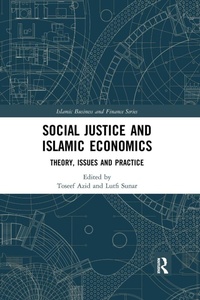
Social Justice and Islamic Economics
Theory, Issues and Practice
1st Edition
Published on 30. September 2020
Book
Paperback/Softback
228 pages
978-0-367-66047-5 (ISBN)
Description
Under the rule of the current economic order, social injustice is ever-increasing. Issues such as poverty, inhumane working conditions, inadequate wages, social insecurity and an unhealthy labor market continue to persist. Many states are also unable to produce policies capable of resolving these problems. The characteristics of the capitalist system currently render it unable to provide social justice. In fact, on the contrary, the system reinforces these injustices and prevents economic and social welfare from reaching the masses. Many Muslim scholars have analyzed and, indeed, criticized this system for years.
This book argues that an alternative and more equitable theoretical and practical economical order can been developed within the framework of Islamic principles. On the other hand, the experiences of societies under the rule of Muslim governments do not always seem to hold great promise for an alternative understanding of social justice. In addition, the behaviors of Muslim individuals within their economic lives are mostly shaped by the necessities of daily economic conditions rather than by the tenets of Islam that stand with social justice. Until 1990s, studies of Islamic economics made connections between finance and the notion of social justice, but work conducted more recently has neglected this issue.
It is therefore evident that the topic of social justice needs to be revisited in a more in-depth manner. Filling an important gap in existing literature, the book uniquely connects social justice and Islamic finance and economics on this topic. Theory, practice and key issues are presented simultaneously throughout this book, which is based on the writings of a number of eminent scholars.
This book argues that an alternative and more equitable theoretical and practical economical order can been developed within the framework of Islamic principles. On the other hand, the experiences of societies under the rule of Muslim governments do not always seem to hold great promise for an alternative understanding of social justice. In addition, the behaviors of Muslim individuals within their economic lives are mostly shaped by the necessities of daily economic conditions rather than by the tenets of Islam that stand with social justice. Until 1990s, studies of Islamic economics made connections between finance and the notion of social justice, but work conducted more recently has neglected this issue.
It is therefore evident that the topic of social justice needs to be revisited in a more in-depth manner. Filling an important gap in existing literature, the book uniquely connects social justice and Islamic finance and economics on this topic. Theory, practice and key issues are presented simultaneously throughout this book, which is based on the writings of a number of eminent scholars.
More details
Series
Language
English
Place of publication
London
United Kingdom
Publishing group
Taylor & Francis Ltd
Target group
College/higher education
Postgraduate and Undergraduate
Dimensions
Height: 234 mm
Width: 156 mm
Thickness: 12 mm
Weight
354 gr
ISBN-13
978-0-367-66047-5 (9780367660475)
Copyright in bibliographic data and cover images is held by Nielsen Book Services Limited or by the publishers or by their respective licensors: all rights reserved.
Schweitzer Classification
Other editions
Additional editions
Book
03/2019
1st Edition
Routledge
€206.30
Shipment within 10-20 days
E-Book
02/2019
1st Edition
Routledge
€61.99
Available for download
E-Book
02/2019
1st Edition
Routledge
€61.99
Available for download
Persons
Toseef Azid is Professor of Economics at the College of Business and Economics, Qassim University, Saudi Arabia.
Lutfi Sunar is Associate Professor of Sociology at the University of Istanbul, Turkey.
Lutfi Sunar is Associate Professor of Sociology at the University of Istanbul, Turkey.
Content
List of illustrations
List of tables
List of contributors
Foreword
Preface
1 Social Justice in Islam: An Introduction
TOSEEF AZID & LUTFI SUNAR
2 A theory of justice in Islam
MASUDUL ALAM CHOUDHURY
3 Social justice, market, society and government: an Islamic perspective
TOSEEF AZID, OSAMAH HUSSAIN Al RAWASHDEH & MUHAMMAD OMER CHAUDHRY
4 Contractual freedom, market economy and social justice in Islam: the "invisible hand" of God-man's agency relationship (Khilafah)
VALENTINO CATTELAN
5 How can Islamic banks achieve social justice?
KHOUTEM BEN JEDIDIA
6 How social aids affect people's willingness to work: developing a social aid framework within the context of Islam
OMER FARUK TEKDOGAN &MEHMET TARIK ERSALAN
7 The role of waqf in socio-economic life in terms of poverty alleviation
HUSNU TEKIN
8 Interest and social justice: the impact of real interest rate on income inequality
OZAN MARASL
9 Productive zakat as a mechanism of social justice in Indonesia
AIMATUL YUMNA
10 Potential zakat collectible in OIC countries and poverty gap
SALMAN AHMED SHAIKH & QAZI MASOOD AHMED
11 Pursuing social justice through Islamic micro-takaful in the informal economy: social capital matter
YULIZAR D. SANREGO
12 Conclusion
TOSEEF AZID & LUTFI SUNAR
Index
List of tables
List of contributors
Foreword
Preface
1 Social Justice in Islam: An Introduction
TOSEEF AZID & LUTFI SUNAR
2 A theory of justice in Islam
MASUDUL ALAM CHOUDHURY
3 Social justice, market, society and government: an Islamic perspective
TOSEEF AZID, OSAMAH HUSSAIN Al RAWASHDEH & MUHAMMAD OMER CHAUDHRY
4 Contractual freedom, market economy and social justice in Islam: the "invisible hand" of God-man's agency relationship (Khilafah)
VALENTINO CATTELAN
5 How can Islamic banks achieve social justice?
KHOUTEM BEN JEDIDIA
6 How social aids affect people's willingness to work: developing a social aid framework within the context of Islam
OMER FARUK TEKDOGAN &MEHMET TARIK ERSALAN
7 The role of waqf in socio-economic life in terms of poverty alleviation
HUSNU TEKIN
8 Interest and social justice: the impact of real interest rate on income inequality
OZAN MARASL
9 Productive zakat as a mechanism of social justice in Indonesia
AIMATUL YUMNA
10 Potential zakat collectible in OIC countries and poverty gap
SALMAN AHMED SHAIKH & QAZI MASOOD AHMED
11 Pursuing social justice through Islamic micro-takaful in the informal economy: social capital matter
YULIZAR D. SANREGO
12 Conclusion
TOSEEF AZID & LUTFI SUNAR
Index