

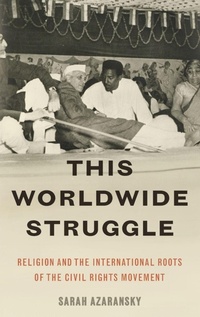
This Worldwide Struggle
Religion and the International Roots of the Civil Rights Movement
Published on 6. July 2017
Book
Hardback
296 pages
978-0-19-026220-4 (ISBN)
Description
This Worldwide Struggle: Religion and the International Roots of the Civil Rights Movement examines a group of black Christian intellectuals and activists who looked abroad, even to other religious traditions, for ideas and practices that could transform American democracy. From the 1930s to the 1950s, this core group drew lessons from independence movements around for the world for an American campaign that would be part of a global network of resistance to colonialism and white supremacy. This book argues that their religious perspectives and methods of moral reasoning developed a theological blueprint for what Bayard Rustin called the "classical phase" of the Civil Rights Movement.
Existing scholarship on the book's main figures, including Howard Thurman, Benjamin Mays, and William Stuart Nelson, pioneers of African American Christian nonviolence James Farmer, Pauli Murray, and Bayard Rustin, and YWCA leaders Juliette Derricotte and Sue Bailey Thurman, focuses on individuals and misses important streams of influence and creative collaborations. This book traces fertile intersections of worldwide resistance movements, explores American racial politics and interreligious exchanges that crossed literal borders and disciplinary boundaries, enriches our understanding of the international roots of the Civil Rights Movement, and offers lessons on the role of religion in justice movements.
Existing scholarship on the book's main figures, including Howard Thurman, Benjamin Mays, and William Stuart Nelson, pioneers of African American Christian nonviolence James Farmer, Pauli Murray, and Bayard Rustin, and YWCA leaders Juliette Derricotte and Sue Bailey Thurman, focuses on individuals and misses important streams of influence and creative collaborations. This book traces fertile intersections of worldwide resistance movements, explores American racial politics and interreligious exchanges that crossed literal borders and disciplinary boundaries, enriches our understanding of the international roots of the Civil Rights Movement, and offers lessons on the role of religion in justice movements.
Reviews / Votes
Azaransky's book is both an inspiration and a caution to those interested in the ongoing struggle for justice anywhere--economic, racial, gender or environmental. Her exploration of her subjects' early lives gives the reader a way to connect with their own sources of spiritual, religious and moral energy, stamina and courage. Her depiction of the huge network of connections and relationships across cities, countries and continents reminds activists and allies of the importance of the need for solidarity, humility and communication with allies. * Robin Wardlaw, Touchstone Journal * Sarah has written an exceptional text tracing the personal, political, and intellectual exchange of ideas between liberation movements in India and West Africa and the religious leaders and activists who would provide the foundations for and lead the Civil Rights Movement in the United States ... Those interested in the history of the Civil Rights Movement, Black theology in the 20th century, and global anticolonial networks in the first half of the 20th century will find this text indispensable. * James McCarty, Reading Religion * Azaransky's sterling book represents nothing less than a significant reframing of the US Civil Rights Movement. Her lucid telling renders visible the conditions that made the King era of civil rights possible... Of special note, too, is the role the Howard University School of Religion plays as an intellectual and activist center. Any future account of the academic study of religion in the US must now include Howard's role in shaping the field. Highly recommended. * J. Kahn, CHOICE * [A] rewarding historical study...This Worldwide Struggle makes several interventions in religious and social ethics. It addresses the gap in histories of black internationalism which overlook religious intellectuals and in peace movement histories which ignore racial speci?city. It contributes to civil rights studies' consideration of this generation of religious thinkers, further expanding what Jacquelyn Dowd Hall calls the 'long civil rights movement' through an international moral geography. * Tyler Davis, Reviews in Religion & Theology *More details
Language
English
Place of publication
New York
United States
Target group
College/higher education
Product notice
sewn/stitched
Cloth over boards
Dimensions
Height: 241 mm
Width: 164 mm
Thickness: 30 mm
Weight
528 gr
ISBN-13
978-0-19-026220-4 (9780190262204)
Copyright in bibliographic data and cover images is held by Nielsen Book Services Limited or by the publishers or by their respective licensors: all rights reserved.
Schweitzer Classification
Other editions
Additional editions
Sarah Azaransky
This Worldwide Struggle
Religion and the International Roots of the Civil Rights Movement
E-Book
05/2017
1st Edition
OUP eBook
€21.99
Available for download
Sarah Azaransky
This Worldwide Struggle
Religion and the International Roots of the Civil Rights Movement
E-Book
05/2017
1st Edition
OUP eBook
€21.99
Available for download
Person
Sarah Azaransky is Assistant Professor of Social Ethics at Union Theological Seminary. She is the author of The Dream is Freedom: Pauli Murray and American Democratic Faith and the editor of Religion and Politics in America's Borderlands.
Content
Introduction Part of This Worldwide Struggle
Chapter 1 Spiritual Recognition of Empire (1930s)
Chapter 2 Passing Through a Similar Transition (1930s)
Chapter 3 We Can Add to the World Justice (1940s)
Chapter 4 An Admixture of Tragedy and Triumph (1940s)
Chapter 5 Opposing Injustice, First of All in Ourselves (1940s & 1950s)
Chapter 6 Moral Leadership of the World (1950s)
Chapter 1 Spiritual Recognition of Empire (1930s)
Chapter 2 Passing Through a Similar Transition (1930s)
Chapter 3 We Can Add to the World Justice (1940s)
Chapter 4 An Admixture of Tragedy and Triumph (1940s)
Chapter 5 Opposing Injustice, First of All in Ourselves (1940s & 1950s)
Chapter 6 Moral Leadership of the World (1950s)