

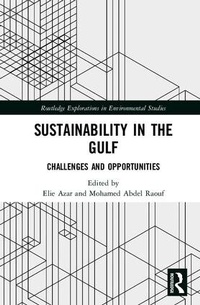
Sustainability in the Gulf
Challenges and Opportunities
1st Edition
Published on 8. August 2017
Book
Hardback
288 pages
978-1-138-04068-7 (ISBN)
Description
Sustainability is a topic of great interest today, particularly for the Gulf Cooperation Council (GCC) countries, which have witnessed very rapid economic and demographic growth over the past decade. The observed growth has led to unsustainable consumption patterns of vital resources such as water, energy, and food, highlighting the need for an urgent shift towards green growth and sustainable development strategies.
Sustainability in the Gulf covers the region's contemporary development challenges through the lens of the UN's Sustainable Development Goals (SDGs), which place sustainability at the centre of the solution to the current environmental, economic, and social imbalances facing GCC countries. The book presents multiple analyses of Gulf-specific sustainability topics, examining the current status, challenges, and opportunities, as well as identifying key lessons learned. Innovative and practical policy recommendations are provided, as well as new conceptual angles to the evolving academic debates on the post-oil era in the Gulf. Through chapters covering sector-related studies, as well as the socio-economic dimensions of the sustainability paradigm, this volume offers valuable insights into current research efforts made by the GCC states, proposing a way forward based on lessons learned.
This is a valuable resource for students, academics, and researchers in the areas of Environmental Studies, Political Economy, and Economics of the GCC states.
Sustainability in the Gulf covers the region's contemporary development challenges through the lens of the UN's Sustainable Development Goals (SDGs), which place sustainability at the centre of the solution to the current environmental, economic, and social imbalances facing GCC countries. The book presents multiple analyses of Gulf-specific sustainability topics, examining the current status, challenges, and opportunities, as well as identifying key lessons learned. Innovative and practical policy recommendations are provided, as well as new conceptual angles to the evolving academic debates on the post-oil era in the Gulf. Through chapters covering sector-related studies, as well as the socio-economic dimensions of the sustainability paradigm, this volume offers valuable insights into current research efforts made by the GCC states, proposing a way forward based on lessons learned.
This is a valuable resource for students, academics, and researchers in the areas of Environmental Studies, Political Economy, and Economics of the GCC states.
More details
Series
Language
English
Place of publication
London
United Kingdom
Publishing group
Taylor & Francis Ltd
Target group
College/higher education
Professional and scholarly
Postgraduate and Professional
Illustrations
77 s/w Abbildungen, 10 s/w Photographien bzw. Rasterbilder, 41 s/w Zeichnungen, 26 s/w Tabellen
26 Tables, black and white; 41 Line drawings, black and white; 10 Halftones, black and white; 77 Illustrations, black and white
Dimensions
Height: 234 mm
Width: 156 mm
Weight
740 gr
ISBN-13
978-1-138-04068-7 (9781138040687)
Copyright in bibliographic data and cover images is held by Nielsen Book Services Limited or by the publishers or by their respective licensors: all rights reserved.
Schweitzer Classification
Other editions
Additional editions
Book
06/2019
1st Edition
Routledge
€54.55
Shipment within 15-20 days
E-Book
07/2017
Routledge
€61.99
Available for download
E-Book
07/2017
Routledge
€61.99
Available for download
Persons
Elie Azar is an Assistant Professor of Engineering Systems and Management at the Masdar Institute of Science and Technology, Abu Dhabi, UAE.
Mohamed Abdel Raouf is Sustainability Research Program Manager at the Gulf Research Center, Jeddah, Saudi Arabia.
Mohamed Abdel Raouf is Sustainability Research Program Manager at the Gulf Research Center, Jeddah, Saudi Arabia.
Content
Part I: Introduction
Sustainability issues in GCC
The Gulf's Region Commitment to a Sustainable Lifestyle: A Bibliometric Study
Framework of study and book organization
Part II: Infrastructure Management and Urban Solutions
Water Resources Sustainability in Kuwait against United Nations Sustainable Development Goals
Towards Safe and Sustainable Reuse of Treated Wastewater in Abu Dhabi, UAE
Implementation of the Sustainable Development Goals in GCC countries via application of sustainability-oriented innovation to critical infrastructures
Towards Sustainable Urban Development: Challenges and Chances of Climate-Sensitive Urban Design in Muscat/Oman
The Future of Sustainable Public Transit in Abu Dhabi
Part III: Standards and Policies
Advancing Sustainable Consumption: Energy Efficiency Labels and Standards in the UAE
Sustainability Assessment for Real Estate in UAE: The case of Masdar City Part IV: The socio-economic perspective
Energy Consumption and Transition Dynamics under a Rentier Economy: Case of the GCC States
Economic value of the Abu Dhabi coastal and marine ecosystem services: Estimate and Management Applications
Economic and GHG Emission Policy Co-benefits for Integrated Waste Management Planning across the GCC
Motivating Sustainable Consumption Behavior Through Education, Incentive Programs, and Green Policies in Saudi Arabia Part V: Conclusion
Outlook towards the future of sustainability in the Gulf
Sustainability issues in GCC
The Gulf's Region Commitment to a Sustainable Lifestyle: A Bibliometric Study
Framework of study and book organization
Part II: Infrastructure Management and Urban Solutions
Water Resources Sustainability in Kuwait against United Nations Sustainable Development Goals
Towards Safe and Sustainable Reuse of Treated Wastewater in Abu Dhabi, UAE
Implementation of the Sustainable Development Goals in GCC countries via application of sustainability-oriented innovation to critical infrastructures
Towards Sustainable Urban Development: Challenges and Chances of Climate-Sensitive Urban Design in Muscat/Oman
The Future of Sustainable Public Transit in Abu Dhabi
Part III: Standards and Policies
Advancing Sustainable Consumption: Energy Efficiency Labels and Standards in the UAE
Sustainability Assessment for Real Estate in UAE: The case of Masdar City Part IV: The socio-economic perspective
Energy Consumption and Transition Dynamics under a Rentier Economy: Case of the GCC States
Economic value of the Abu Dhabi coastal and marine ecosystem services: Estimate and Management Applications
Economic and GHG Emission Policy Co-benefits for Integrated Waste Management Planning across the GCC
Motivating Sustainable Consumption Behavior Through Education, Incentive Programs, and Green Policies in Saudi Arabia Part V: Conclusion
Outlook towards the future of sustainability in the Gulf