

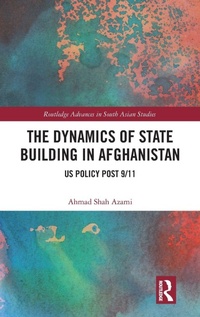
The Dynamics of State Building in Afghanistan
US Policy Post 9/11
1st Edition
Published on 11. June 2026
Book
Hardback
212 pages
978-1-041-13868-6 (ISBN)
Description
This book offers an all-encompassing, critical analysis of U.S.-led state-building in Afghanistan between 2001 and 2021, focusing on the three central pillars of security and peacebuilding, democratization, and economic development and reconstruction.
The book demonstrates how Afghans navigated the promises of an international project that aspired to rebuild sustainable and successful state institutions, but which often provoked fractures and neglected legitimate local agency. Chapters highlight persistent shortcomings in Washington's strategy, including miscalculations and policy failures that undermined local governance and long-term stability. Drawing on extensive fieldwork and interviews, chapters provide original empirical insights by foregrounding Afghan voices-perspectives often marginalized in existing scholarship. Comprehensive in approach, the book ultimately offers a conceptual contribution to the study of intervention and state building, situating Afghanistan within broader debates on war and foreign intervention, peace and stability, and state building and governance.
Revealing the inherent limitations of externally driven state-building in fragile and conflict contexts, this book will be of interest to researchers studying international relations, political science, South Asian and Middle East studies, and the U.S. War on Terror.
The book demonstrates how Afghans navigated the promises of an international project that aspired to rebuild sustainable and successful state institutions, but which often provoked fractures and neglected legitimate local agency. Chapters highlight persistent shortcomings in Washington's strategy, including miscalculations and policy failures that undermined local governance and long-term stability. Drawing on extensive fieldwork and interviews, chapters provide original empirical insights by foregrounding Afghan voices-perspectives often marginalized in existing scholarship. Comprehensive in approach, the book ultimately offers a conceptual contribution to the study of intervention and state building, situating Afghanistan within broader debates on war and foreign intervention, peace and stability, and state building and governance.
Revealing the inherent limitations of externally driven state-building in fragile and conflict contexts, this book will be of interest to researchers studying international relations, political science, South Asian and Middle East studies, and the U.S. War on Terror.
Reviews / Votes
"Perception of facts has a factual reality of its own. Ahmad Shah Azami provides an important, new look at the Afghan war from multiple Afghan perspectives. Sometimes contradictory or self-serving, they nevertheless provide an important addition to the studies of America's longest war. They also illustrate how difficult it is to have a full understanding of how America's actions are understood; a timeless lesson."-- Ronald E. Neumann, US Ambassador to Afghanistan and repeated visitor to and commentator on the country.
More details
Series
Language
English
Place of publication
London
United Kingdom
Publishing group
Taylor & Francis Ltd
Target group
Professional and scholarly
College/higher education
Academic
Illustrations
4 s/w Tabellen, 1 s/w Abbildung, 1 s/w Photographie bzw. Rasterbild
4 Tables, black and white; 1 Halftones, black and white; 1 Illustrations, black and white
Dimensions
Height: 234 mm
Width: 156 mm
Weight
580 gr
ISBN-13
978-1-041-13868-6 (9781041138686)
Copyright in bibliographic data and cover images is held by Nielsen Book Services Limited or by the publishers or by their respective licensors: all rights reserved.
Schweitzer Classification
Other editions
Additional editions
E-Book
06/2026
Routledge
€60.49
Available for download
E-Book
06/2026
Routledge
€60.49
Available for download
Person
Ahmad Shah Azami is an independent researcher with a Ph.D. in international relations. His areas of specialization include politics and security in South Asia, especially Afghanistan and Pakistan, with a particular focus on state-building theory and practice, as well as conflict resolution, and security studies. He has presented his research at various international conferences, and his scholarly articles have appeared in reputed peer-reviewed journals. In addition to several years of teaching international relations at university level, he has more than two decades of experience as a journalist.
Content
Introduction
1 The Dynamics of State Building and U.S. Practices in Afghanistan and Beyond
2 U.S. Approaches to War and Peace in Afghanistan
3 The U.S.-Warlord Alliance and Its Implications for State Building in Afghanistan
4 U.S.-Engineered Democratization in Afghanistan
5 U.S. Financial Engagement in Afghanistan's Economic Development and Reconstruction
Conclusion
1 The Dynamics of State Building and U.S. Practices in Afghanistan and Beyond
2 U.S. Approaches to War and Peace in Afghanistan
3 The U.S.-Warlord Alliance and Its Implications for State Building in Afghanistan
4 U.S.-Engineered Democratization in Afghanistan
5 U.S. Financial Engagement in Afghanistan's Economic Development and Reconstruction
Conclusion