

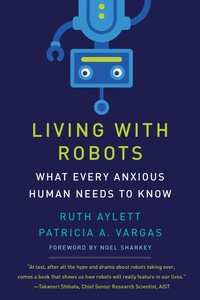
Living with Robots
What Every Anxious Human Needs to Know
Published on 21. September 2021
Book
Hardback
280 pages
978-0-262-04581-0 (ISBN)
Description
THE TRUTH ABOUT ROBOTS: Two robotics experts look beyond the hype, offering a lively and accessible guide to what robots can (and can’t) do.
There’s a lot of hype about robots; some of it is scary and some of it utopian. In this accessible book, two robotics experts reveal the truth about what robots can and can’t do, how they work, and what we can reasonably expect their future capabilities to be. It will not only make you think differently about the capabilities of robots; it will make you think differently about the capabilities of humans.
Find out:
• Why robots can swim and fly but find it difficult to walk
• Which robot features are inspired by animals and insects
• Why we develop feelings for robots
• Which human abilities are hard for robots to emulate
Ruth Aylett and Patricia Vargas discuss the history of our fascination with robots—from chatbots and prosthetics to autonomous cars and robot swarms. They show us the ways in which robots outperform humans and the ways they fall woefully short of our superior talents. They explain how robots see, feel, hear, think, and learn; describe how robots can cooperate; and consider robots as pets, butlers, and companions. Finally, they look at robots that raise ethical and social issues: killer robots, sexbots, and robots that might be gunning for your job. Living with Robots equips readers to look at robots concretely—as human-made artifacts rather than placeholders for our anxieties.
There’s a lot of hype about robots; some of it is scary and some of it utopian. In this accessible book, two robotics experts reveal the truth about what robots can and can’t do, how they work, and what we can reasonably expect their future capabilities to be. It will not only make you think differently about the capabilities of robots; it will make you think differently about the capabilities of humans.
Find out:
• Why robots can swim and fly but find it difficult to walk
• Which robot features are inspired by animals and insects
• Why we develop feelings for robots
• Which human abilities are hard for robots to emulate
Ruth Aylett and Patricia Vargas discuss the history of our fascination with robots—from chatbots and prosthetics to autonomous cars and robot swarms. They show us the ways in which robots outperform humans and the ways they fall woefully short of our superior talents. They explain how robots see, feel, hear, think, and learn; describe how robots can cooperate; and consider robots as pets, butlers, and companions. Finally, they look at robots that raise ethical and social issues: killer robots, sexbots, and robots that might be gunning for your job. Living with Robots equips readers to look at robots concretely—as human-made artifacts rather than placeholders for our anxieties.
More details
Language
English
Place of publication
Cambridge (Massachusetts)
United States
Publishing group
MIT Press Ltd
Product notice
sewn/stitched
Cloth over boards
Illustrations
20
Dimensions
Height: 212 mm
Width: 147 mm
Thickness: 27 mm
Weight
445 gr
ISBN-13
978-0-262-04581-0 (9780262045810)
Copyright in bibliographic data and cover images is held by Nielsen Book Services Limited or by the publishers or by their respective licensors: all rights reserved.
Schweitzer Classification
Other editions
Additional editions
E-Book
09/2021
MIT Press
€21.49
Available for download
Persons
Ruth Aylett and Patricia A. Vargas; foreword by Noel Sharkey
Content
Foreword
Introduction
1 Why are we all so Scared of Robots?
2 Appearance: Will they Look Like Us?
3 Movement: Will they Live with Us?
4 Senses: Will they be Aware of Us?
5 The Lost Robot: Could they Know where they Are and How to Get Home?
6 Touch and Handling: Could I Shake Hands with a Robot?
7 Could Robots be AIs?
8 Could Robots Learn to do things For Themselves?
9 Collaborating Robots: Could they Work as Partners or Groups?
10 Emotions: Could Robots have Feelings?
11 Social Interaction: Pets, Butlers, or Companions?
12 Speech and Language: Would we be Able to Talk to them?
13 Society and Ethics: Could a Robot have Morals?
Acknowledgments
Notes
Index
Introduction
1 Why are we all so Scared of Robots?
2 Appearance: Will they Look Like Us?
3 Movement: Will they Live with Us?
4 Senses: Will they be Aware of Us?
5 The Lost Robot: Could they Know where they Are and How to Get Home?
6 Touch and Handling: Could I Shake Hands with a Robot?
7 Could Robots be AIs?
8 Could Robots Learn to do things For Themselves?
9 Collaborating Robots: Could they Work as Partners or Groups?
10 Emotions: Could Robots have Feelings?
11 Social Interaction: Pets, Butlers, or Companions?
12 Speech and Language: Would we be Able to Talk to them?
13 Society and Ethics: Could a Robot have Morals?
Acknowledgments
Notes
Index