

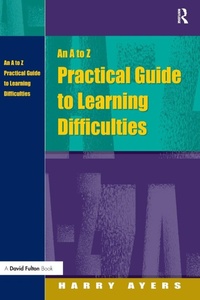
An A to Z Practical Guide to Learning Difficulties
1st Edition
Published on 2. December 2016
Book
Hardback
112 pages
978-1-138-15602-9 (ISBN)
Description
Accessing up-to-date information about general and specific learning difficulties is made easy, with this indispensable reference book. Covering difficulties that relate to children, adolescents and adults, it includes:
crucial legislation to keep practitioners 'in the know'
useful addresses, telephone numbers and websites
It also includes explanations of leaning difficulties including those less than well-known syndromes such as semantic pragmatic difficulties.
crucial legislation to keep practitioners 'in the know'
useful addresses, telephone numbers and websites
It also includes explanations of leaning difficulties including those less than well-known syndromes such as semantic pragmatic difficulties.
More details
Language
English
Place of publication
London
United Kingdom
Publishing group
Taylor & Francis Ltd
Target group
Professional and scholarly
Academic and Professional Practice & Development
Dimensions
Height: 260 mm
Width: 183 mm
Thickness: 11 mm
Weight
425 gr
ISBN-13
978-1-138-15602-9 (9781138156029)
Copyright in bibliographic data and cover images is held by Nielsen Book Services Limited or by the publishers or by their respective licensors: all rights reserved.
Schweitzer Classification
Other editions
Additional editions
Harry Ayers | Francesca Gray
An A to Z Practical Guide to Learning Difficulties
E-Book
04/2013
1st Edition
David Fulton Publishers Ltd
€45.99
Available for download
Harry Ayers | Francesca Gray
An A to Z Practical Guide to Learning Difficulties
E-Book
04/2013
1st Edition
David Fulton Publishers Ltd
€45.99
Available for download
Harry Ayers | Francesca Gray
An A to Z Practical Guide to Learning Difficulties
Book
01/2006
1st Edition
David Fulton Publishers Ltd
€52.30
Shipment within 3-4 weeks
Persons
Harry Ayers
Content
Dedication; Title; Copyright; Preface; A; ABC; Absence; Absences (petit mal); Academic skills disorders; Achievement; ADD/ADHD; Adolescents with learning difficulties; Affective factors; Agraphia; Alexia; Anxiety; Aphasia; Apraxia; Asperger, or Asperger's, syndrome; Assessment; Attentional difficulties; Attitudes; Attribution; Attribution retraining; Attribution theory; Attributional style; Auditory processing; Autism; Autistic spectrum disorders; Avoidance behaviour; B; Behaviour analysis; Behaviour management; Behavioural and emotional difficulties; Behavioural teaching methods; Behavioural theories of learning; Benchmarks and benchmarking; Birth problems; Brain damage; Brain-injured children; Broca's aphasia; C; Calculator use; Children with learning difficulties; Children at risk; Children with Specific Learning Difficulties (SpLD); Chromosomal abnormalities; Class size; Classroom environment; Clinical teaching; Cloze procedure; Code of Practice (COP) (Revised 2001); Cognitive abilities; Cognitive strategies; Cognitive-behavioural theories of learning; Collaborative learning; Communication skills; Comprehension; Computational skills; Computer-assisted learning; Confidence; Constructivist theory of learning; Contextual cues; Co-teaching; Counting skills; Criterion-referenced tests; Curriculum; Curriculum-based assessment; D; Deaf pupils; Decoding; Deficit model; Depression; Developmental delay; Developmental psychology; Diagnostic assessment; Diagnostic tests; Diagnostic-prescriptive teaching; Differentiation; Difficulty level; Direct instruction; Directed reading activity; Discrepancy formulae; Down's syndrome or Down syndrome; Dynamic assessment; Dyscalculia; Dysgraphia; Dyslexia; Dyspraxia or developmental dyspraxia; E; Early intervention; Early intervention strategies; Early signs; Emergent literacy; Emotional and behavioural factors; Epilepsy; Error analysis; Expectancy-value theory; Explanatory style; Explicit teaching; Expressive language disorder; Extrins