

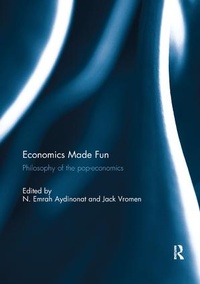
Economics Made Fun
Philosophy of the pop-economics
1st Edition
Published on 7. June 2017
Book
Paperback/Softback
156 pages
978-1-138-08540-4 (ISBN)
Description
Best-selling books such as Freakonomics and The Undercover Economist have paved the way for the flourishing economics-made-fun genre. While books like these present economics as a strong and explanatory science, the ongoing economic crisis has exposed the shortcomings of economics to the general public. In the face of this crisis, many people, including well-known economists such as Paul Krugman, have started to express their doubts about whether economics is a success as a science. As well as academic papers, newspaper columns with a large audience have discussed the failure of economic to predict and explain ongoing trends. The emerging picture is somewhat confusing: economics-made-fun books present economics as a method of thinking that can successfully explain everyday and "freaky" phenomena. On the other hand, however, economics seems to fail in addressing and explaining the most pressing matters related to the field of economics itself.
This book explores the confusion created by this contradictory picture of economics. Could a science that cannot answer its own core questions really be used to explain the logic of everyday life? This book was originally published as a special issue of the Journal of Economic Methodology.
This book explores the confusion created by this contradictory picture of economics. Could a science that cannot answer its own core questions really be used to explain the logic of everyday life? This book was originally published as a special issue of the Journal of Economic Methodology.
More details
Language
English
Place of publication
London
United Kingdom
Publishing group
Taylor & Francis Ltd
Target group
College/higher education
Dimensions
Height: 246 mm
Width: 174 mm
Weight
453 gr
ISBN-13
978-1-138-08540-4 (9781138085404)
Copyright in bibliographic data and cover images is held by Nielsen Book Services Limited or by the publishers or by their respective licensors: all rights reserved.
Schweitzer Classification
Other editions
Additional editions
E-Book
10/2017
1st Edition
Routledge
€47.49
Available for download
E-Book
10/2017
1st Edition
Routledge
€47.49
Available for download
Book
06/2015
1st Edition
Routledge
€133.69
Shipment within 10-20 days
Persons
N. Emrah Aydinonat is an Associate Professor of Economics at Bahcesehir University, Istanbul, Turkey. He is also a part-time lecturer at Bogazici University, Istanbul, Turkey, and a research associate at the Academy of Finland Centre of Excellence in the Philosophy of Social Sciences, University of Helsinki, Finland. He is the author of The Invisible Hand in Economics (Routledge 2008) and What is Economics? (in Turkish, Iletisim 2014). Recently he started writing opinion pieces for The Wall Street Journal Turkey.
Jack Vromen is Professor of Theoretical Philosophy at Erasmus University, Rotterdam, The Netherlands. He is also academic director of the Erasmus Institute for Philosophy and Economics. Since his Ph.D research on Economic Evolution (Routledge, 1995) he has researched theoretical and meta-theoretical issues in Economics and Evolution. Recently he also developed research interests in Neuroeconomics, in social mechanisms and in the booming Economics Made Fun genre.
Jack Vromen is Professor of Theoretical Philosophy at Erasmus University, Rotterdam, The Netherlands. He is also academic director of the Erasmus Institute for Philosophy and Economics. Since his Ph.D research on Economic Evolution (Routledge, 1995) he has researched theoretical and meta-theoretical issues in Economics and Evolution. Recently he also developed research interests in Neuroeconomics, in social mechanisms and in the booming Economics Made Fun genre.
Content
1. The paradox of popularity in economics 2. A less-is-more approach to introductory economics 3. Finding the right levers: the serious side of 'economics made fun' 4. On the philosophy of the new kiosk economics of everything 5. Economics is a serious and difficult subject 6. The two images of economics: why the fun disappears when difficult questions are at stake? 7. Inland empire: economics imperialism as an imperative of Chicago neoliberalism 8. The unbearable lightness of the economics-made-fun genre 9. The evolving notion of relevance: an historical perspective to the 'economics made fun' movement 10. Economic page turners 11. Economics made fun, and made fun of: how 'fun' redefines the domain and identity of the economics profession