

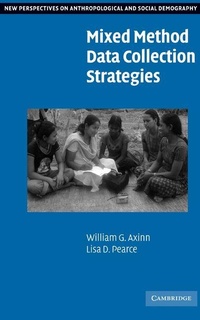
Mixed Method Data Collection Strategies
Published on 2. October 2006
Book
Hardback
246 pages
978-0-521-85568-6 (ISBN)
Description
Social scientists have long relied on a wide range of tools to collect information about the social world, but as individual fields have become more specialised, researchers are trained to use a narrow range of the possible data collection methods. This book, first published in 2006, draws on a broad range of available social data collection methods to formulate a set of data collection approaches. The approaches described here are ideal for social science researchers who plan to collect new data about people, organisations, or social processes. Axinn and Pearce present methods designed to create a comprehensive empirical description of the subject being studied, with an emphasis on accumulating the information needed to understand what causes what with a minimum of error. In addition to providing methodological motivation and underlying principles, the book is filled with detailed instructions and concrete examples for those who wish to apply the methods to their research.
Reviews / Votes
'This book makes a powerful case for the use of mixed methods, a case that focuses on their advantages for, among other things, research design, data quality, and casual modelling. I particularly recommend the book to new investigators and those still at an early stage of their career. ... if new investigators follow Axinn and Pearce's example, demography (and other social sciences) will probably discover more about social processes than they otherwise would. ... I was particularly impressed that the likelihood of surprises was taken into designing the questionnaires for the neighbourhood histories, data for which were collected in three rounds.' Population StudiesMore details
Series
Language
English
Place of publication
Cambridge
United Kingdom
Target group
Professional and scholarly
Illustrations
13 Tables, unspecified
Dimensions
Height: 235 mm
Width: 157 mm
Thickness: 19 mm
Weight
555 gr
ISBN-13
978-0-521-85568-6 (9780521855686)
Copyright in bibliographic data and cover images is held by Nielsen Book Services Limited or by the publishers or by their respective licensors: all rights reserved.
Schweitzer Classification
Other editions
Additional editions
William G. Axinn | Lisa D. Pearce
Mixed Method Data Collection Strategies
E-Book
10/2006
1st Edition
Cambridge University Press
€27.99
Available for download
Persons
William G. Axinn is a Sociologist Demographer and Research Professor at the Survey Research Center and Population Studies Center of the Institute for Social Research at the University of Michigan. He has directed the Population and Ecology Research Laboratory in Nepal for thirteen years. In the United States he is co-Principal Investigator of the Intergenerational Panel Study of Parents and Children (a 31-year longitudinal study) and Deputy Director of the National Survey of Family Growth (a national repeated cross-section study of US families conducted by the National Center for Health Statistics). Lisa D. Pearce is an Assistant Professor of Sociology at the University of North Carolina at Chapel Hill. Her research articles have appeared in journals such as the American Sociological Review, Social Forces, Sociological Methodology, and the Journal for the Scientific Study of Religion. She is Co-Principal Investigator of the National Study of Youth and Religion, a three-year, multi-method panel study of the role of religion in the lives of American youth. In Nepal, she is co-Investigator on the large scale population and environment project directed by Axinn. She was recently selected as a 2005 William T. Grant Scholar to further her work on religion and well-being among youth.
Content
1. Motivations for mixed method social research; 2. Fitting data collection methods to research aims; 3. The micro-demographic community study approach; 4. Systematic anomalous case analysis; 5. Neighborhood history calendars; 6. Life history calendars; 7. Longitudinal data collection; 8. Conclusion.