

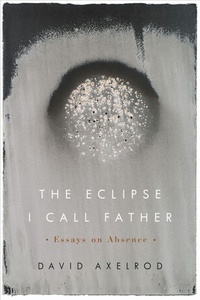
The Eclipse I Call Father
Essays on Absence
Will be published approx. on 30. March 2019
Book
Paperback/Softback
224 pages
978-0-87071-969-1 (ISBN)
Description
In The Eclipse I Call Father: Essays on Absence, David Axelrod recalls a balmy night in May 1970 when he vowed to allow no one and nothing he loves to pass from this life without praise, even if it meant praising the most bewildering losses. In each of these fourteen essays Axelrod delivers on that vow as he ranges across topics as diverse as marriage, Japanese poetry, Craftsman design, Old English riddles, racism, extinction, fatherhood, mountaineering, predatory mega-fauna, street fighting, trains, the Great Depression, and the effects of climate change-accretions of absence that haunt the writer and will likewise haunt readers.
The essays in this collection grew from a ten-year period when the author found himself periodically living and working abroad, wondering why foreign landscapes haunted him more than the familiar landscapes of the inland Pacific Northwest he called home. Each place had a long history of habitation, but at home he was blind, unable to see past the surfaces of things. Axelrod examines many aspects of that phenomenon in these pages, framing surface realities and imagining the scale and scope of that surface, but also trying to sense what is absent or changed, and how, despite its absence, the unseen accretes to ever-greater densities and persists as something uncanny.
Curious, alert, and keenly observant, these essays probe the boundaries between what is here and what is gone, what is present and what is past, in elegant prose. Readers familiar with Axelrod's poetry will find a new facet of his lyrical gifts, while those encountering his work for the first time will be richly rewarded by the discovery of this Northwest literary talent.
The essays in this collection grew from a ten-year period when the author found himself periodically living and working abroad, wondering why foreign landscapes haunted him more than the familiar landscapes of the inland Pacific Northwest he called home. Each place had a long history of habitation, but at home he was blind, unable to see past the surfaces of things. Axelrod examines many aspects of that phenomenon in these pages, framing surface realities and imagining the scale and scope of that surface, but also trying to sense what is absent or changed, and how, despite its absence, the unseen accretes to ever-greater densities and persists as something uncanny.
Curious, alert, and keenly observant, these essays probe the boundaries between what is here and what is gone, what is present and what is past, in elegant prose. Readers familiar with Axelrod's poetry will find a new facet of his lyrical gifts, while those encountering his work for the first time will be richly rewarded by the discovery of this Northwest literary talent.
More details
Language
English
Place of publication
Corvallis, OR
United States
Target group
Professional and scholarly
Dimensions
Height: 156 mm
Width: 228 mm
Thickness: 15 mm
Weight
352 gr
ISBN-13
978-0-87071-969-1 (9780870719691)
Copyright in bibliographic data and cover images is held by Nielsen Book Services Limited or by the publishers or by their respective licensors: all rights reserved.
Schweitzer Classification
Person
David Axelrod is the author of eight collections of poetry, most recently, The Open Hand and Folly, both from Lost Horse Press, as well as a previous collection of essays, Troubled Intimacies: A Life in the Interior West (Oregon State University Press). He is the editor of Sensational Nightingales: The Collected Poems of Walter Pavlich and the award-winning basalt: a journal of fine and literary arts, as well as the director of Eastern Oregon University's low-residency MFA in Creative Writing. In the spring of 2019, he joined Lynx House Press as its managing editor.