


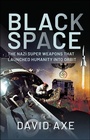
Black Space
The Nazi Superweapons That Launched Humanity Into Orbit
Published on 6. March 2023
Book
Hardback
978-1-3990-1423-6 (ISBN)
Description
Orbital fortresses poised to fry entire cities with no warning using giant mirrors. Bombers that take off from Earth, punch through the thin border between the atmosphere and vacuum and take advantage of that lofty altitude to speed across the globe on missions of mass destruction.
These and other exotic orbital weapons were under consideration, or even active development, in the early decades of humanity's push into space.
And no wonder. The era of frantic, dueling, American and Soviet space-exploration efforts -- which stretched from the end of World War II to the United States' successful Moon landing in July 1969 -- had its roots in Nazi Germany, a country that pinned its hope for global conquest on equally ambitious superweapons.
In the decades following World War II, the top scientists in the U.S. and Soviet space programs were ex-Nazis most notably rocket-designer Wernher von Braun, who sided with the Americans. The basic technologies of the space race derived from Nazi superweapons, in particular von Braun's V-2 rocket.
But orbital war never broke out in those heady decades of intense space competition. It's possible to triangulate the moment the seemingly inevitable became evitable. July 29, 1958. The day U.S. president Dwight Eisenhower reluctantly signed the law creating the National Aeronautics and Space Administration.
Starting that day, the U.S. military gradually ceded to NASA, a civilian agency, leadership of American efforts in space. Even von Braun, once a leading advocate of orbital warfare, went along. Space-based superweapons and their architects, and the high-stakes politics that reined them in, are the subject of this brief book.
These and other exotic orbital weapons were under consideration, or even active development, in the early decades of humanity's push into space.
And no wonder. The era of frantic, dueling, American and Soviet space-exploration efforts -- which stretched from the end of World War II to the United States' successful Moon landing in July 1969 -- had its roots in Nazi Germany, a country that pinned its hope for global conquest on equally ambitious superweapons.
In the decades following World War II, the top scientists in the U.S. and Soviet space programs were ex-Nazis most notably rocket-designer Wernher von Braun, who sided with the Americans. The basic technologies of the space race derived from Nazi superweapons, in particular von Braun's V-2 rocket.
But orbital war never broke out in those heady decades of intense space competition. It's possible to triangulate the moment the seemingly inevitable became evitable. July 29, 1958. The day U.S. president Dwight Eisenhower reluctantly signed the law creating the National Aeronautics and Space Administration.
Starting that day, the U.S. military gradually ceded to NASA, a civilian agency, leadership of American efforts in space. Even von Braun, once a leading advocate of orbital warfare, went along. Space-based superweapons and their architects, and the high-stakes politics that reined them in, are the subject of this brief book.
More details
Language
English
Place of publication
South Yorkshire
United Kingdom
Publishing group
Pen & Sword Books Ltd
Illustrations
105 black and white illustrations
Dimensions
Height: 164 mm
Width: 241 mm
Thickness: 26 mm
Weight
680 gr
ISBN-13
978-1-3990-1423-6 (9781399014236)
Copyright in bibliographic data and cover images is held by Nielsen Book Services Limited or by the publishers or by their respective licensors: all rights reserved.
Schweitzer Classification
Other editions
Additional editions
E-Book
03/2023
Pen and Sword Military
€12.99
Available for download
Person
DAVID AXE is a journalist, historian, filmmaker and former war correspondent. A prolific contributor to Forbes, The Daily Beast, Rolling Stone and many other publications, David has also directed independent movies including the horror-comedy Bae Wolf. David has written and edited several nonfiction books, most recently the graphic novel war memoir Machete Squad and the Pen & Sword book Drone War: Vietnam.