

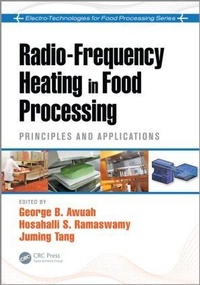
Radio-Frequency Heating in Food Processing
Principles and Applications
1st Edition
Published on 4. December 2014
Book
Hardback
422 pages
978-1-4398-3704-7 (ISBN)
Description
Radio-Frequency Heating in Food Processing: Principles and Applications covers the fundamentals of radio-frequency (RF) heating and the use of RF-heating technologies in modern food processing, preservation, and related industries. Focusing on industrial and lab-scale applications where RF heating has been employed successfully or reported to have potential benefits over conventional heating options, this state-of-the-art reference:
Explains the similarities, differences, advantages, and limitations of RF and microwave heating as applied to agricultural products
Describes fiber-optics temperature sensors and their utility in monitoring temperature during RF and microwave heating
Discusses the dielectric and thermo-physical properties of agricultural products amenable to RF and microwave heating, presenting measurement techniques, mathematical concepts, and computer simulation models
Provides practical perspectives on industrial RF units used in manufacturing food products, addressing free-running oscillators and 50-? designs for RF heaters and applicators
Uses finite-element formulations to determine design parameters including resonant modes, circuit impedance, and electric field distribution in RF applicators
Examines RF-heating effects on microorganisms, enzymes, and food quality attributes for products such as poultry, beef, pork, eggs, fish, milk, fruits, vegetables, and seafood
Explores RF-heating applications beyond food processing, such as agricultural product deinfestation, waste treatment, counterfeit prevention, package tracking, and transportation of food from farm to table
Radio-Frequency Heating in Food Processing: Principles and Applications supplies an in-depth overview of the fundamental science and engineering principles governing RF applications, as well as a solid understanding of industrial RF unit design options, challenges, and opportunities for development.
Explains the similarities, differences, advantages, and limitations of RF and microwave heating as applied to agricultural products
Describes fiber-optics temperature sensors and their utility in monitoring temperature during RF and microwave heating
Discusses the dielectric and thermo-physical properties of agricultural products amenable to RF and microwave heating, presenting measurement techniques, mathematical concepts, and computer simulation models
Provides practical perspectives on industrial RF units used in manufacturing food products, addressing free-running oscillators and 50-? designs for RF heaters and applicators
Uses finite-element formulations to determine design parameters including resonant modes, circuit impedance, and electric field distribution in RF applicators
Examines RF-heating effects on microorganisms, enzymes, and food quality attributes for products such as poultry, beef, pork, eggs, fish, milk, fruits, vegetables, and seafood
Explores RF-heating applications beyond food processing, such as agricultural product deinfestation, waste treatment, counterfeit prevention, package tracking, and transportation of food from farm to table
Radio-Frequency Heating in Food Processing: Principles and Applications supplies an in-depth overview of the fundamental science and engineering principles governing RF applications, as well as a solid understanding of industrial RF unit design options, challenges, and opportunities for development.
More details
Series
Language
English
Place of publication
Bosa Roca
United States
Publishing group
Taylor & Francis Inc
Target group
Professional and scholarly
Professional Reference
Product notice
sewn/stitched
Cloth over boards
Illustrations
192 s/w Abbildungen, 30 s/w Tabellen
30 Tables, black and white; 192 Illustrations, black and white
Dimensions
Height: 258 mm
Width: 177 mm
Thickness: 28 mm
Weight
952 gr
ISBN-13
978-1-4398-3704-7 (9781439837047)
Copyright in bibliographic data and cover images is held by Nielsen Book Services Limited or by the publishers or by their respective licensors: all rights reserved.
Schweitzer Classification
Other editions
Additional editions
George B. Awuah | Hosahalli S. Ramaswamy | Juming Tang
Radio-Frequency Heating in Food Processing
Principles and Applications
E-Book
12/2014
1st Edition
CRC Press
€311.99
Available for download
George B. Awuah | Hosahalli S. Ramaswamy | Juming Tang
Radio-Frequency Heating in Food Processing
Principles and Applications
E-Book
12/2014
1st Edition
CRC Press
€311.99
Available for download
Persons
George B. Awuah is currently the thermal process manager and process authority for Mars Petcare US, Franklin, Tennessee. He holds a B.Sc (Hon) from the Kwame Nkrumah University of Science and Technology, Ghana, and a Ph.D from McGill University, Montreal, Quebec, Canada. He previously taught at the Kwame Nkrumah University of Science and Technology; was a scientist and senior scientist at the Grocery Manufacturers Association, Washington, District of Columbia, USA; served as a research associate at McGill University; and collaborated with Agriculture and Agri-Food Canada, Guelph, Ontario. Widely published, Dr. Awuah is a member of the Institute for Thermal Processing Specialists and Institute of Food Technologists.
Hosahalli S. Ramaswamy holds a BS from Bangalore University, India; an MS from the Central Food Technological Research Institute, Mysore, India; and an MS and Ph.D from the University of British Columbia, Vancouver, Canada. He is professor of food processing at McGill University, Ste-Anne-de-Bellevue, Quebec, Canada. During his 25 years at McGill, he has established several research programs in postharvest technology and food processing. Widely published and highly decorated, Dr. Ramaswamy is a popular keynote speaker, the editor of the Journal of Food Engineering, and a member of numerous boards and professional societies and a recipient of several awards, the recent ones being the Marvin Tung Award (IFTPS), fellow of CIFST, and fellow IUFoST. Recently, he led the Canadian team to win the bid to bring the 2015 International Congress of Food Engineering to Canada.
Juming Tang is Regents professor and distinguished chair of food engineering at Washington State University, Pullman, USA. He has more than 20 years of research experience in areas of thermal processing using microwave and radio-frequency energy for food safety and pest control applications, in close collaboration with equipment and processing companies, related regulatory agencies, and US government research institutions. His laboratory developed 915 MHz single-mode microwave assisted sterilization (MATS) and pasteurization (MAP) technologies for packaged foods. Widely published and highly decorated, Dr. Tang is a fellow of the International Microwave Power Institute, American Society of Agricultural and Biological Engineers, and Institute of Food Technologists.
Hosahalli S. Ramaswamy holds a BS from Bangalore University, India; an MS from the Central Food Technological Research Institute, Mysore, India; and an MS and Ph.D from the University of British Columbia, Vancouver, Canada. He is professor of food processing at McGill University, Ste-Anne-de-Bellevue, Quebec, Canada. During his 25 years at McGill, he has established several research programs in postharvest technology and food processing. Widely published and highly decorated, Dr. Ramaswamy is a popular keynote speaker, the editor of the Journal of Food Engineering, and a member of numerous boards and professional societies and a recipient of several awards, the recent ones being the Marvin Tung Award (IFTPS), fellow of CIFST, and fellow IUFoST. Recently, he led the Canadian team to win the bid to bring the 2015 International Congress of Food Engineering to Canada.
Juming Tang is Regents professor and distinguished chair of food engineering at Washington State University, Pullman, USA. He has more than 20 years of research experience in areas of thermal processing using microwave and radio-frequency energy for food safety and pest control applications, in close collaboration with equipment and processing companies, related regulatory agencies, and US government research institutions. His laboratory developed 915 MHz single-mode microwave assisted sterilization (MATS) and pasteurization (MAP) technologies for packaged foods. Widely published and highly decorated, Dr. Tang is a fellow of the International Microwave Power Institute, American Society of Agricultural and Biological Engineers, and Institute of Food Technologists.
Content
Principles of Radio-Frequency and Microwave Heating. Radio-Frequency and Microwave Applications: Similarities, Advantages, and Limitations. Temperature Measurement in Radio-Frequency Applications. Dielectric Properties of Agricultural Products: Fundamental Principles, Influencing Factors, and Measurement Techniques. Electrical Conductivity Effect on Dielectric Properties and Radio-Frequency Heating. The Industrial Radio-Frequency Heater. The RF 50 ? Technology versus Variable-Frequency RF Technology. Analysis of Radio-Frequency Industrial Heating Systems Using Computational Techniques. Modeling Electro-Assisted Processing Using Computational Fluid Dynamics. Radio Frequency Heating Effects on Microbial Destruction. Effect of Radio-Frequency Heating on Food Quality Factors. Radio-Frequency Drying of Food Materials. Radio-Frequency Baking and Roasting of Food Products. Radio-Frequency Thawing and Tempering. Radio-Frequency Pasteurization and Sterilization of Packaged Foods. Radio-Frequency Heating of Dry Foods and Agricultural Commodities. Applications of Radio-Frequency Heating to Meat, Fish, and Poultry Products. Application of Radio-Frequency Heating of Milk and Dairy Products. RF Treatment of Fresh Fruits and Vegetables. RF Deinfestation (Pest Control) of Agricultural Products. Radio Frequency Treatment of Food-Related Materials, Waste, and By-Products. Radio Frequency in Packaging, Inventory Control, and Tracking in the Food-Processing Industry.