

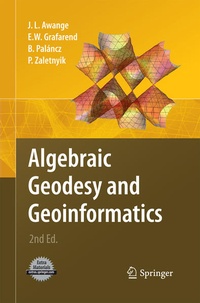
Algebraic Geodesy and Geoinformatics
2nd Edition
Published on 23. November 2014
Book
Paperback/Softback
XVIII, 377 pages
978-3-642-43113-5 (ISBN)
Description
While preparing and teaching 'Introduction to Geodesy I and II' to undergraduate students at Stuttgart University, we noticed a gap which motivated the writing of the present book: Almost every topic that we taught required some skills in algebra, and in particular, computer algebra! From positioning to transformation problems inherent in geodesy and geoinformatics, knowledge of algebra and application of computer algebra software were required. In preparing this book therefore, we have attempted to put together basic concepts of abstract algebra which underpin the techniques for solving algebraic problems. Algebraic computational algorithms useful for solving problems which require exact solutions to nonlinear systems of equations are presented and tested on various problems. Though the present book focuses mainly on the two ?elds, the concepts and techniques presented herein are nonetheless applicable to other ?elds where algebraic computational problems might be encountered. In Engineering for example, network densi?cation and robotics apply resection and intersection techniques which require algebraic solutions. Solution of nonlinear systems of equations is an indispensable task in almost all geosciences such as geodesy, geoinformatics, geophysics (just to mention but a few) as well as robotics. These equations which require exact solutions underpin the operations of ranging, resection, intersection and other techniques that are normally used. Examples of problems that require exact solutions include; three-dimensional resection problem for determining positions and orientation of sensors, e. g. , camera, theodolites, robots, scanners etc.
Reviews / Votes
From the reviews of the second edition:"I compliment the authors on this book because it brings together mathematical methods for the solution of multi-variable polynomial equations that are hardly covered side by side in any ordinary mathematical book: The book explains both algebraic ("exact") and numerical ("approximate") methods. It also points to the recent combination of algebraic and numerical methods ("hybrid" methods), which is currently one of the most promising directions in the area of computer mathematics. Prof. Dr.phil. Dr.h.c.mult. Bruno Buchberger, Professor of Computer Mathematics, and Head of Softwarepark Hagenberg. . As the person responsible for Mathematica's GroebnerBasis and NSolve implementations, I am delighted to see them put to such practical use. It is, moreover, a pleasure to see methods from an abstract branch of mathematics come into play in attacking problems from a very important branch of technology." Daniel Lichtblau, Wolfram Research."The book consists of the two parts. In the first part, the authors give a review of some known results in linear algebra and numerical methods which are used in the second part. The second part is the basic in the book. . Each theoretical statement given in the book is accompanied with many careful neat examples. A rich bibliography envelopes all basic directions in algebraic geodesy and geoinformatics." (I. V. Boikov, Zentralblatt MATH, Vol. 1197, 2010)More details
Edition
Second Edition 2010
Language
English
Place of publication
Berlin
Germany
Publishing group
Springer Berlin
Target group
Professional and scholarly
Research
Edition type
Revised edition
Illustrations
XVIII, 377 p.
Dimensions
Height: 235 mm
Width: 155 mm
Thickness: 22 mm
Weight
598 gr
ISBN-13
978-3-642-43113-5 (9783642431135)
DOI
10.1007/978-3-642-12124-1
Schweitzer Classification
Other editions
New editions
Book
02/2016
3rd Edition
Springer
€106.99
Shipment within 10-15 days
Additional editions
Joseph L. Awange | Erik W. Grafarend | Béla Paláncz
Algebraic Geodesy and Geoinformatics
Book
07/2010
2nd Edition
Springer
€181.89
Article exhausted; check for reprint
Previous edition
Joseph L. Awange | Erik W. Grafarend
Solving Algebraic Computational Problems in Geodesy and Geoinformatics
The Answer to Modern Challenges
Book
11/2004
Springer
€123.00
Article exhausted; check for reprint
Persons
Silvelyn Zwanzig is Professor of Mathematical Statistics at Uppsala University. She studied Mathematics at the Humboldt-University in Berlin and received her Ph.D. in Mathematics at the Academy of Science of the GDR, in 1984. She completed her habilitation in Mathematics at the University of Hamburg in 1998, where she continued to work as Assistant Professor, and concurrently also in Astrometry. In her habilitation she studied asymptotic properties of the total least squares estimator in nonlinear models. In 2000 she moved to Sweden where she has been working at Uppsala University. Her research interests have moved from theoretical and asymptotic statistics to computer intensive methods. Since 1991, she has taught Statistics to undergraduate and graduate students.
Professor Joseph Awange joined Spatial Sciences (School of Earth and Planetary Sciences, Curtin University, Australia) in 2006 under a Curtin Research Fellowship and concurrently undertook the prestigious Alexander vonHumboldt (AvH) Fellowship at the Geodetic Institute (Karlsruhe Institute of Technology, Germany) having been awarded the Australian 2008-2011 Ludwig Leichhardt Memorial Fellowship for experienced researchers. In 2015, he won all the three major Fellowship Awards: Alexander von Humboldt (Germany), Japan Society of Promotion of Science (Japan) and Brazil Frontier of Science (Brazil) to carry out research in those countries. At Curtin University, he is currently a Professor of Environmental Geoinformatics engaged in teaching and research having attracted more than $2.5M worth of research grants. He obtained his BSc and MSc degrees in Surveying from the University of Nairobi (Kenya), and was also awarded a merit scholarship by the German Academic Exchange Program (DAAD), which facilitated his obtaining a second MSc degree and PhD in Geodesy at Stuttgart University (Germany). In 2002-2004, he was awarded the prestigious Japan Society for Promotion of Science (JSPS) Fellowship to pursue postdoctoral research at Kyoto University (Japan). Prof Awange attained International Editorial role in Springer Earth Science Books and has authored more than 20 scholarly books with the prestigious Springer International publishers and more than 200 peer-reviewed high impact journal publications (in e.g., Remote Sensing of Environment, Journal of Climate, Climatic Change, Advances in Water Resources, International Journal of Climatology, and Journal of Hydrology among others). His main research areas that have attracted media coverage (e.g., Environmental Monitor) are in the fields of (i) Environmental Geoinformatics: Satellite Environmental Sensing (e.g., changes in global and regional stored water (surface, underground, ice, and soil moisture) using GRACE/GRACE-FO and TRMM satellites; Climate Change using GNSS and altimetry satellites), which is employed to face the emerging challenges of the 21st century posed by increased extreme hydroclimatic conditions, e.g., severity and frequency of droughts in Australia and Greater Horn of Africa (GHA), and the changing monsoon characteristics in Asia and Africa leading to floods, and (ii) Mathematical Geosciences: Hybrid-symbolic solutions that delivers hybrid symbolic-numeric computations (HSNC), which is a large and growing area at the boundary of mathematics and computer science and currently an active area of research.
Content
Algebraic symbolic and numeric methods.- Basics of ring theory.- Basics of polynomial theory.- Groebner basis.- Polynomial resultants.- Linear homotpy.- Solutions of Overdetermined Systems.- Extended Newton-Raphson method.- Procrustes solution.- Applications to geodesy and geoinformatics.- LPS-GNSS orientations and vertical deflections.- Cartesian to ellipsoidal mapping.- Positioning by ranging.- Positioning by resection methods.- Positioning by intersection methods.- GNSS environmental monitoring.- Algebraic diagnosis of outliers.- Datum transformation problems.