

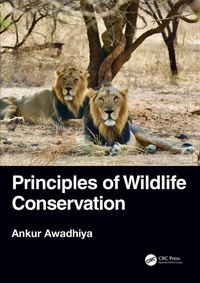
Principles of Wildlife Conservation
1st Edition
Published on 15. July 2021
Book
Hardback
386 pages
978-1-032-02332-8 (ISBN)
Description
Wildlife tend our forests - they pollinate flowers, disperse seeds, eat insects that harm trees, and keep herbivores and diseases in check. They keep our forests healthy and resilient - ready and able to face and counter any challenges, such as global warming and climate change. They are the individual cogs that keep the forest machine functioning. And we desperately need our forests - to sequester carbon, to purify our air and water, to protect our soils from getting eroded, and to save our dams and waterways. Wildlife do need our care, concern, and attention, but we also need our wildlife - perhaps much more sincerely. A majority of wildlife arrived on this planet much before humans, and the Earth belongs to them as well.
So how do we conserve wildlife? This is the question that Principles of Wildlife Conservation seeks to answer. It presents a lucid - cogent, yet simple - narration about the why's and how's of conserving wildlife. It begins with the first principles - and thus requires no prerequisite other than an urge to seek knowledge. It is full of pictures and case studies from the field - to facilitate easy grasping of the subject. The book builds a solid foundation of the theory of wildlife conservation, and tops that up with experiences from actually doing wildlife conservation. In this way, it equips the reader to master both the science - and the art - of conserving wildlife.
So how do we conserve wildlife? This is the question that Principles of Wildlife Conservation seeks to answer. It presents a lucid - cogent, yet simple - narration about the why's and how's of conserving wildlife. It begins with the first principles - and thus requires no prerequisite other than an urge to seek knowledge. It is full of pictures and case studies from the field - to facilitate easy grasping of the subject. The book builds a solid foundation of the theory of wildlife conservation, and tops that up with experiences from actually doing wildlife conservation. In this way, it equips the reader to master both the science - and the art - of conserving wildlife.
Reviews / Votes
"This comprehensive textbook on wildlife conservation covers the main principles of animal ecology while opening readers' eyes to Asian examples of conservation approaches and Asian views and priorities. Eleven chapters address the organization of life (biodiversity, energetics, interactions), emphasizing demography and extinction threats. Detailed methods for monitoring populations and trends, managing disease, and handling wildlife are provided, from capturing and sedating to sampling and tagging. Population genetics, viability analysis, and habitat management are covered as are new technologies and economics and controversies over management in zoos vs. wild management. Theory is well illustrated by figures, and mathematics is limited to simple algebra. Numerous black-and-white photographs-mostly clear-of wildlife and their habitats and conservationists at work are included. Particularly valuable are the sections on methodology for finding, observing, and counting wildlife. Many conservation studies require capturing animals, testing them for disease, and marking them for subsequent identification. One unique feature is the inclusion of details on anesthetizing and handling dangerous animals -think tigers."--J. Burger, Rutgers, The State University of New Jersey, New Brunswick, Choice May 2023
More details
Language
English
Place of publication
London
United Kingdom
Publishing group
Taylor & Francis Ltd
Target group
College/higher education
Professional and scholarly
Postgraduate, Professional, Professional Practice & Development, and Undergraduate Advanced
Illustrations
74 s/w Abbildungen, 42 s/w Photographien bzw. Rasterbilder, 32 s/w Zeichnungen, 17 s/w Tabellen
17 Tables, black and white; 32 Line drawings, black and white; 42 Halftones, black and white; 74 Illustrations, black and white
Dimensions
Height: 280 mm
Width: 210 mm
Weight
900 gr
ISBN-13
978-1-032-02332-8 (9781032023328)
Copyright in bibliographic data and cover images is held by Nielsen Book Services Limited or by the publishers or by their respective licensors: all rights reserved.
Schweitzer Classification
Other editions
Additional editions
Ankur Awadhiya
Principles of Wildlife Conservation
Book
07/2021
1st Edition
CRC Press
€106.80
Shipment within 15-20 days
Ankur Awadhiya
Principles of Wildlife Conservation
E-Book
07/2021
1st Edition
CRC Press
€100.99
Available for download
Ankur Awadhiya
Principles of Wildlife Conservation
E-Book
07/2021
1st Edition
CRC Press
€100.99
Available for download
Person
Dr. Ankur Awadhiya (b. 1987) is an IFS officer of 2014 batch borne on the Madhya Pradesh cadre. Trained as an engineer, he earned his B. Tech in Biological Sciences and Bioengineering in 2009 from IIT Kanpur, followed by a Ph.D from IIT Kanpur in 2015, AIGNFA (Honours Diploma) from IGNFA Dehradun in 2016 and Post Graduate Diploma in Advanced Wildlife Management (Honours Diploma) from WII Dehradun in 2018. He maintains a keen interest in academics and research and has been a recipient of several honours including the NTSE scholarship, KVPY fellowship, Shri P. Srinivas Memorial prize, K. P. Sagriya Shreshta Vaniki puraskar and the S. K. Seth Prize. Besides academics, he maintains a passion towards photography, painting, movie-making, and creative literary pursuits.
Content
Introduction. Organisation of life. Population growth and community organisation. Threats to wildlife resources. Wildlife monitoring. Wildlife disease management. Animal restraint and immobilisation. Wildlife genetics. Habitat management. Ex-situ and in-situ conservation. Emerging aspects of wildlife management. References. Index.