

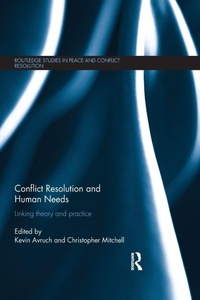
Conflict Resolution and Human Needs
Linking Theory and Practice
1st Edition
Published on 27. April 2015
Book
Paperback/Softback
264 pages
978-1-138-84760-6 (ISBN)
Description
This edited volume examines Basic Human Needs theory and interactive problem solving, looking at recent developments in thinking about both and how these might affect peacebuilding in contemporary conflicts of the twenty-first century.
The era in the immediate aftermath of World War II was, paradoxically, a time of great optimism in parts of academia. There was, especially in the United States and much of Europe, a widespread belief in the social sciences that systematic scholarly analysis would enable humanity to understand and do something about the most complex of social processes, and thus about solving persistent human problems: unemployment, delinquency, racism, under-development, and even issues of conflict, war and peace.
This book examines the evolution of the Basic Human Needs theory and is divided into two key parts: Basic Human Needs in Theory and Basic Human Needs in Practice. Exploring this theory through a wide range of different lenses, including gender, ethics and power, the volume brings together some of the leading scholars in the field of peace and conflict studies and draws upon research both past and present to forecast where the movement is headed in the future.
This book will be of much interest to students of peace and conflict studies, conflict resolution, psychology, security studies and IR.
The era in the immediate aftermath of World War II was, paradoxically, a time of great optimism in parts of academia. There was, especially in the United States and much of Europe, a widespread belief in the social sciences that systematic scholarly analysis would enable humanity to understand and do something about the most complex of social processes, and thus about solving persistent human problems: unemployment, delinquency, racism, under-development, and even issues of conflict, war and peace.
This book examines the evolution of the Basic Human Needs theory and is divided into two key parts: Basic Human Needs in Theory and Basic Human Needs in Practice. Exploring this theory through a wide range of different lenses, including gender, ethics and power, the volume brings together some of the leading scholars in the field of peace and conflict studies and draws upon research both past and present to forecast where the movement is headed in the future.
This book will be of much interest to students of peace and conflict studies, conflict resolution, psychology, security studies and IR.
More details
Series
Language
English
Place of publication
London
United Kingdom
Publishing group
Taylor & Francis Ltd
Target group
College/higher education
Illustrations
2 s/w Zeichnungen, 2 s/w Tabellen
2 Tables, black and white; 2 Line drawings, black and white
Dimensions
Height: 234 mm
Width: 156 mm
Thickness: 14 mm
Weight
406 gr
ISBN-13
978-1-138-84760-6 (9781138847606)
Copyright in bibliographic data and cover images is held by Nielsen Book Services Limited or by the publishers or by their respective licensors: all rights reserved.
Schweitzer Classification
Other editions
Additional editions
E-Book
05/2013
Routledge
€77.49
Available for download
E-Book
05/2013
1st Edition
Routledge
€77.99
Available for download
Book
04/2013
1st Edition
Routledge
€233.30
Shipment within 15-20 days
Persons
Kevin Avruch is the Henry Hart Rice Professor of Conflict Resolution and Professor of Anthropology at the School for Conflict Analysis and Resolution, and senior fellow and faculty in the Peace Operations Policy Program, School of Public Policy, at George Mason University. He is author or editor of six books, including Context and Pretext in Conflict Resolution: Culture, Identity, Power and Practice (2012), Culture and Conflict Resolution (1998) and Information Campaigns for Peace Operations (2000).
Christopher Mitchell is currently Emeritus Professor of Conflict Research at George Mason University, Virginia, where he was Director of the Institute for Conflict Analysis and Resolution between 1991 and 1994. Most recently he has published Gestures of Conciliation (2000), A Handbook of Conflict Resolution (1995) and (with Landon Hancock) Zones of Peace (2007).
Christopher Mitchell is currently Emeritus Professor of Conflict Research at George Mason University, Virginia, where he was Director of the Institute for Conflict Analysis and Resolution between 1991 and 1994. Most recently he has published Gestures of Conciliation (2000), A Handbook of Conflict Resolution (1995) and (with Landon Hancock) Zones of Peace (2007).
Content
Introduction: Basic Human Needs in Theory and Practice, Kevin Avruch and Christopher Mitchell PART 1: BASIC HUMAN NEEDS IN THEORY 1. Extending the Reach of Basic Human Needs(BHN): A Comprehensive Theory for the Twenty-First Century, Dennis J.D. Sandole 2. Basic Human Needs and the Dilemma of Power in Conflict Resolution, Kevin Avruch 3. Through Gender Lenses: Human Needs in Theory in Conflict Resolution, Ingrid Sandole-Staroste 4. Moral Judgements, Human Needs and Conflict Resolution: Alternative Approaches to Ethical Standards, Louis Kriesberg 5.Ethics of Conflict Resolution Mediator: From Scientific Gaze to Sensitive and Skillful Action, Tarja Vayrynen 6. Explaining Human Conflict: Human Needs Theory and the Insight Approach, Jamie Price 7. From Human Needs to the Moral Imagination: The Promise of Post-Burtonian Conflict Resolution, Solon Simmons PART 2: BASIC HUMAN NEEDS IN PRACTICE 8. Beyond the "Classical Model" of Problem Solving Workshops: 25 Years of Experience, Experiment and Adaptation, Christopher Mitchell 9: Basic Human Needs: Bridging the Gap Between Theory and Practice, Mohammed Abu-Nimer 10. Acknowledging Basic Human Needs and Adjusting the Focus of the Problem-Solving Workshop, Ronald J. Fisher 11.Basic Human Needs in Practice: The Georgian-South Ossetian Point of View Process, Susan Allen Nan and Jacquie L. Greiff 12. Human Needs and Conflict Resolution in Practice: Environment and Community, E. Franklin Dukes Afterword