

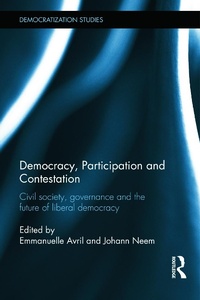
Democracy, Participation and Contestation
Civil society, governance and the future of liberal democracy
1st Edition
Published on 22. June 2014
Book
Hardback
302 pages
978-0-415-74863-6 (ISBN)
Description
The establishment of democracy on both sides of the Atlantic has not been a smooth evolution towards an idealized presumed endpoint. Far from it, democratization has been marked by setbacks and victories, a process often referred to as 'contested democracy'. In view of recent mobilizations such as the Arab Spring and the Occupy movement, in which new technologies have played a key role, there is a need for a renewed analysis of the long-term evolution of US and UK political systems.
Using new areas of research, this book argues that the ideals and the practices of Anglo-American democracy can be best understood by studying diverse forms of participation, which go beyond classical expressions of contestation and dissent such as voting. The authors analyze political parties, social movements, communications and social media, governance, cultural diversity, identity politics, public-private actors and social cohesion to illustrate how the structure and context of popular participation play a significant role in whether, and when, citizens? efforts have any meaningful impact on those who exercise political power. In doing so, the authors take crucial steps towards understanding how a vigorous public sphere and popular sovereignty can be made to work in today's global environment.
This book will be of interest to students and scholars of political science, British and US history, democracy, political participation, governance, social movements and politics.
Using new areas of research, this book argues that the ideals and the practices of Anglo-American democracy can be best understood by studying diverse forms of participation, which go beyond classical expressions of contestation and dissent such as voting. The authors analyze political parties, social movements, communications and social media, governance, cultural diversity, identity politics, public-private actors and social cohesion to illustrate how the structure and context of popular participation play a significant role in whether, and when, citizens? efforts have any meaningful impact on those who exercise political power. In doing so, the authors take crucial steps towards understanding how a vigorous public sphere and popular sovereignty can be made to work in today's global environment.
This book will be of interest to students and scholars of political science, British and US history, democracy, political participation, governance, social movements and politics.
More details
Series
Language
English
Place of publication
London
United Kingdom
Publishing group
Taylor & Francis Ltd
Target group
College/higher education
Product notice
sewn/stitched
Cloth over boards
Illustrations
22 s/w Abbildungen, 15 s/w Photographien bzw. Rasterbilder, 7 s/w Zeichnungen, 1 s/w Tabelle
1 Tables, black and white; 7 Line drawings, black and white; 15 Halftones, black and white; 22 Illustrations, black and white
Dimensions
Height: 231 mm
Width: 155 mm
Thickness: 23 mm
Weight
590 gr
ISBN-13
978-0-415-74863-6 (9780415748636)
Copyright in bibliographic data and cover images is held by Nielsen Book Services Limited or by the publishers or by their respective licensors: all rights reserved.
Schweitzer Classification
Other editions
Additional editions
Emmanuelle Avril | Johann Neem
Democracy, Participation and Contestation
Civil society, governance and the future of liberal democracy
Book
04/2016
1st Edition
Routledge
€70.50
Shipment within 10-20 days
Emmanuelle Avril | Johann Neem
Democracy, Participation and Contestation
Civil society, governance and the future of liberal democracy
E-Book
08/2014
1st Edition
Routledge
€72.49
Available for download
Emmanuelle Avril | Johann Neem
Democracy, Participation and Contestation
Civil society, governance and the future of liberal democracy
E-Book
08/2014
1st Edition
Routledge
€72.49
Available for download
Persons
Emmanuelle Avril is Professor in British Politics and Society at Universite Sorbonne Nouvelle, Paris, France.
Johann Neem is Associate Professor of History at Western Washington University, USA.
Johann Neem is Associate Professor of History at Western Washington University, USA.
Content
List of illustrations and tables List of Contributors Acknowledgements Introduction "Contested Democracy": A critical evaluation Emmanuelle Avril & Johann Neem Part I Contested Definitions of Democracy Chapter 1 Rethinking 1828: The Emergence of Competing Democracies in the United States Reeve Huston Chapter 2: Some Ideological Aspects of the 'Battle of Cable Street' Christos Efstathiou Chapter 3 Democracy inc. and Radical Criticism in the US Pierre Guerlain Chapter 4 Is Equality the Goal?: Challenging Economic Inequality in the US and UK Scot T. Fitzgerald Part II Who Participates? Political Inclusion and Exclusion Chapter 5 Democracy: America's Other "Peculiar Institution" Andrew W. Robertson Chapter 6 Undocumented Immigrants, From Pariahs to Citizens? Mobilizations and Arguments in Favor of Inclusion James Cohen Chapter 7 Productive Protest? The contested higher education reforms in England under the Coalition Government Sarah Pickard Chapter 8 A Tale of Polarizations: Stress, Inertia and Social Change in the New Gilded Age Jean-Baptiste Velut Part III Governance and the Management of Democratic Processes Chapter 9 Public Participation, Planning and Housing: a Changing Balance of Power? David Fee Chapter 10 The English Regions since 1994: Decentralization and the Contested Terrain of Territorial Governance Houari Mired Chapter 11 The European Citizens' Initiative: the Influence of Anglo-American Governance Ideology on Recent EU Institutional Reforms Coralie Raffenne Chapter 12 Channeling Indigenous Contestation of Uranium Mining in Australia: Legislation, Negotiation, Co-optation Sandrine Tolazzi Chapter 13 Partners not protesters? Managing Contests to Traditional Democracy through Expanded Public Input into Political Decision-making Jennifer Lees-Marshment Part IV A Changing Public Sphere. New Spaces and New Tools Chapter 14 Contested Boundaries of Representation: Patterns of Transformation in Black Petitioning in Massachusetts, 1770-1850 Daniel Carpenter and Nicole Topich Chapter 15: Social networks and Democracy: Fightbacks and Backlashes in the World Wide Agora Emmanuelle Avril Chapter 16 Local Democracy and Public Spaces in Contest: Graffiti in San Francisco Guillaume Marche Chapter 17 A Faux-Public Sphere: Liberty Mutual Markets an Online Conversation Economy for Citizen-Consumers Sheena Raja Chapter 18 Social Media and Political Activism: Breaking the Offline and Online Division Cristiana Olcese Concluding remarks: Does Democracy Have a Future? Gary Gerstle Index