

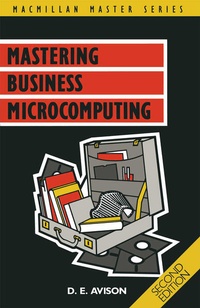
Mastering Business Microcomputing
2nd Edition
Published on 18. June 1990
Book
Paperback/Softback
XV, 244 pages
978-0-333-52511-1 (ISBN)
Description
Designed to give an overview of the business applications of microcomputers, this is an introduction for college and polytechnic students on computing and business courses. Managers of small or medium sized businesses or of departments in larger companies will also find the book helpful.
More details
Series
Edition
Second Edition 1990
Language
English
Place of publication
London
United Kingdom
Target group
Professional and scholarly
Product notice
Paperback (trade)
Unsewn / adhesive bound
Illustrations
XV, 244 p.
Dimensions
Height: 216 mm
Width: 140 mm
Thickness: 15 mm
Weight
340 gr
ISBN-13
978-0-333-52511-1 (9780333525111)
DOI
10.1007/978-1-349-11608-9
Schweitzer Classification
Other editions
Additional editions
D.E. Avison
Mastering Business Microcomputing
E-Book
06/1990
2nd Edition
Palgrave Macmillan
€53.49
Available for download
Content
Part 1 Choosing your microcomputer system: the microcomputer maze; types of microcomputer applications; the feasibility study; getting information; suppliers; planning and user involvement; hardware; software. Part 2 Word processing and the electronic office: word processing; editing; storing text; printing; spelling and dictionary; electronic mail; other features of the electronic office; local area networks; desk top publishing; implementing the new technology. Part 3 File management and data base applications: clerical and computer files; features of file management packages; types of file management and data base system; functions of a data base system; distributed data bases. Part 4 Spreadsheet and financial modelling: the spreadsheet concept; features of spreadsheet packages; creating the spreadsheet; printing and saving the spreadsheet; problems with spreadsheets; financial modelling packages. Part 5 Business graphics: worth a thousand words; the basic charts; Icon (WIMP) interface; computer aided design (CAD). Part 6 Accounting and related data processing applications: features of accounting systems; control; sales ledger; purchase ledger; nominal ledger; sales order processing and invoicing; stock recording; costing; payroll; integrated accounts. Part 7 Integrated systems and other applications: integrated packages; project control; statistics; writing your own procedures; applications generators; expert systems.