

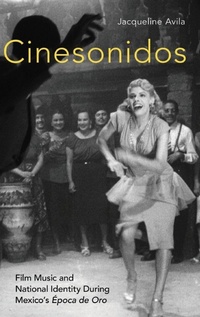
Cinesonidos
Film Music and National Identity During Mexico's Epoca de Oro
Published on 14. October 2019
Book
Hardback
288 pages
978-0-19-067130-3 (ISBN)
Description
During Mexico's silent (1896-1930) and early sound (1931-52) periods, cinema saw the development of five significant genres: the prostitute melodrama (including the cabaretera subgenre), the indigenista film (on indigenous themes or topics), the cine de anoranza porfiriana (films of Porfirian nostalgia), the Revolution film, and the comedia ranchera (ranch comedy). In this book, author Jacqueline Avila looks at examples from all genres, exploring the ways that the popular, regional, and orchestral music in these films contributed to the creation of tropes and archetypes now central to Mexican cultural nationalism. Integrating primary source material--including newspaper articles, advertisements, films--with film music studies, sound studies, and Mexican film and cultural history, Avila examines how these tropes and archetypes mirrored changing perceptions of mexicanidad manufactured by the State and popular and transnational culture. As she shows, several social and political agencies were heavily invested in creating a unified national identity in an attempt to merge the previously fragmented populace as a result of the Revolution. The commercial medium of film became an important tool to acquaint a diverse urban audience with the nuances of Mexican national identity, and music played an essential and persuasive role in the process. In this heterogeneous environment, cinema and its music continuously reshaped the contested, fluctuating space of Mexican identity, functioning both as a sign and symptom of social and political change.
Reviews / Votes
Cinesonidos is one of those rare first-of-a-kind books, due to its original work engaging Mexico through lines of musicology that are coming into their first dialogue with the work of Latin Americanist scholars working in cinema and communications. In doing so, Avila proposes an original, scholarly sound and intellectually valuable account of sound in Mexican cinema, one that will not only be an obligatory reference to scholars, but that opens new lines of scholars working on cinema and sound outside of Hollywood and Western European paradigms. * Ignacio M. Sanchez Prado, author of Screening Neoliberalism: Transforming Mexican Cinema, 1988-2012 * Avila's deeply-textured and interdisciplinary analysis shows how filmmakers, composers, and onscreen musicians tapped into a broad web of widely understood political, social, and historical references that aurally shaped the very idea of Mexican modernity and the role of the Mexican film industry in an expanding global market.Her work offers an important challenge to the current Hollywood-centric hegemony of film music scholarship and encourages us to look-and listen-beyond national boundaries in narrating histories of music and the moving image. * Susan Thomas, Director of the American Music Research Center and Professor of Musicology, University of Colorado-Boulder *More details
Series
Language
English
Place of publication
New York
United States
Illustrations
29 illus.
Dimensions
Height: 240 mm
Width: 161 mm
Thickness: 20 mm
Weight
599 gr
ISBN-13
978-0-19-067130-3 (9780190671303)
Copyright in bibliographic data and cover images is held by Nielsen Book Services Limited or by the publishers or by their respective licensors: all rights reserved.
Schweitzer Classification
Other editions
Additional editions
Book
10/2019
Oxford University Press Inc
€53.10
Shipment within 15-20 days
E-Book
09/2019
OUP eBook
€22.99
Available for download
E-Book
09/2019
OUP eBook
€17.49
Available for download
Person
Jacqueline Avila is Associate Professor in Musicology at the University of Tennessee. Her research focuses on film music and sound practice from the silent period to present, and the intersections of cultural identity, tradition, and modernity in the Hollywood and Mexican film industries. Dr. Avila was the recipient of the UC MEXUS Dissertation Research Grant, the American Musicological Society's Howard Mayer Brown Fellowship, the UC MEXUS Postdoctoral Fellowship (2014-15), and the University of New Mexico's Robert E. Greenleaf Visiting Library Scholar Award (2016). Her publications can be found in the Journal of Film Music, Latin American Music Review, Opera Quarterly, and the Oxford Research Encyclopedia of Latin American History.
Content
- Acknowledgements
- Introduction
- Chapter One: The Prostitute and the Cinematic Cabaret: Musicalizing the "Fallen Woman" and Mexico City's Nightlife
- Chapter Two: The Salon, the Stage, and Porfirian Nostalgia
- Chapter Three: The Sounds of Indigenismo: Cultural Integration and Musical Exoticism in Janitzio (1934) and María Candelaria (1943)
- Chapter Four: The Singing Charro in the Comedia Ranchera: Music, Machismo, and the Invention of a Tradition
- Chapter Five: The Strains of the Revolution: Musicalizing the Soldadera in the Revolutionary Melodrama
- Epilogue
- Bibliography