

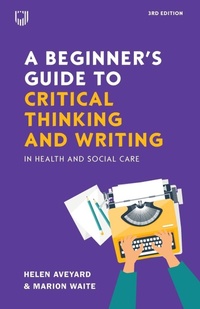
A Beginner's Guide to Critical Thinking and Writing in Health and Social Care, 3e
3rd Edition
Published on 24. October 2024
Book
Paperback/Softback
200 pages
978-0-335-25253-4 (ISBN)
Description
"From start to finish, this book gives a clear overview of the skills required to be successful at thinking critically both in academic work and within clinical practice."
Ruth Trout, Senior Lecturer in Acute Care, Programme and BSc Dissertation Lead, MSc Dissertation Supervisor, Buckinghamshire New University, UK
"This third edition of this book continues where the first and second editions excelled - in providing the foundations of critical thinking for students of health and social care."
Dr David M Rea, School of Health and Social Care, Swansea University, UK
Ever been told to be 'more critical' in your essay writing?
Ever wondered what critical thinking actually is and how you can apply it in your academic work and practice?
Returning in its third edition, this bestselling guide takes you through every stage of becoming a critical thinker, from approaching your subject to writing your essays or dissertation in health and social care. Each chapter tackles a different aspect of critical thinking and shows you how it's done using examples and simple language.
Beginning with an overview of the importance of critical thinking, the book goes on to cover:
How to think more critically about readily available information
How to find the 'best available' evidence and be more critical of it
How to demonstrate critical thinking in written work and presentations
How to adopt critical thinking in practice
How critical thinking can play a key part in the development of health and social care services
Refreshed with up-to-date theory and contemporary ideas throughout, this fully revised third edition includes:
Further examples to illustrate important points
Additional activities to help deepen learning
New sections on writing with a critical voice from notetaking to a final draft
Advice about thinking and writing critically when using online resources and social media
Further developments to the key tool 'Six questions for critical thinking' which will assist you in developing your skills for academic work and practice - updated for this edition in response to student evaluation
This book is an essential purchase for students and qualified healthcare staff alike.
Dr Helen Aveyard is a Principal Lecturer in the Oxford School of Nursing and Midwifery at Oxford Brookes University, UK.
Dr Marion Waite is a Principal Lecturer in Nursing and Education in the Oxford School of Nursing and Midwifery
at Oxford Brookes University, UK.
Ruth Trout, Senior Lecturer in Acute Care, Programme and BSc Dissertation Lead, MSc Dissertation Supervisor, Buckinghamshire New University, UK
"This third edition of this book continues where the first and second editions excelled - in providing the foundations of critical thinking for students of health and social care."
Dr David M Rea, School of Health and Social Care, Swansea University, UK
Ever been told to be 'more critical' in your essay writing?
Ever wondered what critical thinking actually is and how you can apply it in your academic work and practice?
Returning in its third edition, this bestselling guide takes you through every stage of becoming a critical thinker, from approaching your subject to writing your essays or dissertation in health and social care. Each chapter tackles a different aspect of critical thinking and shows you how it's done using examples and simple language.
Beginning with an overview of the importance of critical thinking, the book goes on to cover:
How to think more critically about readily available information
How to find the 'best available' evidence and be more critical of it
How to demonstrate critical thinking in written work and presentations
How to adopt critical thinking in practice
How critical thinking can play a key part in the development of health and social care services
Refreshed with up-to-date theory and contemporary ideas throughout, this fully revised third edition includes:
Further examples to illustrate important points
Additional activities to help deepen learning
New sections on writing with a critical voice from notetaking to a final draft
Advice about thinking and writing critically when using online resources and social media
Further developments to the key tool 'Six questions for critical thinking' which will assist you in developing your skills for academic work and practice - updated for this edition in response to student evaluation
This book is an essential purchase for students and qualified healthcare staff alike.
Dr Helen Aveyard is a Principal Lecturer in the Oxford School of Nursing and Midwifery at Oxford Brookes University, UK.
Dr Marion Waite is a Principal Lecturer in Nursing and Education in the Oxford School of Nursing and Midwifery
at Oxford Brookes University, UK.
More details
Edition
3rd edition
Language
English
Place of publication
Milton Keynes
United Kingdom
Target group
College/higher education
Dimensions
Height: 135 mm
Width: 216 mm
Thickness: 15 mm
Weight
280 gr
ISBN-13
978-0-335-25253-4 (9780335252534)
Copyright in bibliographic data and cover images is held by Nielsen Book Services Limited or by the publishers or by their respective licensors: all rights reserved.
Schweitzer Classification
Content
Acknowledgements
Introduction
1. What is 'critical thinking' and why is it important?
2. Thinking more critically about readily available information
3. Being more critical: finding the 'best available' evidence
4. Demonstrating your critical thinking skills in your written work and presentations
5. Adopting critical thinking in your professional practise
6. Shaping the future: what is the role of critical thinking in the development of health and social care services?
Appendix
Glossary
References
Index
Introduction
1. What is 'critical thinking' and why is it important?
2. Thinking more critically about readily available information
3. Being more critical: finding the 'best available' evidence
4. Demonstrating your critical thinking skills in your written work and presentations
5. Adopting critical thinking in your professional practise
6. Shaping the future: what is the role of critical thinking in the development of health and social care services?
Appendix
Glossary
References
Index