

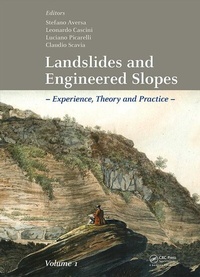
Landslides and Engineered Slopes. Experience, Theory and Practice
Proceedings of the 12th International Symposium on Landslides (Napoli, Italy, 12-19 June 2016)
Published on 6. June 2016
Book
2224 pages
978-1-138-02988-0 (ISBN)
Description
Landslides and Engineered Slopes. Experience, Theory and Practice contains the invited lectures and all papers presented at the 12th International Symposium on Landslides, (Naples, Italy, 12-19 June 2016). The book aims to emphasize the relationship between landslides and other natural hazards. Hence, three of the main sessions focus on Volcanic-induced landslides, Earthquake-induced landslides and Weather-induced landslides respectively, while the fourth main session deals with Human-induced landslides. Some papers presented in a special session devoted to "Subareal and submarine landslide processes and hazard" and in a "Young Session" complete the books.
Landslides and Engineered Slopes. Experience, Theory and Practice underlines the importance of the classic approach of modern science, which moves from experience to theory, as the basic instrument to study landslides. Experience is the key to understand the natural phenomena focusing on all the factors that play a major role. Theory is the instrument to manage the data provided by experience following a mathematical approach; this allows not only to clarify the nature and the deep causes of phenomena but mostly, to predict future and, if required, manage similar events. Practical benefits from the results of theory to protect people and man-made works.
Landslides and Engineered Slopes. Experience, Theory and Practice is useful to scientists and practitioners working in the areas of rock and soil mechanics, geotechnical engineering, engineering geology and geology.
Landslides and Engineered Slopes. Experience, Theory and Practice underlines the importance of the classic approach of modern science, which moves from experience to theory, as the basic instrument to study landslides. Experience is the key to understand the natural phenomena focusing on all the factors that play a major role. Theory is the instrument to manage the data provided by experience following a mathematical approach; this allows not only to clarify the nature and the deep causes of phenomena but mostly, to predict future and, if required, manage similar events. Practical benefits from the results of theory to protect people and man-made works.
Landslides and Engineered Slopes. Experience, Theory and Practice is useful to scientists and practitioners working in the areas of rock and soil mechanics, geotechnical engineering, engineering geology and geology.
More details
Language
English
Place of publication
London
United Kingdom
Publishing group
Taylor & Francis Ltd
Target group
College/higher education
Professional and scholarly
Postgraduate and Professional
Dimensions
Height: 246 mm
Width: 174 mm
Weight
4270 gr
ISBN-13
978-1-138-02988-0 (9781138029880)
Copyright in bibliographic data and cover images is held by Nielsen Book Services Limited or by the publishers or by their respective licensors: all rights reserved.
Schweitzer Classification
Other editions
Additional editions
Stefano Aversa | Leonardo Cascini | Luciano Picarelli
Landslides and Engineered Slopes. Experience, Theory and Practice
Proceedings of the 12th International Symposium on Landslides (Napoli, Italy, 12-19 June 2016)
E-Book
04/2018
CRC Press
€462.99
Available for download
Persons
Prof. Stefano Aversa is professor of Geotechnics at the University of Napoli Parthenope
Prof. Leonardo Cascini is professor of Geotechnics at the University of Salerno
Prof. Luciano Picarelli is professor of Geotechnics at the Second University of Napoli
Prof. Claudio Scavia is professor of Geotechnics at the Politecnico of Torino
Prof. Leonardo Cascini is professor of Geotechnics at the University of Salerno
Prof. Luciano Picarelli is professor of Geotechnics at the Second University of Napoli
Prof. Claudio Scavia is professor of Geotechnics at the Politecnico of Torino
Content
Introduction; I: The Human Child Examined: Soma, Psyche, Mind; Introduction; 1: The Psyche-Soma and the Mind; 2: Ill-Health; 3: Inter-Relationship of Body Disease and Psychological Disorder; 4: The Psycho-Somatic Field; II: The Emotional Development of the Human Being; Introduction; 1: Interpersonal Relationships; 2: The Concept of Health Using Instinct Theory; III: Establishment of Unit Status; Introduction; 1: The Depressive Position; 2: Development of the Theme of the Inner World; 3: Various Types of Psycho-Therapy Material; 4: Hypochondriacal Anxiety; IV: From Instinct Theory to EGO Theory; Introduction: Primitive Emotional Development; 1: Establishment of Relationship with External Reality; 2: Integration; 3: Dwelling of Psyche in Body; 4: The Earliest States; 5: Primary State of Being: Pre-Primitive Stages; 6: Chaos; 7: The Intellectual Function; 8: Withdrawal and Regression; 9: The Birth Experience; 10: Environment; 11: Psycho-Somatic Disorder Reconsidered