

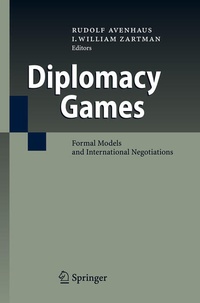
Diplomacy Games
Formal Models and International Negotiations
Published on 15. May 2007
Book
Hardback
XX, 350 pages
978-3-540-68303-2 (ISBN)
Description
In this book, leading experts in international negotiations present formal models of conflict resolution and international negotiations. Besides the description of different models and approaches, the book answers three questions: How can the abstract concepts and results of rational choice theorists be made more understandable and plausible to political and social scientists not trained to work with formal models? What can be done to encourage practitioners to use not only simple but also mathematically advanced approaches in their analysis of real world negotiation problems? How can practitioners (e.g., politicians and diplomats) become interested in, take into account, and apply formal models of their more important problems?
More details
Edition
2007 ed.
Language
English
Place of publication
Berlin
Germany
Publishing group
Springer Berlin
Target group
Professional and scholarly
Research
Illustrations
37 s/w Abbildungen
XX, 350 p. 37 illus.
Dimensions
Height: 241 mm
Width: 160 mm
Thickness: 25 mm
Weight
723 gr
ISBN-13
978-3-540-68303-2 (9783540683032)
DOI
10.1007/978-3-540-68304-9
Schweitzer Classification
Other editions
Additional editions
Book
10/2010
Springer
€160.49
Shipment within 7-9 days
E-Book
05/2007
1st Edition
Springer
€149.79
Available for download
Content
Introduction: Formal Models of, in, and for International Negotiations.- Introduction: Formal Models of, in, and for International Negotiations.- General Evaluations.- Game Models of Peace and War: Some Recent Themes.- Formal Models of Intervention: A Stocktaking and Analysis of the Implications for Policy.- Rationality of Choice versus Rationality of Knowledge.- Negotiation Models and Applications.- Models of International Negotiations.- A Dynamical Systems Model of Small Group Decision Making.- Formal Methods for Forecasting Outcomes of Negotiations on Interstate Conflicts.- Bridging Games and Diplomacy.- Greek-Turkish Territorial Waters Game.- Models in International Negotiations.- Some Lessons from the Use of the RAINS Model in International Negotiations.- Converting Competition to Collaboration: Creative Applications of Models in the Law of the Sea Negotiations.- Models for International Negotiations.- International Negotiations on Climate Change: A Noncooperative Game Analysis of the Kyoto Protocol.- The Graph Model for Conflict Resolution as a Tool for Negotiators.- A Minimax Procedure for Negotiating Multilateral Treaties.- "Adjusted Winner" (AW) Analyses of the 1978 Camp David Accords-Valuable Tools for Negotiators?.- Procedural Design for Conflict Resolution.- Conclusion: Lessons for Theory and Practice.