

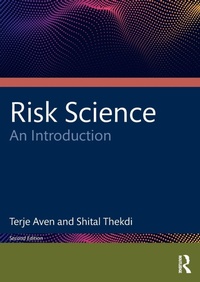
Risk Science
An Introduction
2nd Edition
Published on 12. September 2024
Book
Paperback/Softback
430 pages
978-1-032-79890-5 (ISBN)
Description
Risk science is becoming increasingly important as businesses, policymakers and public sector leaders are tasked with decision-making and investment using varying levels of knowledge and information. Risk Science: An Introduction explores the theory and practice of risk science, providing concepts and tools for understanding and acting under conditions of uncertainty.
The chapters in this book cover the fundamental concepts, principles, approaches, methods and models for how to understand, assess, communicate, manage and govern risk. These topics are presented and examined in a way which details how they relate, for example, how to characterize and communicate risk with particular emphasis on reflecting uncertainties; how to distinguish risk perception and professional risk judgments; how to assess risk and guide decision-makers, especially for cases involving large uncertainties and value differences; and how to integrate risk assessment with resilience-based strategies. The text provides a variety of examples and case studies that relate to highly visible and relevant issues facing risk academics, practitioners and non-risk leaders who must make risk-related decisions.
This revised and updated second edition features an entirely new chapter on the integrity and quality of risk studies, and dealing with misinformation in the context of risk. Presenting both the foundational and most recent advancements in the subject matter, this work particularly suits students of risk science courses at college and university level. The book also provides broader key reading for students and scholars in other domains, including business, engineering and public health.
The chapters in this book cover the fundamental concepts, principles, approaches, methods and models for how to understand, assess, communicate, manage and govern risk. These topics are presented and examined in a way which details how they relate, for example, how to characterize and communicate risk with particular emphasis on reflecting uncertainties; how to distinguish risk perception and professional risk judgments; how to assess risk and guide decision-makers, especially for cases involving large uncertainties and value differences; and how to integrate risk assessment with resilience-based strategies. The text provides a variety of examples and case studies that relate to highly visible and relevant issues facing risk academics, practitioners and non-risk leaders who must make risk-related decisions.
This revised and updated second edition features an entirely new chapter on the integrity and quality of risk studies, and dealing with misinformation in the context of risk. Presenting both the foundational and most recent advancements in the subject matter, this work particularly suits students of risk science courses at college and university level. The book also provides broader key reading for students and scholars in other domains, including business, engineering and public health.
More details
Edition
2nd edition
Language
English
Place of publication
London
United Kingdom
Publishing group
Taylor & Francis Ltd
Target group
College/higher education
Professional and scholarly
Postgraduate, Professional Practice & Development, and Undergraduate Advanced
Illustrations
38 s/w Abbildungen, 38 s/w Zeichnungen, 44 s/w Tabellen
44 Tables, black and white; 66 Line drawings, black and white; 66 Illustrations, black and white
Dimensions
Height: 246 mm
Width: 174 mm
Thickness: 24 mm
Weight
792 gr
ISBN-13
978-1-032-79890-5 (9781032798905)
Copyright in bibliographic data and cover images is held by Nielsen Book Services Limited or by the publishers or by their respective licensors: all rights reserved.
Schweitzer Classification
Other editions
Additional editions
E-Book
09/2024
2nd Edition
Routledge
€69.99
Available for download
Book
09/2024
2nd Edition
Routledge
€186.90
Shipment within 10-20 days
E-Book
09/2024
2nd Edition
Routledge
€69.99
Available for download
Previous edition
Book
09/2021
1st Edition
Routledge
€60.65
Article exhausted; check for reprint
Persons
Terje Aven is Professor of Risk Analysis and Risk Science at the University of Stavanger, Norway.
Shital Thekdi is Associate Professor of Analytics and Operations at the University of Richmond, USA.
Shital Thekdi is Associate Professor of Analytics and Operations at the University of Richmond, USA.
Content
1. Illustrative examples
2. What is risk?
3. Measuring and describing risk
4. Basic theory of risk assessment
5. More on risk assessment methods
6. Risk perception
7. Risk communication
8. Basic theory of risk management
9. Methods for balancing different concerns: Decision and cost-benefit analysis
10. General knowledge and experience
11. Integrity and quality of risk studies: Misinformation
12. Cases: Personal, organizational and public
2. What is risk?
3. Measuring and describing risk
4. Basic theory of risk assessment
5. More on risk assessment methods
6. Risk perception
7. Risk communication
8. Basic theory of risk management
9. Methods for balancing different concerns: Decision and cost-benefit analysis
10. General knowledge and experience
11. Integrity and quality of risk studies: Misinformation
12. Cases: Personal, organizational and public