

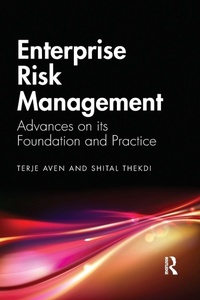
Enterprise Risk Management
Advances on its Foundation and Practice
1st Edition
Published on 2. August 2021
Book
Paperback/Softback
212 pages
978-1-032-08269-1 (ISBN)
Description
Enterprise Risk Management: Advances on its Foundation and Practice relates the fundamental enterprise risk management (ERM) concepts and current generic risk assessment and management principles that have been influential in redefining the risk field over the last decade. It defines ERM with a particular focus on understanding the nexus between risk, uncertainty, knowledge and performance.
The book argues that there is critical need for ERM concepts, principles and methods to adapt to the latest and most influential risk management developments, as there are several issues with outdated ERM theories and practices; problems include the inability to effectively and systematically balance both opportunity and downside performance, or relying too much on narrow probability-based perspectives for risk assessment and decision-making. It expands traditional loss-based risk principles into new and innovative performance-risk frameworks, and presents fundamental risk principles that have recently been developed by the Society for Risk Analysis (SRA). All relevant statistical and risk concepts are clearly explained and interpreted using minimal mathematical notation. The focus of the book is centered around ideas and principles, more than technicalities.
The book is primarily intended for risk professionals, researchers and graduate students in the fields of engineering and business, and should also be of interest to executive managers and policy makers with some background in quantitative methods such as statistics.
The book argues that there is critical need for ERM concepts, principles and methods to adapt to the latest and most influential risk management developments, as there are several issues with outdated ERM theories and practices; problems include the inability to effectively and systematically balance both opportunity and downside performance, or relying too much on narrow probability-based perspectives for risk assessment and decision-making. It expands traditional loss-based risk principles into new and innovative performance-risk frameworks, and presents fundamental risk principles that have recently been developed by the Society for Risk Analysis (SRA). All relevant statistical and risk concepts are clearly explained and interpreted using minimal mathematical notation. The focus of the book is centered around ideas and principles, more than technicalities.
The book is primarily intended for risk professionals, researchers and graduate students in the fields of engineering and business, and should also be of interest to executive managers and policy makers with some background in quantitative methods such as statistics.
More details
Language
English
Place of publication
London
United Kingdom
Publishing group
Taylor & Francis Ltd
Target group
Professional and scholarly
Professional Reference
Illustrations
13 s/w Abbildungen
13 Illustrations, black and white
Dimensions
Height: 234 mm
Width: 156 mm
Thickness: 12 mm
Weight
330 gr
ISBN-13
978-1-032-08269-1 (9781032082691)
Copyright in bibliographic data and cover images is held by Nielsen Book Services Limited or by the publishers or by their respective licensors: all rights reserved.
Schweitzer Classification
Other editions
Additional editions
Book
12/2019
1st Edition
Routledge
€78.00
Shipment within 10-20 days
E-Book
12/2019
1st Edition
Routledge
€67.49
Available for download
Persons
Terje Aven is Professor of Risk Analysis and Risk Management at the University of Stavanger, Norway. He has recently served as Chair of the European Safety and Reliability Association (ESRA) and as the President of Society for Risk Analysis (SRA) worldwide. He is Editor-in-Chief of the Journal of Risk and Reliability, and Associate Editor for Risk Analysis.
Shital Thekdi is Associate Professor of Management at the University of Richmond, USA.
Shital Thekdi is Associate Professor of Management at the University of Richmond, USA.
Content
1 Some illustrating examples 2 What is risk and enterprise risk? 3 Basic principles of ERM 4 Distinguishing between ERM and Task Risk Management (TRM) 5 Potential surprises and the unforeseen (black swans) 6 Integrating performance, risk and resilience-based thinking and methods 7 Balancing different concerns, by seeing beyond traditional cost-benefit types of analysis using expected values 8 Improving ERM practices: Practical challenges 9 Revisiting key examples