

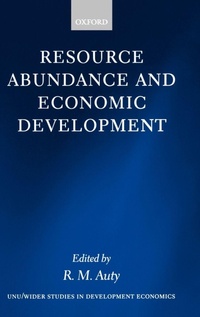
Resource Abundance and Economic Development
Published on 28. June 2001
Book
Hardback
356 pages
978-0-19-924688-5 (ISBN)
Description
Since the 1960s the per capita incomes of the resource-poor countries have grown significantly faster than those of the resource-abundant countries. In fact, in recent years economic growth has been inversely proportional to the share of natural resource rents in GDP, so that the small mineral-driven economies have performed least well and the oil-driven economies worst of all. Yet the mineral-driven resource-rich economies have high growth potential because the mineral exports boost their capacity to invest and to import.
"Resource Abundance and Economic Development" explains the disappointing performance of resource-abundant countries by extending the growth accounting framework to include natural and social capital. The resulting synthesis identifies two contrasting development trajectories: the competitive industrialization of the resource-poor countries and the staple trap of many resource-abundant countries. The resource-poor countries are less prone to policy failure than the resource-abundant countries because social pressures force the political state to align its interests with the majority poor and follow relatively prudent policies. Resource-abundant countries are more likely to engender political states in which vested interests vie to capture resource surpluses (rents) at the expense of policy coherence. A longer dependence on primary product exports also delays industrialization, heightens income inequality, and retards skill accumulation. Fears of 'Dutch disease' encourage efforts to force industrialization through trade policy to protect infant industry. The resulting slow-maturing manufacturing sector demands transfers from the primary sector that outstrip the natural resource rents and sap the competitiveness of the economy.
The chapters in this collection draw upon historical analysis and models to show that a growth collapse is not the inevitable outcome of resource abundance and that policy counts. Malaysia, a rare example of successful resource-abundant development, is contrasted with Ghana, Bolivia, Saudi Arabia, Mexico, and Argentina, which all experienced a growth collapse. The book also explores policies for reviving collapsed economies with reference to Costa Rica, South Africa, Russia and Central Asia. It demonstrates the importance of initial conditions to successful economic reform.
"Resource Abundance and Economic Development" explains the disappointing performance of resource-abundant countries by extending the growth accounting framework to include natural and social capital. The resulting synthesis identifies two contrasting development trajectories: the competitive industrialization of the resource-poor countries and the staple trap of many resource-abundant countries. The resource-poor countries are less prone to policy failure than the resource-abundant countries because social pressures force the political state to align its interests with the majority poor and follow relatively prudent policies. Resource-abundant countries are more likely to engender political states in which vested interests vie to capture resource surpluses (rents) at the expense of policy coherence. A longer dependence on primary product exports also delays industrialization, heightens income inequality, and retards skill accumulation. Fears of 'Dutch disease' encourage efforts to force industrialization through trade policy to protect infant industry. The resulting slow-maturing manufacturing sector demands transfers from the primary sector that outstrip the natural resource rents and sap the competitiveness of the economy.
The chapters in this collection draw upon historical analysis and models to show that a growth collapse is not the inevitable outcome of resource abundance and that policy counts. Malaysia, a rare example of successful resource-abundant development, is contrasted with Ghana, Bolivia, Saudi Arabia, Mexico, and Argentina, which all experienced a growth collapse. The book also explores policies for reviving collapsed economies with reference to Costa Rica, South Africa, Russia and Central Asia. It demonstrates the importance of initial conditions to successful economic reform.
Reviews / Votes
Not only does this book provide a foray into the cutting edge of cross-disciplinary research into the problems of natural resource-led development, but it is also specialized reading on how we might more broadly understand the connections between resources and conflict. This volume poses a serious challenge to theories of 'ecoviolence' that see scarcity of resources as a cause of socio-economic decay and violence. * Journal of Peace Research * ... the volume is to be welcomed, and will hopefully be widely read and cited. * Journal of International Development *More details
Series
Language
English
Place of publication
Oxford
United Kingdom
Target group
Professional and scholarly
Illustrations
numerous figures and tables
Dimensions
Height: 240 mm
Width: 161 mm
Thickness: 24 mm
Weight
705 gr
ISBN-13
978-0-19-924688-5 (9780199246885)
Copyright in bibliographic data and cover images is held by Nielsen Book Services Limited or by the publishers or by their respective licensors: all rights reserved.
Schweitzer Classification
Other editions
Additional editions
R. M. Auty
Resource Abundance and Economic Development
Book
10/2004
Oxford University Press
€136.40
Shipment within 15-20 days
Person
R. M. Auty is Professor of Economic Geography in the Department of Geography at Lancaster University.
Content
I. INTRODUCTION ; Introduction and Overview ; II. CRITICAL PARAMETERS IN RESOURCE-BASED DEVELOPMENT MODELS ; 2. Natural Resources, Capital Accumulation, Structural Change, and Welfare ; 3. The Sustainability of Extractive Economies ; 4. Natural Resources, Human Capital, and Growth ; 5. The Social Foundations of Poor Economic Growth in Resource-Rich Countries ; III. LONG-TERM PERSPECTIVE ON, AND MODELS OF, RESOURCE-BASED GROWTH ; 6. Natural Resources and Economic Development: The 1870-1914 Experience ; 7. Short-Run Models of Contrasting Natural Resource Endowments ; 8. Political Economy of Resource-Abundant States ; IV. DEVELOPMENT TRAJECTORIES OF RESOURCE-ABUNDANT COUNTRIES ; 9. Competitive Industrialization with Natural Resource Abundance: Malaysia ; 10. A Growth Collapse with Diffuse Resources: Ghana ; 11. A Growth Collapse with Point Resources: Bolivia ; 12. A Growth Collapse with High Rent Point Resources: Saudi Arabia ; 13. Large Resource-Abundant Countries Squander their Size Advantage: Mexico and Argentina ; V. LESSONS FOR POLICY REFORM ; 14. Reforming a Small Resource-Rich Developing Market Economy: Costa Rica ; 15. Growth, Capital Accumulation, and Economic Reform in South Africa ; 16. Reforming Resource-Abundance Transition Economies: Kazakhstan and Uzbekistan ; 17. Reforming a Large Resource-Abundant Transition Economy: Russia ; 18. A Nordic Perspective on Natural Resource Abundance ; VI. CONCLUSIONS ; 19. Conclusions: Resource Abundance, Growth Collapse, and Policy