

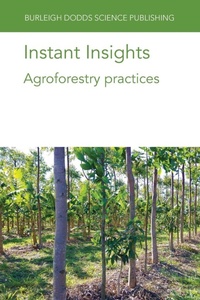
Instant Insights: Agroforestry Practices
Agroforestry practices
Published on 27. August 2024
Book
Paperback/Softback
156 pages
978-1-80146-989-0 (ISBN)
Description
This book features five peer-reviewed reviews on the implementation of agroforestry practices.
The first chapter reviews the use of integrated crop-livestock systems, with a focus on agroforestry systems. The chapter discusses the potential environmental and economic benefits of agroforestry systems, as well as their contribution to animal health and welfare.
The second chapter considers the plantation and management of temperate agroforestry systems which combine timber trees and herbaceous crops. The chapter covers choice of tree species, techniques of tree planting, plantation maintenance and approaches to tree pruning and thinning.
The third chapter provides an overview of the implementation of alley cropping in agroforestry systems. The chapter explores the economic and ecological benefits of alley cropping, as well as the challenges and major considerations of implementing these practices within North America.
The fourth chapter addresses the challenges and key issues in the sustainable production and use of willow as feedstock for biofuel production in northern temperate regions, including the issues of feedstock quality for biofuel use.
The final chapter explores the contribution of agroforestry to meet global strategies to increase biodiversity while sustainably increasing agricultural systems resource efficiency.
The first chapter reviews the use of integrated crop-livestock systems, with a focus on agroforestry systems. The chapter discusses the potential environmental and economic benefits of agroforestry systems, as well as their contribution to animal health and welfare.
The second chapter considers the plantation and management of temperate agroforestry systems which combine timber trees and herbaceous crops. The chapter covers choice of tree species, techniques of tree planting, plantation maintenance and approaches to tree pruning and thinning.
The third chapter provides an overview of the implementation of alley cropping in agroforestry systems. The chapter explores the economic and ecological benefits of alley cropping, as well as the challenges and major considerations of implementing these practices within North America.
The fourth chapter addresses the challenges and key issues in the sustainable production and use of willow as feedstock for biofuel production in northern temperate regions, including the issues of feedstock quality for biofuel use.
The final chapter explores the contribution of agroforestry to meet global strategies to increase biodiversity while sustainably increasing agricultural systems resource efficiency.
More details
Series
Language
English
Place of publication
Cambridge
United Kingdom
Target group
College/higher education
Professional and scholarly
Academic researchers in forestry and agricultural science; international and national government and research agencies promoting agroforestry in particular countries and regions
Product notice
Paperback (trade)
Illustrations
Color tables, photos and figures
Dimensions
Height: 229 mm
Width: 152 mm
Thickness: 10 mm
Weight
254 gr
ISBN-13
978-1-80146-989-0 (9781801469890)
DOI
10.19103/9781801469906
Copyright in bibliographic data and cover images is held by Nielsen Book Services Limited or by the publishers or by their respective licensors: all rights reserved.
Schweitzer Classification
Other editions
Additional editions
Various Authors | Alfredo J. Escribano | J. Ryschawy
Instant Insights: Agroforestry Practices
E-Book
08/2024
Burleigh Dodds Science Publishing Limited
€49.49
Available for download
Persons
Dr Lindsay Whistance is Senior Livestock Researcher at the Organic Research Centre in the UK. She is internationally known for her research on farm animal behaviour, health, welfare and nutrition in organic agriculture.
Dr Maria Rosa Mosquera-Losada is Distinguished Professor at the University of Santiago de Compostela, Spain. Professor Mosquera-Losada is President of the Spanish Agroforestry Association (AGFE) and a former President of the European Agroforestry Federation (EURAF). She is also Coordinator of the EU-funded Agroforestry Innovation Networks (AFINET) project, a Policy Work Package Leader for the EU project AGFORWARD (Agroforestry that will Advance Rural Development) and Data Knowledge Work Package Leader for the EU project EURAKNOS (Connecting Thematic Networks as Knowledge Reservoirs: towards a European Agricultural Knowledge Innovation Open Source System) and is also co-Chair of the Croplands Working Group of the Global Research Alliance and of the Global Alliance for Climate Smart Agriculture (FAO).
Professor Anastasia Pantera is Vice-President of the Department of Forestry and Natural Environment Management at the Agricultural University of Athens, Greece. Professor Pantera is an Associate Editor of Agroforestry Systems.
Dr Maria Rosa Mosquera-Losada is Distinguished Professor at the University of Santiago de Compostela, Spain. Professor Mosquera-Losada is President of the Spanish Agroforestry Association (AGFE) and a former President of the European Agroforestry Federation (EURAF). She is also Coordinator of the EU-funded Agroforestry Innovation Networks (AFINET) project, a Policy Work Package Leader for the EU project AGFORWARD (Agroforestry that will Advance Rural Development) and Data Knowledge Work Package Leader for the EU project EURAKNOS (Connecting Thematic Networks as Knowledge Reservoirs: towards a European Agricultural Knowledge Innovation Open Source System) and is also co-Chair of the Croplands Working Group of the Global Research Alliance and of the Global Alliance for Climate Smart Agriculture (FAO).
Professor Anastasia Pantera is Vice-President of the Department of Forestry and Natural Environment Management at the Agricultural University of Athens, Greece. Professor Pantera is an Associate Editor of Agroforestry Systems.
Content
Chapter 1 - Integrated crop/livestock systems with agroforestry to improve organic animal farming: A. J. Escribano, Nutrion Internacional, Spain; J. Ryschawy, University of Toulouse, France; and L. K. Whistance, The Organic Research Centre, UK;
1 Introduction
2 Types of ICLS
3 Environmental and economic benefits of ICLS
4 Agroforestry as an ICLS
5 Animals in agroforestry systems
6 Trees as a source of nutrition and medicine
7 Challenges in integrated livestock and forestry systems
8 Conclusion
9 Where to look for further information
10 References
Chapter taken from: Vaarst, M. & Roderick, S. (ed.), Improving organic animal farming, Burleigh Dodds Science Publishing, Cambridge, UK, 2019, (ISBN: 978 1 78676 180 4)
Chapter 2 - Tree planting and management in agroforestry: Lydie Dufour, INRA, France;
1 Introduction
2 Choice of tree species
3 Tree planting
4 Plantation maintenance
5 Tree pruning and thinning
6 Conclusion and future trends
7 Where to look for further information
8 References
Chapter taken from: Mosquera-Losada, M. R. and Prabhu, R. (ed.), Agroforestry for sustainable agriculture, Burleigh Dodds Science Publishing, Cambridge, UK, 2019, (ISBN: 978 1 78676 220 7)
Chapter 3 - Temperate alley cropping systems: Diomy S. Zamora, University of Minnesota, USA; Samuel C. Allen, New Mexico State University, USA; Kent G. Apostol, Independent Researcher and Editor, USA; Shibu Jose, University of Missouri, USA; and Gary Wyatt, University of Minnesota, USA;
1 Introduction
2 Potential of alley cropping
3 Design considerations
4 Functions/benefits of alley cropping
5 Competition for growth resources
6 Evaluating system performance: the case of the pecancotton alley cropping system
7 Future trends and conclusion
8 Where to look for further information
9 References
Chapter taken from: Mosquera-Losada, M. R. and Prabhu, R. (ed.), Agroforestry for sustainable agriculture, Burleigh Dodds Science Publishing, Cambridge, UK, 2019, (ISBN: 978 1 78676 220 7)
Chapter 4 - Sustainable production of willow for biofuel use: M. Weih, P.-A. Hansson, J. A. Ohlsson, M. Sandgren, A. Schnuerer and A.-C. Roennberg- Waestljung, Swedish University of Agricultural Sciences, Sweden;
1 Introduction
2 Feedstock quality for biofuel use
3 Feedstock productivity
4 Cropping security
5 Biodiversity
6 Nutrient uptake and use
7 Carbon accumulation and sequestration
8 Ecosystem services and environmental impact
9 Case study
10 Summary and future trends
11 Acknowledgements
12 Where to look for further information
13 References
Chapter taken from: Saffron, C. (ed.), Achieving carbon-negative bioenergy systems from plant materials, Burleigh Dodds Science Publishing, Cambridge, UK, 2020, (ISBN: 978 1 78676 252 8)
Chapter 5 - The importance of agroforestry systems in supporting biodiversity conservation and agricultural production: a European perspective: M. R. Mosquera-Losada, J. J. Santiago-Freijanes, A. Rigueiro-Rodriguez, F. J. Rodriguez-Rigueiro, D. Arias Martinez, A. Pantera and N. Ferreiro-Dominguez, University of Santiago de Compostela, Spain;
1 Introduction
2 The contribution of agroforestry to global biodiversity goals
3 Agroforestry and the protection of species and habitats
4 Agroforestry and the maintenance and restoration of ecosystems
5 Achieving more sustainable agriculture and forestry
6 Stopping the loss of global biodiversity
7 Future trends
8 Where to look for further information
9 Acknowledgements
10 References
Chapter taken from: Saffron, C. (ed.), Achieving carbon-negative bioenergy systems from plant materials, Burleigh Dodds Science Publishing, Cambridge, UK, 2020, (ISBN: 978 1 78676 252 8)
1 Introduction
2 Types of ICLS
3 Environmental and economic benefits of ICLS
4 Agroforestry as an ICLS
5 Animals in agroforestry systems
6 Trees as a source of nutrition and medicine
7 Challenges in integrated livestock and forestry systems
8 Conclusion
9 Where to look for further information
10 References
Chapter taken from: Vaarst, M. & Roderick, S. (ed.), Improving organic animal farming, Burleigh Dodds Science Publishing, Cambridge, UK, 2019, (ISBN: 978 1 78676 180 4)
Chapter 2 - Tree planting and management in agroforestry: Lydie Dufour, INRA, France;
1 Introduction
2 Choice of tree species
3 Tree planting
4 Plantation maintenance
5 Tree pruning and thinning
6 Conclusion and future trends
7 Where to look for further information
8 References
Chapter taken from: Mosquera-Losada, M. R. and Prabhu, R. (ed.), Agroforestry for sustainable agriculture, Burleigh Dodds Science Publishing, Cambridge, UK, 2019, (ISBN: 978 1 78676 220 7)
Chapter 3 - Temperate alley cropping systems: Diomy S. Zamora, University of Minnesota, USA; Samuel C. Allen, New Mexico State University, USA; Kent G. Apostol, Independent Researcher and Editor, USA; Shibu Jose, University of Missouri, USA; and Gary Wyatt, University of Minnesota, USA;
1 Introduction
2 Potential of alley cropping
3 Design considerations
4 Functions/benefits of alley cropping
5 Competition for growth resources
6 Evaluating system performance: the case of the pecancotton alley cropping system
7 Future trends and conclusion
8 Where to look for further information
9 References
Chapter taken from: Mosquera-Losada, M. R. and Prabhu, R. (ed.), Agroforestry for sustainable agriculture, Burleigh Dodds Science Publishing, Cambridge, UK, 2019, (ISBN: 978 1 78676 220 7)
Chapter 4 - Sustainable production of willow for biofuel use: M. Weih, P.-A. Hansson, J. A. Ohlsson, M. Sandgren, A. Schnuerer and A.-C. Roennberg- Waestljung, Swedish University of Agricultural Sciences, Sweden;
1 Introduction
2 Feedstock quality for biofuel use
3 Feedstock productivity
4 Cropping security
5 Biodiversity
6 Nutrient uptake and use
7 Carbon accumulation and sequestration
8 Ecosystem services and environmental impact
9 Case study
10 Summary and future trends
11 Acknowledgements
12 Where to look for further information
13 References
Chapter taken from: Saffron, C. (ed.), Achieving carbon-negative bioenergy systems from plant materials, Burleigh Dodds Science Publishing, Cambridge, UK, 2020, (ISBN: 978 1 78676 252 8)
Chapter 5 - The importance of agroforestry systems in supporting biodiversity conservation and agricultural production: a European perspective: M. R. Mosquera-Losada, J. J. Santiago-Freijanes, A. Rigueiro-Rodriguez, F. J. Rodriguez-Rigueiro, D. Arias Martinez, A. Pantera and N. Ferreiro-Dominguez, University of Santiago de Compostela, Spain;
1 Introduction
2 The contribution of agroforestry to global biodiversity goals
3 Agroforestry and the protection of species and habitats
4 Agroforestry and the maintenance and restoration of ecosystems
5 Achieving more sustainable agriculture and forestry
6 Stopping the loss of global biodiversity
7 Future trends
8 Where to look for further information
9 Acknowledgements
10 References
Chapter taken from: Saffron, C. (ed.), Achieving carbon-negative bioenergy systems from plant materials, Burleigh Dodds Science Publishing, Cambridge, UK, 2020, (ISBN: 978 1 78676 252 8)