

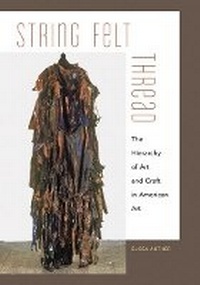
String, Felt, Thread
The Hierarchy of Art and Craft in American Art
Published on 1. December 2009
Book
Paperback/Softback
280 pages
978-0-8166-5609-7 (ISBN)
Description
String, Felt, Thread presents an unconventional history of the American art world, chronicling the advance of thread, rope, string, felt, and fabric from the "low" world of craft to the "high" world of art in the 1960s and 1970s and the emergence today of a craft counterculture. In this full-color illustrated volume, Elissa Auther discusses the work of American artists using fiber, considering provocative questions of material, process, and intention that bridge the art-craft divide.
Drawn to the aesthetic possibilities and symbolic power of fiber, the artists whose work is explored here-Eva Hesse, Robert Morris, Claire Zeisler, Miriam Schapiro, Faith Ringgold, and others-experimented with materials that previously had been dismissed for their associations with the merely decorative, with "arts and crafts," and with "women's work." In analyzing this shift and these exceptional artists' works, Auther engages far-reaching debates in the art world: What accounts for the distinction between art and craft? Who assigns value to these categories, and who polices the boundaries distinguishing them?
String, Felt, Thread not only illuminates the centrality of fiber to contemporary artistic practice but also uncovers the social dynamics-including the roles of race and gender-that determine how art has historically been defined and valued.
Drawn to the aesthetic possibilities and symbolic power of fiber, the artists whose work is explored here-Eva Hesse, Robert Morris, Claire Zeisler, Miriam Schapiro, Faith Ringgold, and others-experimented with materials that previously had been dismissed for their associations with the merely decorative, with "arts and crafts," and with "women's work." In analyzing this shift and these exceptional artists' works, Auther engages far-reaching debates in the art world: What accounts for the distinction between art and craft? Who assigns value to these categories, and who polices the boundaries distinguishing them?
String, Felt, Thread not only illuminates the centrality of fiber to contemporary artistic practice but also uncovers the social dynamics-including the roles of race and gender-that determine how art has historically been defined and valued.
More details
Language
English
Place of publication
Minnesota
United States
Dimensions
Height: 254 mm
Width: 178 mm
Thickness: 18 mm
ISBN-13
978-0-8166-5609-7 (9780816656097)
Copyright in bibliographic data and cover images is held by Nielsen Book Services Limited or by the publishers or by their respective licensors: all rights reserved.
Schweitzer Classification
Person
Elissa Auther is associate professor of contemporary art at the University of Colorado, Colorado Springs.
Content
List of Illustrations
Introduction: The Hierarchy of Art and Craft
1. Fiber Art and the Struggle for Legitimacy
The Category "Fiber Art"
Cultural Definitions of Textiles and Bauhaus Weavers
Fiber and Women's Work
Fiber Art, the Craft Revival of the 1960s and 1970s, and Popular Craft
The Critical Reception of Fiber Art in the 1960s and 1970s
Mildred Constantine and the Battle for Fiber Art
2. Postminimalism, Materiality, and Process Art
Felt in the Work of Robert Morris
The Critical Reception of the Felts
String, Rope, and Cord in the Work of Eva Hesse
The Reception of Hesse's Work in Fiber
Fiber, Tactility, and the Boundary Between Art and "Non-Art"
3. The Feminist Politicization of the Art/Craft Divide
The Promises and Problems of the Feminist Critique of the Hierarchy of Art and Craft
Faith Ringgold: "A painter who works in the quilt medium"
Miriam Schapiro: "The Quiet Revolution"
Introduction: The Hierarchy of Art and Craft
1. Fiber Art and the Struggle for Legitimacy
The Category "Fiber Art"
Cultural Definitions of Textiles and Bauhaus Weavers
Fiber and Women's Work
Fiber Art, the Craft Revival of the 1960s and 1970s, and Popular Craft
The Critical Reception of Fiber Art in the 1960s and 1970s
Mildred Constantine and the Battle for Fiber Art
2. Postminimalism, Materiality, and Process Art
Felt in the Work of Robert Morris
The Critical Reception of the Felts
String, Rope, and Cord in the Work of Eva Hesse
The Reception of Hesse's Work in Fiber
Fiber, Tactility, and the Boundary Between Art and "Non-Art"
3. The Feminist Politicization of the Art/Craft Divide
The Promises and Problems of the Feminist Critique of the Hierarchy of Art and Craft
Faith Ringgold: "A painter who works in the quilt medium"
Miriam Schapiro: "The Quiet Revolution"