

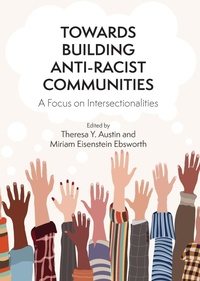
Towards Building Anti-Racist Communities
A Focus on Intersectionalities
Published on 12. May 2026
Book
Hardback
364 pages
978-1-78892-128-2 (ISBN)
Description
Invites readers to undertake active leadership addressing equity in their own contexts.
Aimed at educators and community members seeking to build an anti-racist society, this book examines lived teaching and researching experiences which illustrate and challenge the inequities that arise in classrooms with diverse student bodies. The authors draw on the constructs of intersectionality and complexity to examine complex issues of race, language variety, religious practice, educational background, social status, family relationships, institutional and local context and historical memory.
Through honest and transparent reflection on actual experiences the book invites readers to bravely acknowledge the political and practical constraints they face, critically assess their own practice, and from this develop authentic pedagogies and relevant practical actions to better serve the communities within which they live and work. Readers seeking to build an anti-racist society will benefit from these inspirational narratives of courage in the face of inequities in daily life, classrooms and communities.
Aimed at educators and community members seeking to build an anti-racist society, this book examines lived teaching and researching experiences which illustrate and challenge the inequities that arise in classrooms with diverse student bodies. The authors draw on the constructs of intersectionality and complexity to examine complex issues of race, language variety, religious practice, educational background, social status, family relationships, institutional and local context and historical memory.
Through honest and transparent reflection on actual experiences the book invites readers to bravely acknowledge the political and practical constraints they face, critically assess their own practice, and from this develop authentic pedagogies and relevant practical actions to better serve the communities within which they live and work. Readers seeking to build an anti-racist society will benefit from these inspirational narratives of courage in the face of inequities in daily life, classrooms and communities.
Reviews / Votes
This exciting new edited volume explores how teachers, teacher educators, and researchers can build anti-racist communities by centering intersectional identities. Drawing from both US and global contexts, chapters invite authors to engage in critical reflection, dialogue, and concrete, sustained action toward more just classrooms, institutions, and coalition-based community partnerships. * Kendall A. King, University of Minnesota, USA * Through engagement with varied settings, methodologies, and approaches, each chapter of this book offers an opportunity for growth, discovery, and courage. Uniquely organized across within-group, cross-group, multilingual, and institutional perspectives, the volume provides educators and researchers with tangible pathways for sustained anti-racist collaboration and educational equity. * Maria Cioe-Pena, University of Pennsylvania, USA * Towards Building Anti-Racist Communities invites readers into honest, often uncomfortable conversations about race, language, power, and belonging. Through richly grounded chapters, contributors share lived experiences and pedagogical practices that show how anti-racist work is enacted, sustained, and reimagined across classrooms, institutions, and communities. * Nelson Flores, University of Pennsylvania, USA * This volume demonstrates how anti-racist communities are built when we honor differences, confront power, and act together. Through an intersectional lens, the chapters in this collection invite us to listen deeply and repair harm across identities. This is a timely book that reminds us that justice grows where courage meets care, solidarity replaces silence, and belonging becomes a daily, collective responsibility through sustained learning, accountability, and transformative love. * Fernando Naiditch, Montclair State University, USA *More details
Language
English
Place of publication
Bristol
United Kingdom
Target group
College/higher education
Dimensions
Height: 250 mm
Width: 180 mm
Thickness: 26 mm
Weight
896 gr
ISBN-13
978-1-78892-128-2 (9781788921282)
Copyright in bibliographic data and cover images is held by Nielsen Book Services Limited or by the publishers or by their respective licensors: all rights reserved.
Schweitzer Classification
Other editions
Additional editions
Theresa Y. Austin | Miriam Eisenstein Ebsworth
Towards Building Anti-Racist Communities
A Focus on Intersectionalities
Book
05/2026
Multilingual Matters
€70.90
Shipment within 3-4 weeks
Persons
Theresa Y. Austin is a Professor in the College of Education, University of Massachusetts, Amherst, USA. She is author of Engaging with Ethics in Multilingual Learning Communities (with H. Celibi Celikkran, 2025, Mouton De Gruyter).
Miriam Eisenstein Ebsworth is an Associate Professor in the Department of Teaching and Learning, New York University-Steinhardt, USA. She is co-editor of Language Maintenance, Revival and Shift in the Sociology of Religion (with R. Pandharipande and M. David, 2020, Multilingual Matters).
Miriam Eisenstein Ebsworth is an Associate Professor in the Department of Teaching and Learning, New York University-Steinhardt, USA. She is co-editor of Language Maintenance, Revival and Shift in the Sociology of Religion (with R. Pandharipande and M. David, 2020, Multilingual Matters).
Content
Contributors
Acknowledgments
Preface
Part 1: Within-Group Perspectives
Chapter 1. Shelton K. Johnson and John E. Petrovic: Discussing Race and White Emotionality: Teachers, Learners and Pedagogy
Chapter 2. Karen Julien and Lyn Trudeau: Balancing Emotional Safety and Brave Accountable Spaces to Discuss Hard Truths about Race and Inclusion in Higher Education Classrooms
Chapter 3. Darold Harmon Joseph, Chris Lanterman, Catharyn C. Shelton, Christine K. Lemley, Jennie DeGroat, Alma Montemayor-Sandigo, James K. Ingram and Hoda Harati: Where Are We From?: Drawing on 'Peoplehood' to Humanize Higher Education Anti-Racist Work
Chapter 4. Yin Lam Lee-Johnson, Katherine O'Connor and Jimmy Fuller: Subversive Power of Intersectionality: Counterstory Analysis of Biracial and Multiracial Microaggressions among School-Age Learners
Chapter 5. Laurie Hahn Ganser: Translanguaging Pedagogies in the Anti-Racist Classroom
Part 2: Examining Perspectives across Groups
Chapter 6. Gertrude Tinker Sachs, Rihab Alsulami, Tonya DeGeorge, Brooks Salter, Cheryll Thompson-Smith, Ethan Trinh and Sterline Caldwell: Coming to Consciousness in a Teacher Education Doctoral Course through Paired Critical Curriculum Development
Chapter 7. Luis E. Poza, Rebeca Burciaga, Marcos Pizarro, Heather Lattimer, Saili Kulkarni, Sudha Krishnan, Kyoung Mi Choi, Robert Marx, Marcella McCollum and Marisol Quevedo: Emancipatory Education as Praxis
Chapter 8. Atiya McGhee, Masumi Hayashi-Smith and Brett Collins: Race Affinity Spaces: Complexities for Self-Identification
Chapter 9. Miriam Eisenstein Ebsworth and Timothy John Ebsworth: A Reflexive Study of a Teacher and Teacher Educator: Addressing Conflicts of Identity, Language, Values and Race
Part 3: Examining Multilingual Multiracial Issues
Chapter 10. Kristin A. Sinclair and Sabrina Wesley-Nero: 'If Not Me, Who?': Working toward Anti-Racism through Race-Based Affinity Groups for Future Education Professionals
Chapter 11. Aida Nevarez-La Torre and Xueyi Luo: Intersectionality of Language, Race and Poverty in Education: Urban Teachers' Perspectives
Chapter 12. Haidy G. Diaz: Understanding the Differences in Latinx Communities to Better Understand Intragroup Culture
Chapter 13. Sayonara Tomoum and Theresa Austin: What, Me a Racist? Impact of (Mis)identification in Complex Interracial Interactions in Higher Education
Part 4: Institutional/Community Perspectives
Chapter 14. Samina Hadi-Tabassum: Building Black and Brown Coalitions
Chapter 15. Kristen L. White, Laura M. Kennedy and Briana L. Bancroft: Using Children's Literature to Facilitate Anti-Racist Pedagogy: An Interdisciplinary, Rural-Based Collaboration
Chapter 16. Shelley Wong, Dawn Hathaway, Sujin Kim, Nader Ayish, Anita Bright, R. V. Pierre Rodgers and Anwar Hussein-Abdel Razeq: An Anti-Racist Faculty Book Club: Multi-Voiced Dialogues for Self-Reflection and Decolonizing Teacher Education
Chapter 17. Stella L. Smith, Kristin D. Medlin, Lauren A. Wendling and Katie A. Evans: Infusing Anti-Racism into Community Engagement: A Community Dialogue on Institutions of Higher Education
Chapter 18. Lauren Mark: Approaching Anti-Racism through Intersectionality, Reciprocity and the Bittersweetness of Radical Listening
Index
Acknowledgments
Preface
Part 1: Within-Group Perspectives
Chapter 1. Shelton K. Johnson and John E. Petrovic: Discussing Race and White Emotionality: Teachers, Learners and Pedagogy
Chapter 2. Karen Julien and Lyn Trudeau: Balancing Emotional Safety and Brave Accountable Spaces to Discuss Hard Truths about Race and Inclusion in Higher Education Classrooms
Chapter 3. Darold Harmon Joseph, Chris Lanterman, Catharyn C. Shelton, Christine K. Lemley, Jennie DeGroat, Alma Montemayor-Sandigo, James K. Ingram and Hoda Harati: Where Are We From?: Drawing on 'Peoplehood' to Humanize Higher Education Anti-Racist Work
Chapter 4. Yin Lam Lee-Johnson, Katherine O'Connor and Jimmy Fuller: Subversive Power of Intersectionality: Counterstory Analysis of Biracial and Multiracial Microaggressions among School-Age Learners
Chapter 5. Laurie Hahn Ganser: Translanguaging Pedagogies in the Anti-Racist Classroom
Part 2: Examining Perspectives across Groups
Chapter 6. Gertrude Tinker Sachs, Rihab Alsulami, Tonya DeGeorge, Brooks Salter, Cheryll Thompson-Smith, Ethan Trinh and Sterline Caldwell: Coming to Consciousness in a Teacher Education Doctoral Course through Paired Critical Curriculum Development
Chapter 7. Luis E. Poza, Rebeca Burciaga, Marcos Pizarro, Heather Lattimer, Saili Kulkarni, Sudha Krishnan, Kyoung Mi Choi, Robert Marx, Marcella McCollum and Marisol Quevedo: Emancipatory Education as Praxis
Chapter 8. Atiya McGhee, Masumi Hayashi-Smith and Brett Collins: Race Affinity Spaces: Complexities for Self-Identification
Chapter 9. Miriam Eisenstein Ebsworth and Timothy John Ebsworth: A Reflexive Study of a Teacher and Teacher Educator: Addressing Conflicts of Identity, Language, Values and Race
Part 3: Examining Multilingual Multiracial Issues
Chapter 10. Kristin A. Sinclair and Sabrina Wesley-Nero: 'If Not Me, Who?': Working toward Anti-Racism through Race-Based Affinity Groups for Future Education Professionals
Chapter 11. Aida Nevarez-La Torre and Xueyi Luo: Intersectionality of Language, Race and Poverty in Education: Urban Teachers' Perspectives
Chapter 12. Haidy G. Diaz: Understanding the Differences in Latinx Communities to Better Understand Intragroup Culture
Chapter 13. Sayonara Tomoum and Theresa Austin: What, Me a Racist? Impact of (Mis)identification in Complex Interracial Interactions in Higher Education
Part 4: Institutional/Community Perspectives
Chapter 14. Samina Hadi-Tabassum: Building Black and Brown Coalitions
Chapter 15. Kristen L. White, Laura M. Kennedy and Briana L. Bancroft: Using Children's Literature to Facilitate Anti-Racist Pedagogy: An Interdisciplinary, Rural-Based Collaboration
Chapter 16. Shelley Wong, Dawn Hathaway, Sujin Kim, Nader Ayish, Anita Bright, R. V. Pierre Rodgers and Anwar Hussein-Abdel Razeq: An Anti-Racist Faculty Book Club: Multi-Voiced Dialogues for Self-Reflection and Decolonizing Teacher Education
Chapter 17. Stella L. Smith, Kristin D. Medlin, Lauren A. Wendling and Katie A. Evans: Infusing Anti-Racism into Community Engagement: A Community Dialogue on Institutions of Higher Education
Chapter 18. Lauren Mark: Approaching Anti-Racism through Intersectionality, Reciprocity and the Bittersweetness of Radical Listening
Index