

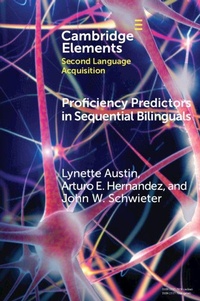
Proficiency Predictors in Sequential Bilinguals
The Proficiency Puzzle
Published on 11. April 2019
Book
Paperback/Softback
96 pages
978-1-108-72524-8 (ISBN)
Description
This Element provides an overview of research considering variables deemed to impact bilingual language acquisition, and highlights research outcomes from a variety of disciplines. An exploratory study takes into account these variables and examines the language acquisition of adult Spanish-English bilinguals across a range of domains in their two languages. The results demonstrate that the highly interactive nature of bilingual speakers' languages is in line with a holistic view of the dynamic, interdependent nature of bilingualism as described by usage-based theories and dynamic systems theories, and by the conceptualization of bilingual language from a Dynamic Interactive Processing Perspective.
More details
Series
Language
English
Place of publication
Cambridge
United Kingdom
Target group
Professional and scholarly
College/higher education
Product notice
Paperback (trade)
Illustrations
Worked examples or Exercises; 16 Tables, unspecified; 1 Line drawings, unspecified
Dimensions
Height: 229 mm
Width: 152 mm
Thickness: 6 mm
Weight
153 gr
ISBN-13
978-1-108-72524-8 (9781108725248)
Copyright in bibliographic data and cover images is held by Nielsen Book Services Limited or by the publishers or by their respective licensors: all rights reserved.
Schweitzer Classification
Other editions
Additional editions
Lynette Austin | Arturo E. Hernandez | John W. Schwieter
Proficiency Predictors in Sequential Bilinguals
The Proficiency Puzzle
E-Book
07/2019
Cambridge University Press
€15.49
Available for download
E-Book
04/2019
Cambridge University Press
€14.49
Available for download
Persons
Content
1. What are the key concepts?; 2. What are the main branches of research?; 3. What are the key readings?; 4. What are the new avenues for research?; 5. What are the implications for SLA, bilingualism, and pedagody?; 6. Conclusion: moving away from a deficiency view of bilingual language skills.