

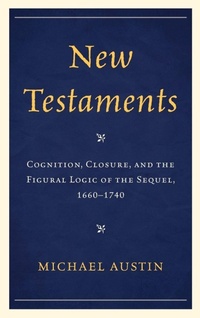
New Testaments
Cognition, Closure, and the Figural Logic of the Sequel, 1660-1740
Published on 17. November 2011
Book
Hardback
180 pages
978-1-61149-364-1 (ISBN)
Description
In the seventeenth and eighteenth centuries, popular works of literature attracted-as they attract today-sequels, prequels, franchises, continuations, and parodies. Sequels of all kinds demonstrate the economic realities of the literary marketplace. This represents something fundamental about the way human beings process narrative information. We crave narrative closure, but we also resist its finality, making such closure both inevitable and inadequate in human narratives. Many cultures incorporate this fundamental ambiguity towards closure in the mythic frameworks that fuel their narrative imaginations. New Testaments: Cognition, Closure and the Figural Logic of the Sequel, 1660-1740 examines both the inevitability and the inadequacy of closure in the sequels to four major works of literature written in England between 1660 and 1740: Paradise Lost, The Pilgrim's Progress, Robinson Crusoe, and Pamela. Each of these works spawned sequels, which-while often different from the original works-connected themselves through rhetorical strategies that can be loosely defined as figural. Such strategies came directly from the culture's two dominant religious narratives: the Old and New Testaments of the Christian Bible-two vastly dissimilar works seen universally as complementary parts of a unified and coherent narrative.
More details
Language
English
Place of publication
United States
Publishing group
Bloomsbury Publishing Plc
Target group
College/higher education
Dimensions
Height: 235 mm
Width: 157 mm
Thickness: 14 mm
Weight
420 gr
ISBN-13
978-1-61149-364-1 (9781611493641)
Copyright in bibliographic data and cover images is held by Nielsen Book Services Limited or by the publishers or by their respective licensors: all rights reserved.
Schweitzer Classification
Other editions
Additional editions
E-Book
11/2011
1st Edition
University of Delaware Press
€90.99
Available for download
E-Book
11/2011
1st Edition
University of Delaware Press
€90.99
Available for download
Person
Michael Austin is provost, vice president for Academic Affairs, and professor of English at Newman University in Wichita, Kansas.
Content
Acknowledgments
Introduction
Chapter 1: Narrative Closure as a Cognitive Problem
Chapter 2: God's Sequel
Chapter 3: "His Great Duel, Not of Arms": Davidic Typologyand Rhetorical Combat in Paradise Regained
Chapter 4: The Figural Logic of the Sequel and the Unity of The Pilgrim's Progress
Chapter 5: "Jesting with the Truth": Figura, Trace, and theBoundaries of Fiction in Robinson Crusoe and its Sequels
Chapter 6: Everybody's Story: Pamela as Type
Conclusion
End Notes
Works Cited
Introduction
Chapter 1: Narrative Closure as a Cognitive Problem
Chapter 2: God's Sequel
Chapter 3: "His Great Duel, Not of Arms": Davidic Typologyand Rhetorical Combat in Paradise Regained
Chapter 4: The Figural Logic of the Sequel and the Unity of The Pilgrim's Progress
Chapter 5: "Jesting with the Truth": Figura, Trace, and theBoundaries of Fiction in Robinson Crusoe and its Sequels
Chapter 6: Everybody's Story: Pamela as Type
Conclusion
End Notes
Works Cited