

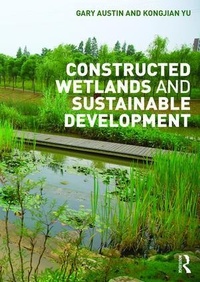
Constructed Wetlands and Sustainable Development
1st Edition
Published on 26. August 2016
Book
Paperback/Softback
302 pages
978-1-138-90899-4 (ISBN)
Description
This book explains how with careful planning and design, the functions and performance of constructed wetlands can provide a huge range of benefits to humans and the environment. It documents the current designs and specifications for free water surface wetlands, horizontal and vertical subsurface flow wetlands, hybrid wetlands and bio retention basins; and explores how to plan, engineer, design and monitor these natural systems.
Sections address resource management (landscape planning), technical issues (environmental engineering and botany), recreation and physical design (landscape architecture), and biological systems (ecology). Site and municipal scale strategies for flood management, storm-water treatment and green infrastructure are illustrated with case studies from the USA, Europe and China, which show how these principles have been put into practice.
Written for upper level students and practitioners, this highly illustrated book provides designers with the tools they need to ensure constructed wetlands are sustainably created and well manage
Sections address resource management (landscape planning), technical issues (environmental engineering and botany), recreation and physical design (landscape architecture), and biological systems (ecology). Site and municipal scale strategies for flood management, storm-water treatment and green infrastructure are illustrated with case studies from the USA, Europe and China, which show how these principles have been put into practice.
Written for upper level students and practitioners, this highly illustrated book provides designers with the tools they need to ensure constructed wetlands are sustainably created and well manage
Reviews / Votes
'What do you need to know about constructed wetlands? It's probably here. The authors cover benefits, design, plantings, ecology, and more. With a target audience of upper-level students and practitioners, this extensively illustrated book does have a tendency to get into the weeds of the topic (Sample sentence: "Swans, geese, many species of ducks, and king rail eat the plant's seeds and tubers, while muskrat, beaver, and porcupine eat the tubers."). But they're wetland-friendly weeds.'Landscape Architecture Magazine
More details
Language
English
Place of publication
London
United Kingdom
Publishing group
Taylor & Francis Ltd
Target group
College/higher education
Professional and scholarly
Postgraduate, Professional, and Professional Practice & Development
Illustrations
251 Farbfotos bzw. farbige Rasterbilder, 17 farbige Zeichnungen, 37 farbige Tabellen
37 Tables, color; 17 Line drawings, color; 251 Halftones, color
Dimensions
Height: 177 mm
Width: 246 mm
Thickness: 19 mm
Weight
684 gr
ISBN-13
978-1-138-90899-4 (9781138908994)
Copyright in bibliographic data and cover images is held by Nielsen Book Services Limited or by the publishers or by their respective licensors: all rights reserved.
Schweitzer Classification
Other editions
Additional editions
Gary Austin | Kongjian Yu
Constructed Wetlands and Sustainable Development
Book
08/2016
1st Edition
Routledge
€282.25
Shipment within 10-20 days
Gary Austin | Kongjian Yu
Constructed Wetlands and Sustainable Development
E-Book
08/2016
1st Edition
Routledge
€94.99
Available for download
Gary Austin | Kongjian Yu
Constructed Wetlands and Sustainable Development
E-Book
08/2016
Routledge
€94.99
Available for download
Persons
Gary Austin is the author of Green Infrastructure for Landscape Planning (Routledge 2014). He is a landscape architect who studied under John Lyle and taught at the California State Polytechnic University, Pomona, USA. He has practised in the public and private sectors and has taught landscape architecture at the University of Washington, USA, and the University of Idaho, USA. His teaching and research focus on community revitalization, urban biological diversity and treatment of wastewater and stormwater for water quality improvement.
Kongjian Yu is co-author of the influential book The Art of Survival (2007). He is Visiting Professor of Landscape Architecture at Harvard University, USA, and the principal of Turenscape, a large landscape architecture firm in China. The many constructed and monitored wetland projects that his firm has designed appear in this book. He is also Professor and Dean at Beijing University, China.
Kongjian Yu is co-author of the influential book The Art of Survival (2007). He is Visiting Professor of Landscape Architecture at Harvard University, USA, and the principal of Turenscape, a large landscape architecture firm in China. The many constructed and monitored wetland projects that his firm has designed appear in this book. He is also Professor and Dean at Beijing University, China.
Content
1. Water and Sustainable Urban Design, 2. Wastewater Characteristics, 3. Free Water Surface Constructed Wetlands, 4. Horizontal Subsurface Flow Treatment Wetlands, 5. Vertical Subsurface Flow Treatment Wetlands, 6. Hybrid Constructed Wetlands, 7. Plants in Constructed Wetlands, 8. Riparian Wetlands, 9. Stormwater Management and Sustainable Development, 10. Increasing the Sustainability of Agriculture, 11. Treatment of Industrial Effluent in Constructed Wetlands, Appendix