

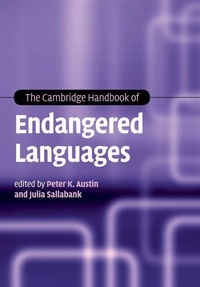
The Cambridge Handbook of Endangered Languages
Published on 1. October 2015
Book
Paperback/Softback
580 pages
978-1-107-55244-9 (ISBN)
Description
It is generally agreed that about 7,000 languages are spoken across the world today and at least half may no longer be spoken by the end of this century. This state-of-the-art Handbook examines the reasons behind this dramatic loss of linguistic diversity, why it matters, and what can be done to document and support endangered languages. The volume is relevant not only to researchers in language endangerment, language shift and language death, but to anyone interested in the languages and cultures of the world. It is accessible both to specialists and non-specialists: researchers will find cutting-edge contributions from acknowledged experts in their fields, while students, activists and other interested readers will find a wealth of readable yet thorough and up-to-date information.
Reviews / Votes
'This handbook is an excellent assemblage of facts and ideas about the fast declining world's linguistic diversity. It is uniquely resourceful and comprehensive.' Herman M. Batibo, Former President, World Congress of African Linguistics 'This splendid handbook is an authoritative resource for those seeking to respond responsibly to ongoing loss of the world's languages.' Nancy H. Hornberger, University of Pennsylvania 'The Cambridge Handbook of Endangered Languages is without a doubt a welcome contribution to the field of linguistics and language preservation. One of the key aspects of preserving minority languages is public engagement, so the production of easy to read and highly accessible texts such as this is an important step in the process. It is authoritative and comprehensive, providing both facts and current academic theory to great and provocative effect.' Zoe Bartliff, LinguistList (www.linguistlist.org)More details
Series
Language
English
Place of publication
Cambridge
United Kingdom
Target group
Professional and scholarly
Product notice
Paperback (trade)
Illustrations
10 Tables, black and white; 7 Halftones, unspecified; 9 Line drawings, unspecified
Dimensions
Height: 244 mm
Width: 170 mm
Thickness: 32 mm
Weight
987 gr
ISBN-13
978-1-107-55244-9 (9781107552449)
Copyright in bibliographic data and cover images is held by Nielsen Book Services Limited or by the publishers or by their respective licensors: all rights reserved.
Schweitzer Classification
Other editions
Additional editions
Peter K. Austin | Julia Sallabank
The Cambridge Handbook of Endangered Languages
Book
03/2011
Cambridge University Press
€185.50
Shipment within 15-20 days
Persons
Peter K. Austin is Maerit Rausing Chair in Field Linguistics and Director of the Endangered Languages Academic Programme at the School of Oriental and African Studies, University of London. Julia Sallabank is Lecturer in Language Support and Revitalisation in the Endangered Languages Academic Programme at the School of Oriental and African Studies, University of London.
Content
1. Introduction Peter K. Austin and Julia Sallabank; Part I. Endangered Languages: 2. Language ecology and endangerment Lenore Grenoble; 3. Speakers and communities Colette Grinevald and Michel Bert; 4. Survey of endangered language situations around the world David Bradley; 5. Language contact and change in endangered languages Carmel O'Shannessy; 6. Structural aspects of language endangerment Naomi Palosaari and Lyle Campbell; 7. Language and culture Lev Michael; 8. Language and society Bernard Spolsky; Part II. Language Documentation: 9. Language documentation Tony Woodbury; 10. Speakers and language documentation Lise Dobrin and Josh Berson; 11. Data and language documentation Jeff Good; 12. Archiving and language documentation Lisa Conathan; 13. Digital archiving David Nathan; Part III. Responses: 14. Language policy for endangered languages Julia Sallabank; 15. Revitalisation of endangered languages Leanne Hinton; 16. Orthography development Friederike Luepke; 17. Lexicography in endangered language communities Ulrike Mosel; 18. Language curriculum design and evaluation for endangered languages Serafin Coronel-Molina and Teresa McCarty; 19. The role of information technology in supporting minority and endangered languages Gary Holton; Part IV. Challenges: 20. Endangered languages and economic development Wayne Harbert; 21. Researcher training and capacity development in language documentation Anthony Jukes; 22. New roles for endangered languages Mairead Moriarty; 23. Planning a language documentation project Claire Bowern.