

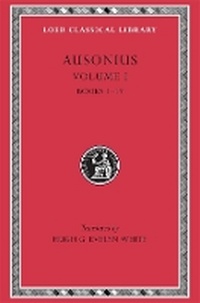
Ausonius, Volume I
Books 1-17
Published on 1. January 1919
Book
Hardback
448 pages
978-0-674-99107-1 (ISBN)
Description
A master of the jeweled style.
Ausonius (Decimus Magnus), ca. AD 310-ca. 395, a doctor's son, was born at Burdigala (Bordeaux). After a good education in grammar and rhetoric and a short period during which he was an advocate, he took to teaching rhetoric in a school that he began in the University of Bordeaux in 334. Among his students was Paulinus, who was afterwards Bishop of Nola; and he seems to have become some sort of Christian himself. Thirty years later Ausonius was called by Emperor Valentinian to be tutor to Gratian, who subsequently as emperor conferred on him honors including a consulship in 379. In 383, after Gratian's murder, Ausonius retired to Bordeaux.
Ausonius' surviving works, some with deep feeling, some composed it seems for fun, some didactic, include much poetry: poems about himself and family, notably "The Daily Round"; epitaphs on heroes in the Trojan War, memorials on Roman emperors, and epigrams on various subjects; poems about famous cities and about friends and colleagues. "The Moselle," a description of that river, is among the most admired of his poems. There is also an address of thanks to Gratian for the consulship.
The Loeb Classical Library edition of Ausonius is in two volumes; the second includes Eucharisticus ("Thanksgiving") by Paulinus Pellaeus.
Ausonius (Decimus Magnus), ca. AD 310-ca. 395, a doctor's son, was born at Burdigala (Bordeaux). After a good education in grammar and rhetoric and a short period during which he was an advocate, he took to teaching rhetoric in a school that he began in the University of Bordeaux in 334. Among his students was Paulinus, who was afterwards Bishop of Nola; and he seems to have become some sort of Christian himself. Thirty years later Ausonius was called by Emperor Valentinian to be tutor to Gratian, who subsequently as emperor conferred on him honors including a consulship in 379. In 383, after Gratian's murder, Ausonius retired to Bordeaux.
Ausonius' surviving works, some with deep feeling, some composed it seems for fun, some didactic, include much poetry: poems about himself and family, notably "The Daily Round"; epitaphs on heroes in the Trojan War, memorials on Roman emperors, and epigrams on various subjects; poems about famous cities and about friends and colleagues. "The Moselle," a description of that river, is among the most admired of his poems. There is also an address of thanks to Gratian for the consulship.
The Loeb Classical Library edition of Ausonius is in two volumes; the second includes Eucharisticus ("Thanksgiving") by Paulinus Pellaeus.
More details
Series
Language
English
Place of publication
Cambridge, Mass
United States
Publishing group
Harvard University Press
Target group
College/higher education
Professional and scholarly
Illustrations
1 map, 3 line illustrations, 1 table on insert
Dimensions
Height: 162 mm
Width: 108 mm
Thickness: 25 mm
Weight
340 gr
ISBN-13
978-0-674-99107-1 (9780674991071)
Copyright in bibliographic data and cover images is held by Nielsen Book Services Limited or by the publishers or by their respective licensors: all rights reserved.
Schweitzer Classification