

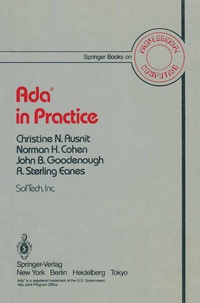
Ada® in Practice
Published on 25. October 1985
Book
Paperback/Softback
XV, 195 pages
978-0-387-96182-8 (ISBN)
Description
Ada® in Practice started lifeas a case studies report, the result of work per formed under government contract at SofTech, Inc. as part of an effort to identify and resolve issues related to Ada usage. Although that report has now evolved into a book intended for a more general audience, its objectives are largely unchanged. Asbefore,the primary goal is to promote effective use of Ada, both in general programming and design practice and in embedded computer systems specifically. Many features of Ada will be new to pro grammers and designers familiar with other languages; the program examples presented in the case studies are intended to serve as guidelines for proper usage of such features while pointing out common misconceptions and programming errors. In addition, we hope that this book as a whole will highlight the advan tages of using Ada at all stages of a program's life cycle, from problem analysis through testing and maintenance. However, it does not purport to hold all the answers to questions ofAda application;areas that would benefit from further investigation or more definitive guidelines are also suggested.
More details
Series
Edition
Softcover reprint of the original 1st ed. 1985
Language
English
Place of publication
New York
United States
Target group
Professional and scholarly
Research
Illustrations
XV, 195 p.
Dimensions
Height: 235 mm
Width: 155 mm
Thickness: 12 mm
Weight
330 gr
ISBN-13
978-0-387-96182-8 (9780387961828)
DOI
10.1007/978-1-4419-8479-1
Other editions
Additional editions
Christine Ausnit | Norman H. Cohen | John B. Goodenough
Ada® in Practice
E-Book
03/2013
Springer
€96.29
Available for download
Content
1. Naming Conventions.- 1.1 Guidelines for the Selection of Identifiers.- Problem: Naming Entities in a Message-Switch Program.- 2. Types.- 2.1 Discrete Types.- 2.2 Implementation of Set Types.- 2.3 Constant Array Declarations.- 2.4 Record Types.- 2.5 Recursive Type Definitions.- 3. Coding Paradigms.- 3.1 Use of Slices.- 3.2 Short Circuit Control Forms.- 3.3 Loop Statements.- 3.4 Use of Block Statements for Local Renaming.- 4. Exceptions.- 4.1 The Use of Exceptions.- 5. Program Structure.- 5.1 Specifying Interfaces for General Purpose, Portable Software: A Study of Ada Input/Output.- 5.2 Information Hiding.- 5.3 Reducing Depth of Nesting.- 5.4 Library Units Versus Subunits.- 6. Ada Life Cycle Design Methodology.- 6.1 Problem Analysis.- 6.2 Requirements Definition.- 6.3 High-Level Design.- 6.4 Low-Level Design.- 6.5 Coding.- 6.6 Unit Testing.- 6.7 Integration Testing.- 6.8 Acceptance Testing.- 6.9 Maintenance.- Appendix A. Areos for Future Study.- A.1 Design Issues.- A.2 Data Abstraction Issues.- A.3 Additional Naming Conventions.- A.4 Additional Coding Paradigms.- A.5 Operational Issues.- Appendix B. Bibliography.