

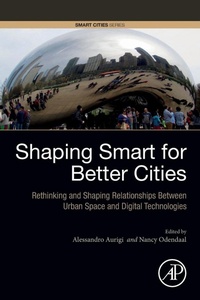
Shaping Smart for Better Cities
Rethinking and Shaping Relationships between Urban Space and Digital Technologies
Published on 18. November 2020
Book
Paperback/Softback
434 pages
978-0-12-818636-7 (ISBN)
Description
Shaping Smart for Better Cities powerfully demonstrates the range of theoretical and practical challenges, opportunities and success factors involved in successfully deploying digital technologies in cities, focusing on the importance of recognizing local context and multi-layered urban relationships in designing successful urban interventions. The first section, 'Rethinking Smart (in) Places' interrogates the smart city from a theoretical vantage point. The second part, 'Shaping Smart Places' examines various case studies critically. Hence the volume offers an intellectual resource that expands on the current literature, but also provides a pedagogical resource to universities as well as a reflective opportunity for practitioners. The cases allow for an examination of the practical implications of smart interventions in space, whilst the theoretical reflections enable expansion of the literature. Students are encouraged to learn from case studies and apply that learning in design. Academics will gain from the learning embedded in the documentation of the case studies in different geographic contexts, while practitioners can apply their learning to the conceptualisation of new forms of technology use.
More details
Series
Language
English
Place of publication
San Diego
United States
Publishing group
Elsevier Science Publishing Co Inc
Target group
Professional and scholarly
Early career researchers and graduate students from urban planning, geography, transport, and economics interested in smart city design. Also of interest to industry professionals and policymakers / public administrators.
Product notice
Paperback (trade)
Dimensions
Height: 229 mm
Width: 152 mm
Thickness: 22 mm
Weight
578 gr
ISBN-13
978-0-12-818636-7 (9780128186367)
Copyright in bibliographic data and cover images is held by Nielsen Book Services Limited or by the publishers or by their respective licensors: all rights reserved.
Schweitzer Classification
Other editions
Additional editions
Alessandro Aurigi | Nancy Odendaal
Shaping Smart for Better Cities
Rethinking and Shaping Relationships between Urban Space and Digital Technologies
E-Book
11/2020
Academic Press
€109.00
Available for download
Persons
Alessandro Aurigi is Professor of Urban Design and Associate Dean: Research at the University of Plymouth, UK. He was previously Head of the School of Architecture, Design and Environment at Plymouth. He also worked at Newcastle University where he was Director (Head of Department) of Architecture, and as a lecturer at UCL (UK). His research focuses on the relationships between our increasingly digital society and the ways we conceive, design, and manage urban space, to enhance and support place quality. Alex is a member of the Peer-Review College of the AHRC, and has published widely on the topic of digital technology and urban space. Nancy Odendaal is Associate Professor in City and Regional Planning at the University of Cape Town. Her research focuses on three interconnected areas of enquiry: infrastructure development, technology innovation and socio-spatial change in cities. She has published extensively on smart cities, with her research focused on the interface between new technologies and marginalised spaces. Previously, Nancy was based at the African Centre for Cities (at the University of Cape Town), where she coordinated the expansion of the Association of African Planning Schools (AAPS), and managed an Africa-wide project on curricula reform of city and regional planning education.
Content
Introduction (Alessandro Aurigi and Nancy Odendaal)
SECTION A - DESIGNING AND SHAPING SMART PLACES
Designing Smart Places: towards a holistic, recombinant approach (Alessandro Aurigi)
Responsive public spaces: five mechanisms for the design of public space in the era of networked urbanism (Martijn de Waal, Frank Suurenbroek and Ivan Nio)
Smart Plays (Ben van Berkel, Filippo Lodi, Wael Batal)
Snowfall on Piazza Castello. Stubborn dispositions and multiple publics in a (temporarily smart) Milanese square (Yulya Besplemennova and Andrea Pollio)
Designing for Hyperlocal: The Use of Locative Media to Augment Place Narratives (Efstathia Kostopoulou and Ava Fatah gen Schieck)
Place-Based Design as Method of Accessing Memories and Meanings: Historical Augmentation in the Harbor Promenade of Lahti (Aale Luusua, Henrika Pihlajaniemi, Mika Hakkarainen, Petri Honkamaa, Eveliina Juntunen & Sami Huuskonen)
Designing smart to revitialise a multicultural shopping street (Ummu Sakiinah, Ingrid Mulder, Annemiek van Boeijen, Rudi Darson)
Affective Technologies for Enchanting Spaces and Cultivating Places (Manuel Portela and Carlos Granell-Canut)
Smart engagement for smart cities: Design patterns for digitally augmented, situated community engagement (Callum Parker, Martin Tomitsch, Joel Fredericks)
SECTION B - CO-PRODUCING SMART PLACES
Platform urbanism and hybrid places in African cities (Nancy Odendaal)
Learning lessons for avoiding the inadvertent exclusion of communities from smart city projects (Alan-Miguel Valdez, Edward Wigley, Oliver Zanetti and Gillian Rose)
Putting the People Back into the 'Smart': Developing a Middle-Out Framework for Engaging Citizens (Glenda Amayo Caldwell, Joel Fredericks, Luke Hespanhol, Marianella Chamorro-Koc, Maria Jose Sanchez Varela Barajas and Maria Jose Castelazo Andre)
Digital Twins of Cities and Evasive Futures (Paul Cureton and Nick Dunn)
The Impact of Peer-to-Peer Accommodation on Place Authenticity: A Placemaking Perspective (Marcus Foth, Ana Bilandzic and Mirko Guaralda)
Smart and Informal? Self-Organisation and Everyday (Jaime Hernandez-Garcia and Iliana Hernandez-Garcia)
Situating urban smartness: ICTs and infrastructure in Nairobi's informal areas (Prince K. Guma)
Emthonjeni - Public space as smart learning networks: A case study of the Violence Prevention Through Urban Upgrading methodology in Cape Town (Kathryn Ewing and Michael Krause)
Watering India's smart cities (Cat Button)
Potential and shortcomings of two design-based strategies for the engagement of city stakeholders with open data (Luca Simeone, Nicola Morelli, Amalia De Goetzen)
SECTION A - DESIGNING AND SHAPING SMART PLACES
Designing Smart Places: towards a holistic, recombinant approach (Alessandro Aurigi)
Responsive public spaces: five mechanisms for the design of public space in the era of networked urbanism (Martijn de Waal, Frank Suurenbroek and Ivan Nio)
Smart Plays (Ben van Berkel, Filippo Lodi, Wael Batal)
Snowfall on Piazza Castello. Stubborn dispositions and multiple publics in a (temporarily smart) Milanese square (Yulya Besplemennova and Andrea Pollio)
Designing for Hyperlocal: The Use of Locative Media to Augment Place Narratives (Efstathia Kostopoulou and Ava Fatah gen Schieck)
Place-Based Design as Method of Accessing Memories and Meanings: Historical Augmentation in the Harbor Promenade of Lahti (Aale Luusua, Henrika Pihlajaniemi, Mika Hakkarainen, Petri Honkamaa, Eveliina Juntunen & Sami Huuskonen)
Designing smart to revitialise a multicultural shopping street (Ummu Sakiinah, Ingrid Mulder, Annemiek van Boeijen, Rudi Darson)
Affective Technologies for Enchanting Spaces and Cultivating Places (Manuel Portela and Carlos Granell-Canut)
Smart engagement for smart cities: Design patterns for digitally augmented, situated community engagement (Callum Parker, Martin Tomitsch, Joel Fredericks)
SECTION B - CO-PRODUCING SMART PLACES
Platform urbanism and hybrid places in African cities (Nancy Odendaal)
Learning lessons for avoiding the inadvertent exclusion of communities from smart city projects (Alan-Miguel Valdez, Edward Wigley, Oliver Zanetti and Gillian Rose)
Putting the People Back into the 'Smart': Developing a Middle-Out Framework for Engaging Citizens (Glenda Amayo Caldwell, Joel Fredericks, Luke Hespanhol, Marianella Chamorro-Koc, Maria Jose Sanchez Varela Barajas and Maria Jose Castelazo Andre)
Digital Twins of Cities and Evasive Futures (Paul Cureton and Nick Dunn)
The Impact of Peer-to-Peer Accommodation on Place Authenticity: A Placemaking Perspective (Marcus Foth, Ana Bilandzic and Mirko Guaralda)
Smart and Informal? Self-Organisation and Everyday (Jaime Hernandez-Garcia and Iliana Hernandez-Garcia)
Situating urban smartness: ICTs and infrastructure in Nairobi's informal areas (Prince K. Guma)
Emthonjeni - Public space as smart learning networks: A case study of the Violence Prevention Through Urban Upgrading methodology in Cape Town (Kathryn Ewing and Michael Krause)
Watering India's smart cities (Cat Button)
Potential and shortcomings of two design-based strategies for the engagement of city stakeholders with open data (Luca Simeone, Nicola Morelli, Amalia De Goetzen)