

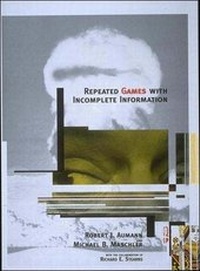
Repeated Games with Incomplete Information
Published on 16. May 1995
Book
Hardback
360 pages
978-0-262-01147-1 (ISBN)
Description
During the height of the Cold War, between 1965 and 1968, Robert Aumann, Michael
Maschler, and Richard Stearns collaborated on research on the dynamics of arms control negotiations
that has since become foundational to work on repeated games. These five seminal papers are
collected here for the first time, with the addition of "postscripts" describing many of the
developments since the papers were written. The basic model studied throughout the book is one in
which players ignorant about the game being played must learn what they can from the actions of the
others.The original work, done under contract to the United States Arms Control and Disarmament
Agency, was intended to tackle the gradual disarmament problem, in which neither player knew what
his own payoff would be for any given agreement, because of uncertainty about the other side's
arsenal and weapons production technology. But the research soon became much more generalized,
covering information concealment and revelation, signaling and learning, and related ideas in any
repeated competitive situation.The first four chapters of the book treat the competitive zero-sum
side of the theory of repeated games. Chapter five takes up cooperative phenomena where one player
may want to signal information to another. An extensive bibliography covers all items mentioned in
the main text, in the postscripts, and in the introduction. The bibliography also includes a
compilation of published papers and books that refer to the original reports.
Maschler, and Richard Stearns collaborated on research on the dynamics of arms control negotiations
that has since become foundational to work on repeated games. These five seminal papers are
collected here for the first time, with the addition of "postscripts" describing many of the
developments since the papers were written. The basic model studied throughout the book is one in
which players ignorant about the game being played must learn what they can from the actions of the
others.The original work, done under contract to the United States Arms Control and Disarmament
Agency, was intended to tackle the gradual disarmament problem, in which neither player knew what
his own payoff would be for any given agreement, because of uncertainty about the other side's
arsenal and weapons production technology. But the research soon became much more generalized,
covering information concealment and revelation, signaling and learning, and related ideas in any
repeated competitive situation.The first four chapters of the book treat the competitive zero-sum
side of the theory of repeated games. Chapter five takes up cooperative phenomena where one player
may want to signal information to another. An extensive bibliography covers all items mentioned in
the main text, in the postscripts, and in the introduction. The bibliography also includes a
compilation of published papers and books that refer to the original reports.
More details
Language
English
Place of publication
Cambridge, Mass.
United States
Publishing group
MIT Press Ltd
Target group
College/higher education
Professional and scholarly
Illustrations
bibliography, index
Dimensions
Height: 229 mm
Width: 152 mm
Thickness: 25 mm
Weight
454 gr
ISBN-13
978-0-262-01147-1 (9780262011471)
Copyright in bibliographic data and cover images is held by Nielsen Book Services Limited or by the publishers or by their respective licensors: all rights reserved.
Schweitzer Classification
Other editions
Additional editions

Robert J. Aumann | Michael Maschler
Repeated Games with Incomplete Information
Book
05/1995
MIT Press
€36.60
Article exhausted; check different version