

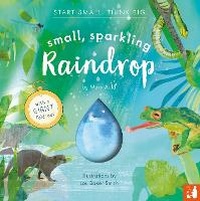
Small, Sparkling Raindrop
A fact-filled picture book about the water cycle with a large fold-out (ages 4-8)
Published on 1. May 2025
Book
Hardback
28 pages
978-1-916780-10-1 (ISBN)
Description
**Books for Topics Recommended Reads - 50 Best Books for Year 2 (Children Aged 6-7)**
Follow the journey of a small sparkling raindrop as it falls from a cloud and learn about its never-ending cycle, vital to all life on Earth.
This book will feed the curiosity of the youngest of readers who are:
keen to know how the world works
fascinated by nature
enjoy learning new information
The story is carefully written for children learning to read, with additional factual captions for more advanced readers.
And here's the WOW-factor - a large fold-out at the end with diagrams, maps and a fun I-Spy game to take children back into the book to find and identify animals in the pictures.
Small, Sparkling Raindrop is part of the Start Small, Think Big series of science-based picture books:
Aimed at children aged 4 to 8
Covers KS1 primary science subjects that children learn at school
High-quality educational content, beautifully illustrated
Small, Sparkling Raindrop explores the story of the water cycle, the impact of water on the land and for creating vibrant wetland habitats. The book focuses on the mighty Mekong River in Southeast Asia, and shows why clean, healthy rivers are vital for both people and wildlife, including endangered species such as Irrawaddy dolphin severely threatened by over-fishing and pollution.
Each book in the series is set in a different habitat and part of the world:
Small, Sparkling Raindrop (Southeast Asia/wetlands and the water cycle)
Small, Speckled Egg (polar regions and the life cycle of an Arctic tern)
Little, Brown Nut (Amazon rainforest and the life cycle of a Brazil Nut tree)
Tiny, Floating Coral (Great Barrier Reef and the life cycle of coral)
Fluffy, Flying Seed (meadowlands and the life cycle of a dandelion)
Small, Shiny Dung Beetle (African savannah and the life cycle of an insect)
Build your own life cycle library with this series, a brilliant addition to any home or school bookshelf.
Printed on FSC paper from sustainable forests.
Follow the journey of a small sparkling raindrop as it falls from a cloud and learn about its never-ending cycle, vital to all life on Earth.
This book will feed the curiosity of the youngest of readers who are:
keen to know how the world works
fascinated by nature
enjoy learning new information
The story is carefully written for children learning to read, with additional factual captions for more advanced readers.
And here's the WOW-factor - a large fold-out at the end with diagrams, maps and a fun I-Spy game to take children back into the book to find and identify animals in the pictures.
Small, Sparkling Raindrop is part of the Start Small, Think Big series of science-based picture books:
Aimed at children aged 4 to 8
Covers KS1 primary science subjects that children learn at school
High-quality educational content, beautifully illustrated
Small, Sparkling Raindrop explores the story of the water cycle, the impact of water on the land and for creating vibrant wetland habitats. The book focuses on the mighty Mekong River in Southeast Asia, and shows why clean, healthy rivers are vital for both people and wildlife, including endangered species such as Irrawaddy dolphin severely threatened by over-fishing and pollution.
Each book in the series is set in a different habitat and part of the world:
Small, Sparkling Raindrop (Southeast Asia/wetlands and the water cycle)
Small, Speckled Egg (polar regions and the life cycle of an Arctic tern)
Little, Brown Nut (Amazon rainforest and the life cycle of a Brazil Nut tree)
Tiny, Floating Coral (Great Barrier Reef and the life cycle of coral)
Fluffy, Flying Seed (meadowlands and the life cycle of a dandelion)
Small, Shiny Dung Beetle (African savannah and the life cycle of an insect)
Build your own life cycle library with this series, a brilliant addition to any home or school bookshelf.
Printed on FSC paper from sustainable forests.
Reviews / Votes
This book is a fantastic way to immerse yourself in the water cycle. We read the larger text on each page as a story, whilst smaller text gives more factual information to support more in-depth learning. The illustrations are beautiful and we loved the huge fold out at the end which encouraged us to go back through the book to find each of the animals, as well as giving an overview of the water cycle. * @milo_and_gigis_bookshelf * A really fun way to introduce early science to your littlest readers. * @posies_book_club * The wonderful illustrations, labelled drawings and maps make this a fun, educational read that is full of facts. We loved the giant fold out page at the end. A great one to link with the curriculum. * @emma.life.in.eyfs * The balance between text and imagery makes this an ideal resource for primary-aged children, particularly those in Key Stage 2 studying the water cycle. Children have shown great interest in this book, eagerly sharing the facts they've learned, which highlights its effectiveness as an educational tool. * Books for Topics *More details
Series
Language
English
Place of publication
United Kingdom
Target group
Children/juvenile
Primary & secondary/elementary & high school
Interest Age: From 4 to 8 years
Product notice
Picture book
mit Klappseite(n)
Die-cut book
Illustrations
Illustrations, color
Dimensions
Height: 230 mm
Width: 230 mm
Thickness: 10 mm
Weight
331 gr
ISBN-13
978-1-916780-10-1 (9781916780101)
Copyright in bibliographic data and cover images is held by Nielsen Book Services Limited or by the publishers or by their respective licensors: all rights reserved.
Schweitzer Classification
Persons
Mary Auld is an award-winning writer of children's information books, most notably How To Build an Orchestra with the London Symphony Orchestra. Mary Auld is a pen name for Rachel Cooke, former Editorial Director at Hachette and an honorary fellow of the English Association in recognition of her work in children's non-fiction. She lives in Nottinghamshire, UK.
Lou Baker Smith is a versatile and established British illustrator and designer who has worked for many major brands, publishers, and co-founded a greeting card company. She started out as a food illustrator for cookery columns in Country Living and Good Housekeeping, moving on to illustrate menus and brochures for British Airways and Selfridges, and packaging for Marks and Spencer, Waitrose and Whittards of Chelsea. She has now added children's non-fiction books to her portfolio, including Protecting the Planet: The Ice Journey of the Polar Bear (Walker Books) and Around the World in 80 Buildings (Welbeck). She lives in Bath.
Dr Nicholas Souter from Conservation International, is an ecologist with over two decades of experience in conservation and natural resource management. Nick is currently leading a project working with fishing communities in Cambodia to improve their livelihoods and conserve their unique natural resources as well as examining freshwater health in the Sesan, Srepok and Sekong River Basin.
Lou Baker Smith is a versatile and established British illustrator and designer who has worked for many major brands, publishers, and co-founded a greeting card company. She started out as a food illustrator for cookery columns in Country Living and Good Housekeeping, moving on to illustrate menus and brochures for British Airways and Selfridges, and packaging for Marks and Spencer, Waitrose and Whittards of Chelsea. She has now added children's non-fiction books to her portfolio, including Protecting the Planet: The Ice Journey of the Polar Bear (Walker Books) and Around the World in 80 Buildings (Welbeck). She lives in Bath.
Dr Nicholas Souter from Conservation International, is an ecologist with over two decades of experience in conservation and natural resource management. Nick is currently leading a project working with fishing communities in Cambodia to improve their livelihoods and conserve their unique natural resources as well as examining freshwater health in the Sesan, Srepok and Sekong River Basin.