

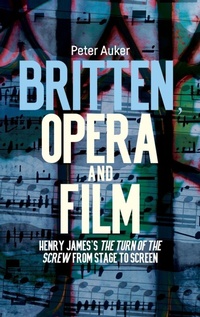
Britten, Opera and Film
Henry James's The Turn of the Screw from Stage to Screen
Published on 14. January 2025
Book
Hardback
230 pages
978-1-83765-123-8 (ISBN)
Description
Investigates cinematic qualities in opera and reveals why Benjamin Britten's operas lend themselves to TV and film interpretations.
Benjamin Britten's 1954 opera The Turn of the Screw, based on Henry James's ghost story, has been described by many critics and commentators as cinematic. Along with Peter Grimes, The Turn of the Screw is one of the most frequently televised or filmed of Britten's operas. Some of these productions have used location footage and/or studio work, and others are based on theatrical settings. This book explores the notion of cinematic opera in the context of The Turn of the Screw and filmed opera in general, and questions what inherent cinematic qualities exist in the work which make it particularly conducive for screen interpretation, an aspect of Britten's compositional style which has rarely been examined in detail before.
Contrary to the prevailing narrative around Britten's disdain for cinema and television, the composer engaged with film as both a cinemagoer and film music composer early in his career and these experiences informed his compositional and dramatic choices. Archival research reveals clues to the composer's adaptation process. By tracing the progress from Henry James's original novella to operatic stage and screen production, via the development of Myfanwy Piper's libretto and Britten's score, the journey of adaptation is discussed in detail. A key part of the book looks at the subsequent interpretation of the opera on screen. Case studies evaluate eight directors' interpretations of the opera ranging from 1959 up to the 2020s. Included is a special study of Peter Morley's 1959 ITV version, which had previously been thought lost. This reveals the roots of Britten's subsequent engagement with screen media, culminating in his television opera Owen Wingrave. The book also briefly explores the influence of cinema on stage productions of the opera which have not been filmed.
Benjamin Britten's 1954 opera The Turn of the Screw, based on Henry James's ghost story, has been described by many critics and commentators as cinematic. Along with Peter Grimes, The Turn of the Screw is one of the most frequently televised or filmed of Britten's operas. Some of these productions have used location footage and/or studio work, and others are based on theatrical settings. This book explores the notion of cinematic opera in the context of The Turn of the Screw and filmed opera in general, and questions what inherent cinematic qualities exist in the work which make it particularly conducive for screen interpretation, an aspect of Britten's compositional style which has rarely been examined in detail before.
Contrary to the prevailing narrative around Britten's disdain for cinema and television, the composer engaged with film as both a cinemagoer and film music composer early in his career and these experiences informed his compositional and dramatic choices. Archival research reveals clues to the composer's adaptation process. By tracing the progress from Henry James's original novella to operatic stage and screen production, via the development of Myfanwy Piper's libretto and Britten's score, the journey of adaptation is discussed in detail. A key part of the book looks at the subsequent interpretation of the opera on screen. Case studies evaluate eight directors' interpretations of the opera ranging from 1959 up to the 2020s. Included is a special study of Peter Morley's 1959 ITV version, which had previously been thought lost. This reveals the roots of Britten's subsequent engagement with screen media, culminating in his television opera Owen Wingrave. The book also briefly explores the influence of cinema on stage productions of the opera which have not been filmed.
Reviews / Votes
Peter Auker's meticulous study Britten, Opera and Film offers a fascinating exploration of the cinematic qualities embedded within Benjamin Britten's 1954 opera The Turn of the Screw, based on the novella by Henry James. * LIMELIGHT *More details
Series
Language
English
Place of publication
Woodbridge
United Kingdom
Publishing group
Boydell & Brewer Ltd
Target group
Professional and scholarly
Product notice
Cloth over boards
Illustrations
17 music exx. and 18 b/w illus
Dimensions
Height: 240 mm
Width: 161 mm
Thickness: 17 mm
Weight
517 gr
ISBN-13
978-1-83765-123-8 (9781837651238)
Copyright in bibliographic data and cover images is held by Nielsen Book Services Limited or by the publishers or by their respective licensors: all rights reserved.
Schweitzer Classification
Other editions
Additional editions
E-Book
01/2025
1st Edition
Boydell & Brewer
€48.99
Available for download
E-Book
01/2025
1st Edition
Boydell & Brewer Ltd
€48.99
Available for download
Person
PETER AUKER has a Masters degree from the University of Sheffield, and subsequently graduated with a PhD in Music from the University of Nottingham.
Content
Introduction
1. Britten and Film
2. Britten and 'Cinematic Opera'
3. Turning the Screw: Creating a Stage Opera
4. The Turn of the Screw from Stage to Screen: Peter Morley's Television Production
5. Analysing Opera on Screen
6. The Turn of the Screw under the Microscope: Examples from Screen Media Productions
7. Britten and TV Opera after The Turn of the Screw
8. Summary and Conclusions
Appendix One: Glossary of Film Terms
Appendix Two: Extract from The Turn of the Screw by Henry James, Chapters IV, V and VI (referred to in Chapter 3).
Filmography
Bibliography
Index
1. Britten and Film
2. Britten and 'Cinematic Opera'
3. Turning the Screw: Creating a Stage Opera
4. The Turn of the Screw from Stage to Screen: Peter Morley's Television Production
5. Analysing Opera on Screen
6. The Turn of the Screw under the Microscope: Examples from Screen Media Productions
7. Britten and TV Opera after The Turn of the Screw
8. Summary and Conclusions
Appendix One: Glossary of Film Terms
Appendix Two: Extract from The Turn of the Screw by Henry James, Chapters IV, V and VI (referred to in Chapter 3).
Filmography
Bibliography
Index