

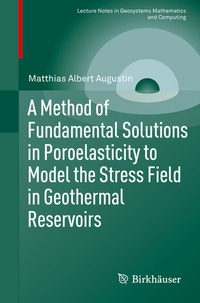
A Method of Fundamental Solutions in Poroelasticity to Model the Stress Field in Geothermal Reservoirs
Published on 23. July 2015
Book
Paperback/Softback
XII, 235 pages
978-3-319-17078-7 (ISBN)
Description
This monograph focuses on the numerical methods needed in the context of developing a reliable simulation tool to promote the use of renewable energy. One very promising source of energy is the heat stored in the Earth's crust, which is harnessed by so-called geothermal facilities. Scientists from fields like geology, geo-engineering, geophysics and especially geomathematics are called upon to help make geothermics a reliable and safe energy production method. One of the challenges they face involves modeling the mechanical stresses at work in a reservoir.
The aim of this thesis is to develop a numerical solution scheme by means of which the fluid pressure and rock stresses in a geothermal reservoir can be determined prior to well drilling and during production. For this purpose, the method should (i) include poroelastic effects, (ii) provide a means of including thermoelastic effects, (iii) be inexpensive in terms of memory and computational power, and (iv) be flexible with regard to the locations of data points.
After introducing the basic equations and their relations to more familiar ones (the heat equation, Stokes equations, Cauchy-Navier equation), the "method of fundamental solutions" and its potential value concerning our task are discussed. Based on the properties of the fundamental solutions, theoretical results are established and numerical examples of stress field simulations are presented to assess the method's performance. The first-ever 3D graphics calculated for these topics, which neither requiring meshing of the domain nor involving a time-stepping scheme, make this a pioneering volume.
The aim of this thesis is to develop a numerical solution scheme by means of which the fluid pressure and rock stresses in a geothermal reservoir can be determined prior to well drilling and during production. For this purpose, the method should (i) include poroelastic effects, (ii) provide a means of including thermoelastic effects, (iii) be inexpensive in terms of memory and computational power, and (iv) be flexible with regard to the locations of data points.
After introducing the basic equations and their relations to more familiar ones (the heat equation, Stokes equations, Cauchy-Navier equation), the "method of fundamental solutions" and its potential value concerning our task are discussed. Based on the properties of the fundamental solutions, theoretical results are established and numerical examples of stress field simulations are presented to assess the method's performance. The first-ever 3D graphics calculated for these topics, which neither requiring meshing of the domain nor involving a time-stepping scheme, make this a pioneering volume.
More details
Series
Edition
1st ed. 2015
Language
English
Place of publication
Cham
Switzerland
Publishing group
Springer International Publishing
Target group
Professional and scholarly
Research
Illustrations
32 farbige Abbildungen, 37 s/w Abbildungen
XII, 235 p. 69 illus., 32 illus. in color.
Dimensions
Height: 235 mm
Width: 155 mm
Thickness: 14 mm
Weight
382 gr
ISBN-13
978-3-319-17078-7 (9783319170787)
DOI
10.1007/978-3-319-17079-4
Schweitzer Classification
Other editions
Additional editions
Matthias Albert Augustin
A Method of Fundamental Solutions in Poroelasticity to Model the Stress Field in Geothermal Reservoirs
E-Book
07/2015
Birkhäuser
€53.49
Available for download
Content
1.Introduction.- 2. Preliminaries.- 3. Physical and Mathematical Foundation.- 4. Boundary Layer Potentials in Poroelasticity.- 5. Methods of Fundamental Solutions in Poroelasticity.- 6. Numerical Results.- 7. Conclusion and Outlook.- A. Fundamental Stresses and Fluid Velocities.- Bibliography.