

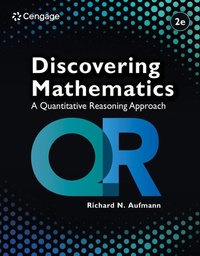
Discovering Mathematics
A Quantitative Reasoning Approach
2nd Edition
Will be published approx. on 1. January 2024
Book
Paperback/Softback
738 pages
978-0-357-76003-1 (ISBN)
Description
Aufmann's DISCOVERING MATHEMATICS: A QUANTITATIVE REASONING APPROACH, 2nd EDITION, with WebAssign, helps you learn mathematics in the context of the world around you. Focusing on topics relevant to your life and on developing critical-thinking skills that you can apply beyond the course, this text provides you with exactly what you need for the world around you in an approachable, engaging and streamlined format.
More details
Edition
2nd edition
Language
English
Place of publication
CA
United States
Publishing group
Cengage Learning, Inc
Target group
College/higher education
Product notice
Paperback (trade)
Unsewn / adhesive bound
Dimensions
Height: 33 mm
Width: 210 mm
Thickness: 274 mm
Weight
1633 gr
ISBN-13
978-0-357-76003-1 (9780357760031)
Copyright in bibliographic data and cover images is held by Nielsen Book Services Limited or by the publishers or by their respective licensors: all rights reserved.
Schweitzer Classification
Person
Richard Aufmann is the lead author of two best-selling DEVELOPMENTAL MATH series and a best-selling COLLEGE ALGEBRA AND TRIGONOMETRY series, as well as several derivative math texts. Mr. Aufmann taught math, computer science and physics at Palomar College in California, where he was on the faculty for 28 years. His textbooks are highly recognized and respected among college mathematics professors. Today, Mr. Aufmann's professional interests include quantitative literacy, the developmental math curriculum and the impact of technology on curriculum development. He holds a Bachelor of Arts in Mathematics from the University of California, Irvine and a Master of Arts degree in Mathematics from California State University, Long Beach.
Content
Module 1: VALIDITY STUDIES.
1. An Introduction to Problem Solving.
Inductive and Deductive Reasoning. Estimation and Graphs. Problem-Solving Strategies. Fair Division.
2. Sets and Logic.
Sets, Set Operations, and Applications. Categorical Logic. Propositional Logic. Investigating Fallacies.
3. Proportions and Variation.
Ratios and Rates. Measurement. Proportions. Percent. Variation.
Module 2: FINANCIAL LITERACY.
4. Managing Your Finances.
Simple Interest. Compound Interest. Future and Present Value of an Annuity. Credit Cards. Student Loans. Financial Considerations of Car Ownership. Financial Considerations of Home Ownership. Stocks, Bonds, and Mutual Funds.
Module 3: MODELING.
5. Linear Functions.
Introduction to Functions. Properties of Linear Functions. Linear Models.
6. Nonlinear Functions.
Exponential Models. Logarithmic Functions. Quadratic Functions.
Module 4: PROBABILITY AND STATISTICS.
7. Introduction to Probability.
The Counting Principle. Permutations and Combinations. Probability and Odds. Addition and Complement Rules. Conditional Probability. Expectations.
8. Introduction to Statistics.
Measures of Central Tendency. Measures of Dispersion. Measures of Relative Position. Normal Distributions. Linear Regression and Correlation.
Module 5: ADDITIONAL TOPICS.
9. Voting and Apportionment.
Introduction to Apportionment. Introduction to Voting. Weighted Voting Systems.
10. Circuits and Networks.
Graphs and Euler Circuits. Weighted Graphs. Planarity and Euler's Formula. Graph Coloring.
11. Geometry.
Measurement. Basic Concepts of Euclidean Geometry. Perimeter and Area of Plane Figures. Volume and Surface Area. Properties of Triangles. Right Triangle Trigonometry. Non-Euclidean Geometry. Fractals.
APPENDICES (AVAILABLE UPON REQUEST. CHECK WITH YOUR CENGAGE LEARNING SALES REPRESENTATIVE).
Appendix A: A Review of Integers, Rational Numbers, and Percents.
Appendix B: Variable Expressions and Equations.
Appendix C: Review of the Rectangular Coordinates and Graphing.
SELECTED ANSWERS.
SOLUTIONS TO PRELIMINARY EXERCISES.
INDEX.
1. An Introduction to Problem Solving.
Inductive and Deductive Reasoning. Estimation and Graphs. Problem-Solving Strategies. Fair Division.
2. Sets and Logic.
Sets, Set Operations, and Applications. Categorical Logic. Propositional Logic. Investigating Fallacies.
3. Proportions and Variation.
Ratios and Rates. Measurement. Proportions. Percent. Variation.
Module 2: FINANCIAL LITERACY.
4. Managing Your Finances.
Simple Interest. Compound Interest. Future and Present Value of an Annuity. Credit Cards. Student Loans. Financial Considerations of Car Ownership. Financial Considerations of Home Ownership. Stocks, Bonds, and Mutual Funds.
Module 3: MODELING.
5. Linear Functions.
Introduction to Functions. Properties of Linear Functions. Linear Models.
6. Nonlinear Functions.
Exponential Models. Logarithmic Functions. Quadratic Functions.
Module 4: PROBABILITY AND STATISTICS.
7. Introduction to Probability.
The Counting Principle. Permutations and Combinations. Probability and Odds. Addition and Complement Rules. Conditional Probability. Expectations.
8. Introduction to Statistics.
Measures of Central Tendency. Measures of Dispersion. Measures of Relative Position. Normal Distributions. Linear Regression and Correlation.
Module 5: ADDITIONAL TOPICS.
9. Voting and Apportionment.
Introduction to Apportionment. Introduction to Voting. Weighted Voting Systems.
10. Circuits and Networks.
Graphs and Euler Circuits. Weighted Graphs. Planarity and Euler's Formula. Graph Coloring.
11. Geometry.
Measurement. Basic Concepts of Euclidean Geometry. Perimeter and Area of Plane Figures. Volume and Surface Area. Properties of Triangles. Right Triangle Trigonometry. Non-Euclidean Geometry. Fractals.
APPENDICES (AVAILABLE UPON REQUEST. CHECK WITH YOUR CENGAGE LEARNING SALES REPRESENTATIVE).
Appendix A: A Review of Integers, Rational Numbers, and Percents.
Appendix B: Variable Expressions and Equations.
Appendix C: Review of the Rectangular Coordinates and Graphing.
SELECTED ANSWERS.
SOLUTIONS TO PRELIMINARY EXERCISES.
INDEX.