

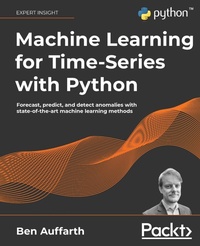
Machine Learning for Time-Series with Python
Forecast, predict, and detect anomalies with state-of-the-art machine learning methods
Published on 29. October 2021
Book
Paperback/Softback
370 pages
978-1-80181-962-6 (ISBN)
Description
Get better insights from time-series data and become proficient in model performance analysis
Key Features
Explore popular and modern machine learning methods including the latest online and deep learning algorithms
Learn to increase the accuracy of your predictions by matching the right model with the right problem
Master time series via real-world case studies on operations management, digital marketing, finance, and healthcare
Book DescriptionThe Python time-series ecosystem is huge and often quite hard to get a good grasp on, especially for time-series since there are so many new libraries and new models. This book aims to deepen your understanding of time series by providing a comprehensive overview of popular Python time-series packages and help you build better predictive systems.
Machine Learning for Time-Series with Python starts by re-introducing the basics of time series and then builds your understanding of traditional autoregressive models as well as modern non-parametric models. By observing practical examples and the theory behind them, you will become confident with loading time-series datasets from any source, deep learning models like recurrent neural networks and causal convolutional network models, and gradient boosting with feature engineering.
This book will also guide you in matching the right model to the right problem by explaining the theory behind several useful models. You'll also have a look at real-world case studies covering weather, traffic, biking, and stock market data.
By the end of this book, you should feel at home with effectively analyzing and applying machine learning methods to time-series.
What you will learn
Understand the main classes of time series and learn how to detect outliers and patterns
Choose the right method to solve time-series problems
Characterize seasonal and correlation patterns through autocorrelation and statistical techniques
Get to grips with time-series data visualization
Understand classical time-series models like ARMA and ARIMA
Implement deep learning models, like Gaussian processes, transformers, and state-of-the-art machine learning models
Become familiar with many libraries like Prophet, XGboost, and TensorFlow
Who this book is forThis book is ideal for data analysts, data scientists, and Python developers who want instantly useful and practical recipes to implement today, and a comprehensive reference book for tomorrow. Basic knowledge of the Python Programming language is a must, while familiarity with statistics will help you get the most out of this book.
Key Features
Explore popular and modern machine learning methods including the latest online and deep learning algorithms
Learn to increase the accuracy of your predictions by matching the right model with the right problem
Master time series via real-world case studies on operations management, digital marketing, finance, and healthcare
Book DescriptionThe Python time-series ecosystem is huge and often quite hard to get a good grasp on, especially for time-series since there are so many new libraries and new models. This book aims to deepen your understanding of time series by providing a comprehensive overview of popular Python time-series packages and help you build better predictive systems.
Machine Learning for Time-Series with Python starts by re-introducing the basics of time series and then builds your understanding of traditional autoregressive models as well as modern non-parametric models. By observing practical examples and the theory behind them, you will become confident with loading time-series datasets from any source, deep learning models like recurrent neural networks and causal convolutional network models, and gradient boosting with feature engineering.
This book will also guide you in matching the right model to the right problem by explaining the theory behind several useful models. You'll also have a look at real-world case studies covering weather, traffic, biking, and stock market data.
By the end of this book, you should feel at home with effectively analyzing and applying machine learning methods to time-series.
What you will learn
Understand the main classes of time series and learn how to detect outliers and patterns
Choose the right method to solve time-series problems
Characterize seasonal and correlation patterns through autocorrelation and statistical techniques
Get to grips with time-series data visualization
Understand classical time-series models like ARMA and ARIMA
Implement deep learning models, like Gaussian processes, transformers, and state-of-the-art machine learning models
Become familiar with many libraries like Prophet, XGboost, and TensorFlow
Who this book is forThis book is ideal for data analysts, data scientists, and Python developers who want instantly useful and practical recipes to implement today, and a comprehensive reference book for tomorrow. Basic knowledge of the Python Programming language is a must, while familiarity with statistics will help you get the most out of this book.
More details
Language
English
Place of publication
Birmingham
United Kingdom
Target group
Professional and scholarly
Dimensions
Height: 235 mm
Width: 191 mm
Thickness: 21 mm
Weight
690 gr
ISBN-13
978-1-80181-962-6 (9781801819626)
Copyright in bibliographic data and cover images is held by Nielsen Book Services Limited or by the publishers or by their respective licensors: all rights reserved.
Schweitzer Classification
Other editions
Additional editions
Ben Auffarth
Machine Learning for Time-Series with Python
Forecast, predict, and detect anomalies with state-of-the-art machine learning methods
E-Book
06/2024
1st Edition
Packt Publishing Limited
from
€39.59
Available for download
Person
Ben Auffarth is a full-stack data scientist who has >15 years of work experience. With a background and Ph.D. in computational and cognitive neuroscience from one of Europe's top engineering universities, he has designed and conducted wet lab experiments on cell cultures, analyzed experiments with terabytes of data, run brain models on IBM supercomputers with up to 64k cores, built production systems processing hundreds of thousands of transactions per day, and trained neural networks on millions of text documents. In his work, he often notices a lack of appreciation for the importance of time-related factors, a deficit he wanted to address in this book. He co-founded and is the former president of Data Science Speakers, London.
Content
Table of Contents
Introduction to Time-Series with Python
Time-Series Analysis with Python
Preprocessing Time-Series
Introduction to Machine Learning for Time Series
Forecasting with Moving Averages and Autoregressive Models
Unsupervised Methods for Time-Series
Machine Learning Models for Time-Series
Online Learning for Time-Series
Probabilistic Models for Time-Series
Deep Learning for Time-Series
Reinforcement Learning for Time-Series
Multivariate Forecasting
Introduction to Time-Series with Python
Time-Series Analysis with Python
Preprocessing Time-Series
Introduction to Machine Learning for Time Series
Forecasting with Moving Averages and Autoregressive Models
Unsupervised Methods for Time-Series
Machine Learning Models for Time-Series
Online Learning for Time-Series
Probabilistic Models for Time-Series
Deep Learning for Time-Series
Reinforcement Learning for Time-Series
Multivariate Forecasting