

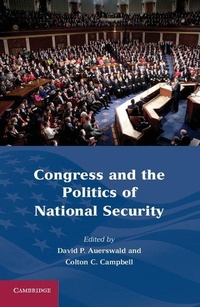
Congress and the Politics of National Security
Published on 19. December 2011
Book
Hardback
282 pages
978-1-107-00686-7 (ISBN)
Description
In an increasingly complex and unpredictable world, a growing number of observers and practitioners have called for a re-examination of our national security system. Central to any such reform effort is an evaluation of Congress. Is Congress adequately organized to deal with national security issues in an integrated and coordinated manner? How have developments in Congress over the past few decades, such as heightened partisanship, message politics, party-committee relationships and bicameral relations, affected topical security issues? This volume examines variation in the ways Congress has engaged federal agencies overseeing our nation's national security as well as various domestic political determinants of security policy.
More details
Language
English
Place of publication
Cambridge
United Kingdom
Target group
Professional and scholarly
Illustrations
6 Tables, unspecified; 3 Line drawings, unspecified
Dimensions
Height: 235 mm
Width: 157 mm
Thickness: 21 mm
Weight
612 gr
ISBN-13
978-1-107-00686-7 (9781107006867)
Copyright in bibliographic data and cover images is held by Nielsen Book Services Limited or by the publishers or by their respective licensors: all rights reserved.
Schweitzer Classification
Other editions
Additional editions
David P. Auerswald | Colton C. Campbell
Congress and the Politics of National Security
E-Book
02/2012
1st Edition
Cambridge University Press
€20.49
Available for download
David P. Auerswald | Colton C. Campbell
Congress and the Politics of National Security
Book
12/2011
Cambridge University Press
€43.40
Shipment within 15-20 days
David P. Auerswald
Congress and the Politics of National Security
E-Book
12/2011
Cambridge University Press
€16.99
Available for download
Persons
David P. Auerswald is Professor of Security Studies at the National War College. Before coming to the National War College, he was an Assistant Professor of Political Science at George Washington University, Washington DC; served on the Senate Foreign Relations Committee staff, working for then-Senator Joseph Biden of Delaware; and was a staff assistant for US Senator Timothy Wirth of Colorado. He has spent time working on the congressional reform team of the Project on National Security Reform, the US Central Command's 2008-9 Assessment Team and the 2008 'Alternative Futures' project for the Office of the Secretary of Defense. He is the author and co-author of Disarmed Democracies: Domestic Institutions and the Use of Force (2000) and The Kosovo Conflict: A Diplomatic History Through Documents (2000). Colton C. Campbell is Professor of National Security Strategy at the National War College. Prior to joining the National War College, he was a Legislative Aide to US Representative Mike Thompson of California, where he handled Appropriations, Defense and Trade matters for the congressman. Before that, he was an Analyst in American National Government at the Congressional Research Service, an Associate Professor of Political Science at Florida International University and an APSA Congressional Fellow in the office of Senator Bob Graham of Florida. He is the author, co-author and co-editor of several books on Congress, including Discharging Congress: Government by Commission (2001) and Impeaching Clinton: Partisan Strife on Capitol Hill (2004).
Content
Part I. Historical and Institutional Challenges: 1. Congress and national security David P. Auerswald and Colton C. Campbell; 2. Congress and US foreign policy: an overview Robert David Johnson; 3. Institutional challenges confronting congress post 9/11: partisan polarization and effective oversight Mark J. Oleszek and Walter J. Oleszek; Part II. Oversight Challenges: 4. Congress and defense Pat Towell; 5. Congress and homeland security Timothy Balunis and William Hemphill; 6. Congress and intelligence Loch K. Johnson; 7. Congress and foreign aid Susan B. Epstein; Part III. Policy Challenges: Contours and Debate: 8. Enemy combatant detainees Harvey Rishikof and Bernard Horowitz; 9. Arms control David P. Auerswald; 10. National security surveillance Louis Fisher.