

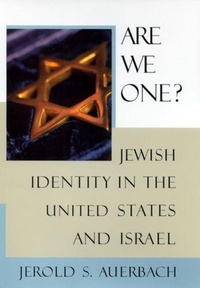
Are We One?
Jewish Identity in the United States and Israel
Published on 1. May 2001
Book
Hardback
264 pages
978-0-8135-2917-2 (ISBN)
Description
What binds together Jews of Israel and the United States? Amid the hope and frustration generated by the Middle East peace process, the meaning of Jewish statehood is more vigorously contested than ever before. A secular democratic Israel, responsive to Western liberal values, is prepared to make peace with the Palestinians by sacrificing its own historic homeland. But a covenantal Israel, which draws its Jewish identity from divine promise and the biblical narrative, refuses to surrender to modern imperatives. As the very nature of Jewish statehood has become ever more polarized, American Jewish life has been profoundly affected by this fateful Zionist contradiction.
In Are We One? Jerold S. Auerbach presents a surprising new interpretation of this contemporary Jewish dilemma. The modern Jewish impulse to embrace Western values, he writes, exacts a terrible price. He offers a critical reassessment of Zionism, a challenging analysis of the sources of the identification of American Jews with Israel-and a gloomy prognosis of the future of Jewish life, both in Israel and the United States.
In a ringing indictment that is sure to spark controversy, he states that the eagerness of secular Israelis to import American culture reflects their sweeping rejection of Jewish and Zionist values. Indeed, the diminishing number of Israelis who actually remain faithful to Jewish religious and historical imperatives are denigrated as fundamentalist zealots by Israeli and American Jews alike. Present-day Israel now exhibits such Jewish self-loathing, he states, that it has depleted its own ability to inspire world Jewry.
In a groundbreaking book that draws upon original historical analysis and extensive personal experience in Israel, Auerbach invites readers to consider the debilitating consequences of an adulterated Jewish identity in Israel and in the United States for the very future of Judaism.
In Are We One? Jerold S. Auerbach presents a surprising new interpretation of this contemporary Jewish dilemma. The modern Jewish impulse to embrace Western values, he writes, exacts a terrible price. He offers a critical reassessment of Zionism, a challenging analysis of the sources of the identification of American Jews with Israel-and a gloomy prognosis of the future of Jewish life, both in Israel and the United States.
In a ringing indictment that is sure to spark controversy, he states that the eagerness of secular Israelis to import American culture reflects their sweeping rejection of Jewish and Zionist values. Indeed, the diminishing number of Israelis who actually remain faithful to Jewish religious and historical imperatives are denigrated as fundamentalist zealots by Israeli and American Jews alike. Present-day Israel now exhibits such Jewish self-loathing, he states, that it has depleted its own ability to inspire world Jewry.
In a groundbreaking book that draws upon original historical analysis and extensive personal experience in Israel, Auerbach invites readers to consider the debilitating consequences of an adulterated Jewish identity in Israel and in the United States for the very future of Judaism.
Reviews / Votes
[Auerbach] posits that foreign cultures have relentlessly impinged upon Jewish identity and autonomy, even in the Jewish State. Even Zionism, the national liberation movement of the Jewish people, has been powerless to resist the accelerating process of disintegration. Indeed, he says, AEZionism now hastens it along.AE In a startling book that is sure to create controversy, Auerbach sees that AEin the end, it now seems clear, only the continued dilution of Judaism can assure harmonious reconciliation with the liberal pro-choice values that so many American Jews and Israelis fervently embrace.AE. (Booklist) [Auerbach] posits that foreign cultures have relentlessly impinged upon Jewish identity and autonomy, even in the Jewish State. Even Zionism, the national liberation movement of the Jewish people, has been powerless to resist the accelerating process of disintegration. Indeed, he says, AEZionism now hastens it along.AE In a startling book that is sure to create controversy, Auerbach sees that AEin the end, it now seems clear, only the continued dilution of Judaism can assure harmonious reconciliation with the liberal pro-choice values that so many American Jews and Israelis fervently embrace.AE. (Booklist) By selectively examining and analyzing crossroads in the history of relations between American and Israeli Jewry since 1948, Auerbach tries to show how, by a terrible irony, the acrid dissolvents of European Jewish life that led to Zionism in the first place are now at work in Zion itself. The core of his argument, amply supported by vivid examples drawn from a variety of sources, is that both assimilation and (shockingly) anti-Semitism have transformed the once Jewish state into a grotesque travesty of what it was intended to be. . . . This is an explosive book, articulatinguand Auerbach is a very articulate writer indeedumisgivings and apprehensions widespread in the Jewish world for many years but rarely expressed openly. (Jerusalem Post) By selectively examining and analyzing crossroads in the history of relations between American and Israeli Jewry since 1948, Auerbach tries to show how, by a terrible irony, the acrid dissolvents of European Jewish life that led to Zionism in the first place are now at work in Zion itself. The core of his argument, amply supported by vivid examples drawn from a variety of sources, is that both assimilation and (shockingly) anti-Semitism have transformed the once Jewish state into a grotesque travesty of what it was intended to be. . . . This is an explosive book, articulatinguand Auerbach is a very articulate writer indeedumisgivings and apprehensions widespread in the Jewish world for many years but rarely expressed openly. (Jerusalem Post) Ending a book on this dark note, Auerbach offers an answer to his lead question, aeAre we one?AEuthat, I suspect, most readers will endorse only reluctantly, if at all. For given the triumphs of Zionism and Israel that millions of Jews have celebrated in our lifetime, the loss of Jewish political sovereignty is simply unthinkable. And yet it would be a mistake to set aside AuerbachAEs conclusions as if they have no logic behind them. His book, historically informed and always articulate, marshals arguments that need to be heeded. If others differ with them and argue with them, that is all to the good, for the stakes are frighteningly high in this debate, and the issues should be avoided. (Judaism) Ending a book on this dark note, Auerbach offers an answer to his lead question, aeAre we one?AEuthat, I suspect, most readers will endorse only reluctantly, if at all. For given the triumphs of Zionism and Israel that millions of Jews have celebrated in our lifetime, the loss of Jewish political sovereignty is simply unthinkable. And yet it would be a mistake to set aside AuerbachAEs conclusions as if they have no logic behind them. His book, historically informed and always articulate, marshals arguments that need to be heeded. If others differ with them and argue with them, that is all to the good, for the stakes are frighteningly high in this debate, and the issues should be avoided. (Judaism) The volatile situation in the Middle East makes it impossible for any pundit to possess a crystal ball, especially one whose strident prejudices cloud his view of the time to come. Despite this caveat, AuerbachAEs well-written reply to the question he poses, aeAre We One?AE cannot be ignored. (Jewish Journal) The volatile situation in the Middle East makes it impossible for any pundit to possess a crystal ball, especially one whose strident prejudices cloud his view of the time to come. Despite this caveat, AuerbachAEs well-written reply to the question he poses, aeAre We One?AE cannot be ignored. (Jewish Journal) An immensely important revisionist critique. Must reading for anyone interested in American Jewry, Israel, and the relationship between them. Part history, part sober analysis, part cri de coeur, this is a book that dispels old pieties and offers a disturbing, unforgettable vision of Zionism's future. - Jonathan D. Sarna (Joseph H. and Belle R. Braun Professor of American Jewish History, Brandeis Univ) An immensely important revisionist critique. Must reading for anyone interested in American Jewry, Israel, and the relationship between them. Part history, part sober analysis, part cri de coeur, this is a book that dispels old pieties and offers a disturbing, unforgettable vision of Zionism's future. - Jonathan D. Sarna (Joseph H. and Belle R. Braun Professor of American Jewish History, Brandeis Univ) Are We One? Is an extended historical essay without footnotes, but with a scholarly appendix. Like his previous work the argument is clear and well written. . . . My real dissatisfaction with the book stems from the overstatements which accompany the basic thesis. My marginal notes fill the pages of the text with aetrue, but exaggeratedAE or aecorrect but too simplistic.AE While I donAEt agree with Auerbach, he could make a fair case for his thesis. Instead, he exaggerates his case, chooses his examples far too selectively. At a certain point, however, the overstatements, the exaggerations, and the selectivity assume a qualitative weight. AuerbachAEs presentation is too simplistic, too lacking in nuance or balance. (American Jewish History) Are We One? Is an extended historical essay without footnotes, but with a scholarly appendix. Like his previous work the argument is clear and well written. . . . My real dissatisfaction with the book stems from the overstatements which accompany the basic thesis. My marginal notes fill the pages of the text with aetrue, but exaggeratedAE or aecorrect but too simplistic.AE While I donAEt agree with Auerbach, he could make a fair case for his thesis. Instead, he exaggerates his case, chooses his examples far too selectively. At a certain point, however, the overstatements, the exaggerations, and the selectivity assume a qualitative weight. AuerbachAEs presentation is too simplistic, too lacking in nuance or balance. (American Jewish History) Impassioned, brilliant, and elegantly written, this explosive book articulates misgivings and apprehensions fairly widespread in the Jewish world for many years but rarely expressed openly. A very important bookuone of the two or three necessary and indispensable utterances on its subject in the past quarter-century. - Edward Alexander (author of Irving Howe: Socialist, Critic, Jew) Impassioned, brilliant, and elegantly written, this explosive book articulates misgivings and apprehensions fairly widespread in the Jewish world for many years but rarely expressed openly. A very important bookuone of the two or three necessary and indispensable utterances on its subject in the past quarter-century. - Edward Alexander (author of Irving Howe: Socialist, Critic, Jew) Though AuerbachAEs subtitle promises a book on the widening gap between the two largest Jewish communities in the world, he has actually delivered a theological and ideological defense of Greater Israel, and it is drenched in the passion of the convert. . . . Auerbach depicts American Jewry simultaneously terrified of being attacked as disloyal and obsessed by an aeinsatiable craving for acceptance.AE Yet as he himself passingly mentions, Jews have been disproportionately represented in radical politics and the labor and civil-rights movements virtually from the time mass immigration from Eastern Europe began. Is that the kind of visible dissidence typical of a cowed, fearful people? . . . . His arguments prove too extreme, however, to effectively sustain. (Jerusalem Report) Though AuerbachAEs subtitle promises a book on the widening gap between the two largest Jewish communities in the world, he has actually delivered a theological and ideological defense of Greater Israel, and it is drenched in the passion of the convert. . . . Auerbach depicts American Jewry simultaneously terrified of being attacked as disloyal and obsessed by an aeinsatiable craving for acceptance.AE Yet as he himself passingly mentions, Jews have been disproportionately represented in radical politics and the labor and civil-rights movements virtually from the time mass immigration from Eastern Europe began. Is that the kind of visible dissidence typical of a cowed, fearful people? . . . . His arguments prove too extreme, however, to effectively sustain. (Jerusalem Report) If weuAmerican Jews and Israelisuare indeed one, what now defines our unity? The attachment may have originated in our ancestral heritage or sacred texts, but these sources have lost their vitality to Jewish identity in the modern era. Toward such traditional sources of Jewish inspiration and renewal, increasing numbers of Jews in both countries are abysmally ignorant, willfully indifferent, or overtly hostile. Rather, most American Jews and Israelisuexcept for the Orthodox minorities in both countriesuseem to share a determination to dilute Judaism with an American infusion of free-choice individualism. (from Are We One? Jewish Identity in the United States and Israel) If weuAmerican Jews and Israelisuare indeed one, what now defines our unity? The attachment may have originated in our ancestral heritage or sacred texts, but these sources have lost their vitality to Jewish identity in the modern era. Toward such traditional sources of Jewish inspiration and renewal, increasing numbers of Jews in both countries are abysmally ignorant, willfully indifferent, or overtly hostile. Rather, most American Jews and Israelisuexcept for the Orthodox minorities in both countriesuseem to share a determination to dilute Judaism with an American infusion of free-choice individualism. (from Are We One? Jewish Identity in the United States and Israel)More details
Language
English
Place of publication
New Brunswick NJ
United States
Target group
College/higher education
Professional and scholarly
Product notice
sewn/stitched
Cloth over boards
Dimensions
Height: 224 mm
Width: 147 mm
Thickness: 27 mm
Weight
472 gr
ISBN-13
978-0-8135-2917-2 (9780813529172)
Copyright in bibliographic data and cover images is held by Nielsen Book Services Limited or by the publishers or by their respective licensors: all rights reserved.
Schweitzer Classification
Person
Jerold S. Auerbach is a professor of history at Wellesley College. His books on Jewish subjects include Jacob's Voices and Rabbis and Lawyers. Professor Auerbach has been a Guggenheim Fellow and Fulbright Lecturer at Tel Aviv University.
Content
Introduction
In Exile at Home: The Emancipation Dilemma
Zionism as Americanism
The Crisis of Diaspora Loyalty
Zionism versus Judaism
The Return to the Biblical Homeland
The Zionist War against the Jews
Altneuland Revisited: A Journey to Palisdan
Acknowledgments
Bibliographical Essay
Index
In Exile at Home: The Emancipation Dilemma
Zionism as Americanism
The Crisis of Diaspora Loyalty
Zionism versus Judaism
The Return to the Biblical Homeland
The Zionist War against the Jews
Altneuland Revisited: A Journey to Palisdan
Acknowledgments
Bibliographical Essay
Index