

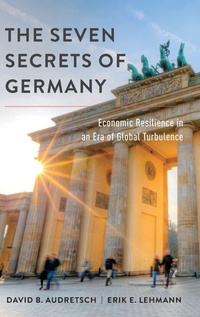
The Seven Secrets of Germany
Economic Resilience in an Era of Global Turbulence
Published on 25. February 2016
Book
Hardback
246 pages
978-0-19-025869-6 (ISBN)
Description
German economic performance has astonished the world. At the turn of the century, Germany had been written off as the sick man of Europe. No more. Even as most of its European neighbors and OECD trading partners have struggled in the face of a turbulent global economy, the German economy has thrived.
How does Germany do it? What is the secret? In The Seven Secrets of Germany, authors David Audretsch and Erik Lehmann answer these very questions. This book reveals, explains, and analyzes seven key aspects of Germany, its economy, and its society that have provided the nation with considerable buoyance in an era of global turbulence. These seven features range from the key and strategic role played by small firms to world leadership in its skilled and trained labor force, an ability to harness global opportunities through leveraging local resources, public infrastructure, the capacity to deal with change and confront challenges in a flexible manner, and the emergence of a remarkably positive identity and image.
The Seven Secrets of Germany have insulated the country from long-term economic deterioration and enabled it to take advantage of the opportunities afforded from globalization rather than succumbing as a victim to globalization. This insights can be instructive to other countries and refute the defeatist view that globalization leads to an inevitable deterioration of the standard of living, quality of life, and degree of economic prosperity.
How does Germany do it? What is the secret? In The Seven Secrets of Germany, authors David Audretsch and Erik Lehmann answer these very questions. This book reveals, explains, and analyzes seven key aspects of Germany, its economy, and its society that have provided the nation with considerable buoyance in an era of global turbulence. These seven features range from the key and strategic role played by small firms to world leadership in its skilled and trained labor force, an ability to harness global opportunities through leveraging local resources, public infrastructure, the capacity to deal with change and confront challenges in a flexible manner, and the emergence of a remarkably positive identity and image.
The Seven Secrets of Germany have insulated the country from long-term economic deterioration and enabled it to take advantage of the opportunities afforded from globalization rather than succumbing as a victim to globalization. This insights can be instructive to other countries and refute the defeatist view that globalization leads to an inevitable deterioration of the standard of living, quality of life, and degree of economic prosperity.
Reviews / Votes
"Just when so many are asking 'How did Germany do it?' a new book appears with some answers. In an enormously well-informed, erudite, and accessible manner, the authors point to seven features that help Germany thrive in the face of globalization, demographic challenges, the Eurozone crisis, and much more. The seven 'secrets,' or features-which range from the small-is-beautiful Mittelstand to the growing comfort zone that Germans feel about being Germancitizens of the EU-allow Germany to foster the central drivers of economic prosperity: innovation, labor skills, and entrepreneurship. Social cohesion is critical in allowing the formal and informal
institutions to work together-to make the whole more than the sum of the parts.
The Seven Secrets of Germany is bound to provoke discussion and disagreement, but it really is a must-read for those who want to understand this nation's remarkable resilience and economic success."
--Richard Baldwin, Professor of International Economics at the Graduate Institute, Geneva and Director of the Center for Economic and Policy Research
"The Seven Secrets of Germany is the second book published recently on Germany that has intrigued me. The first one is Neil MacGregor's Germany: Memories of a Nation, which shows why Germany was special in the past. The Seven Secrets of Germany presents brilliant analysis on Germany's unique economy and economic policy, which has produced a second Wirtschaftswunder for the country today. It is a compulsory reading for anyone
interested in economics."
-- J.-Matthias Graf von der Schulenburg, Professor of Business Economics and Director of the Institute for Risk and Insurance Management, Leibniz University, Hanover, Germany
"Audretsch and Lehmann have written a page turner of a book that explains how Germany has become the most successful globalized economy in the world. They combine a dazzling mastery of economic theory with real-life experiences and lessons for other Western countries that are struggling to compete in a global economy. This is by far the best explanation available on the secrets of Germany's revival from being the "sick man of Europe" to Weltmeister in just a
decade. It is also an essential introduction to today's Germany that seamlessly weaves together history, culture, economics, and politics."
-- Stephen F. Szabo, Executive Director, Transatlantic Academy, and Johns Hopkins SAIS
More details
Language
English
Place of publication
New York
United States
Target group
College/higher education
Professional and scholarly
Dimensions
Height: 240 mm
Width: 161 mm
Thickness: 18 mm
Weight
534 gr
ISBN-13
978-0-19-025869-6 (9780190258696)
Copyright in bibliographic data and cover images is held by Nielsen Book Services Limited or by the publishers or by their respective licensors: all rights reserved.
Schweitzer Classification
Other editions
Additional editions

David B. Audretsch | Erik E. Lehmann
The Seven Secrets of Germany
Economic Resilience in an Era of Global Turbulence
E-Book
11/2015
1st Edition
OUP USA
€43.49
Available for download

David B. Audretsch | Erik E. Lehmann
The Seven Secrets of Germany
Economic Resilience in an Era of Global Turbulence
E-Book
11/2015
1st Edition
OUP eBook
€43.49
Available for download
Persons
David Audretsch is a Distinguished Professor and Ameritech Chair of Economic Development at Indiana University, where he is also serves as Director of the Institute for Development Strategies. He also is an Honorary Professor of Industrial Economics and Entrepreneurship at the WHU-Otto Beisheim School of Management in Germany and a Research Fellow of the Centre for Economic Policy Research in London. Audretsch's research is focused on the links between entrepreneurship, government policy, innovation, economic development and global competitiveness. He is co-founder and co-editor of Small Business Economics: An Entrepreneurship Journal. He is a member of the Advisory Board to a number of international research and policy institutes, including Chair of the the Deutsches Institut fuer Wirtschaftsforschung Berlin (German Institute for Economic Analysis Berlin), Chair of the Stifterverband fuer die Deutsche Wissenschaft (Foundation for the Promotion of German Science), New York Academy of Sciences
Erik E. Lehmann is a Full Professor of Management and Organization at Augsburg University, Germany and Director of the Program Global Business Managemen and Dean of Student Affairs. He received his doctoral degree 1999 from Rostock University and his habilitation (venia legendi) from Konstanz University in 2005. From 2004-2005 he joined the Max Planck Institute (Jena) as an assistant director. Together with Silvio Vismara (University of Bergamo/Italy) he directs the CISAlpino Institute for Comparative Studies in Europe (CCSE). Lehmann's research is focused on the links between corporate governance in family and entrepreneurial firms, innovation, public policy, education and innovation systems, financial constraints and regional and global competition.
Erik E. Lehmann is a Full Professor of Management and Organization at Augsburg University, Germany and Director of the Program Global Business Managemen and Dean of Student Affairs. He received his doctoral degree 1999 from Rostock University and his habilitation (venia legendi) from Konstanz University in 2005. From 2004-2005 he joined the Max Planck Institute (Jena) as an assistant director. Together with Silvio Vismara (University of Bergamo/Italy) he directs the CISAlpino Institute for Comparative Studies in Europe (CCSE). Lehmann's research is focused on the links between corporate governance in family and entrepreneurial firms, innovation, public policy, education and innovation systems, financial constraints and regional and global competition.
Author
Distinguished Professor, Ameritech Chair of Economic Development and Director, Institute for Development StrategiesDistinguished Professor, Ameritech Chair of Economic Development and Director, Institute for Development Strategies, School of Public and Environmental Affairs, Indiana University, Bloomington
Professor of Management and Organization and DirectorProfessor of Management and Organization and Director, Global Business Management Program, University of Augsburg
Content
Chapter 1: Introduction ; Chapter 2: Small Is Beautiful ; Chapter 3: Poets and Thinkers ; Chapter 4: Roots and Wings ; Chapter 5: (Infra)Structure ; Chapter 6: Laptops and Lederhosen ; Chapter 7: Made in Germany ; Chapter 8: It's Good to Be German ; Chapter 9: Conclusions: The Right Zeitgeist for the Zeitalter