

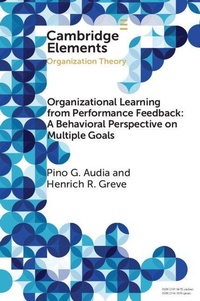
Organizational Learning from Performance Feedback: A Behavioral Perspective on Multiple Goals
A Multiple Goals Perspective
Published on 18. February 2021
Book
Paperback/Softback
72 pages
978-1-108-44093-6 (ISBN)
Description
This Element synthesizes the current state of research on organizational learning from performance feedback and develops a new perspective that deals with the influence of multiple goals. In keeping with the centrality of motives in Cyert & March's influential model, this new perspective rests on a foundation of individual level behaviors that are responsive to mechanisms at the organizational and environmental level of analysis. A key aim is to lay out an agenda for a new wave of empirical research on the interconnections of decision-makers, organizations, and the environment that influence organizational responses to performance.
Reviews / Votes
'... a must read for students of organizations and organizing - especially those interested in making the organization a focal unit of analysis at the interface of organization theory and strategy.' Michael Lounsbury, Administrative Science QuarterlyMore details
Series
Language
English
Place of publication
Cambridge
United Kingdom
Target group
Professional and scholarly
Product notice
Paperback (trade)
Illustrations
Worked examples or Exercises
Dimensions
Height: 222 mm
Width: 153 mm
Thickness: 7 mm
Weight
113 gr
ISBN-13
978-1-108-44093-6 (9781108440936)
Copyright in bibliographic data and cover images is held by Nielsen Book Services Limited or by the publishers or by their respective licensors: all rights reserved.
Schweitzer Classification
Other editions
Additional editions
Pino G. Audia
Organizational Learning from Performance Feedback: A Behavioral Perspective on Multiple Goals
A Multiple Goals Perspective
E-Book
02/2021
Cambridge University Press
€14.49
Available for download
Persons
Content
1. Introduction; 2. The Core Model of Performance Feedback: Goals, Aspiration Levels, Search, and Change; 3. The Modified Core Model; 4. Multiple Goals; 5. Extended Model; 6. An Example; 7. Future Research; 8. Conclusion.