

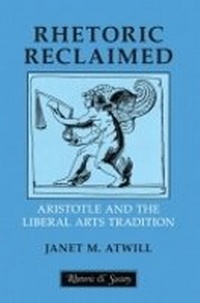
Rhetoric Reclaimed
Aristotle and the Liberal Arts Tradition
Published on 3. September 2009
Book
Paperback/Softback
254 pages
978-0-8014-7605-1 (ISBN)
Description
Thoroughly embedded in postmodern theory, this book offers a critique of traditional conceptions of the liberal arts, exploring the challenges posed by cultural diversity to the aims and methods of a humanist education. Janet M. Atwill investigates a neglected tradition of rhetoric, exemplified by Protagoras and Isocorates, and preserved in Aristotle's Rhetoric. This tradition was rooted in the ancient sophistic and platonic conceptions of techne, or productive knowledge, that appears both in literary texts from the seventh century B.C.E. and in medical and technical treatises from the fifth century B.C.E. Atwill examines these traditions, together with sophistic and platonic conceptions, and considers the commentaries on Aristotle's Rhetoric by E. M. Cope and William S. J. Grimaldi, where the concepts of techne and productive knowledge disappear in the modern opposition between theory and practice.
Since models of knowledge are closely tied to models of subjectivity, Atwill's examination of techne also explores the role of political, economic, and educational institutions in standardizing a specific model for subjectivity. She argues that the liberal arts traditions largely eclipsed the social and political functions of rhetoric, transforming it from an art of disrupting and reinventing lines of power to a discipline of producing a normative subject, defined by virtue but modeled on a specific gender and class type.
Since models of knowledge are closely tied to models of subjectivity, Atwill's examination of techne also explores the role of political, economic, and educational institutions in standardizing a specific model for subjectivity. She argues that the liberal arts traditions largely eclipsed the social and political functions of rhetoric, transforming it from an art of disrupting and reinventing lines of power to a discipline of producing a normative subject, defined by virtue but modeled on a specific gender and class type.
Reviews / Votes
In Rhetoric Reclaimed, Janet Atwill offers a new framework for understanding the history of Western rhetoric and a reinterpretation of Aristotle's place within that history.... She has done much to illuminate the competing forms of knowledge and subjectivity inscribed in the canonical texts of ancient rhetoric and has recovered a lost or under-appreciated dimension of these texts. In so doing, Rhetoric Reclaimed... also suggests a starting point for reassessing and renegotiating the priorities and values we have inherited from the rhetorical tradition.(Rhetorik) The publication of Janet Atwill's Rhetoric Reclaimed has served to powerfully recuperate and supplement an important conversation among the Greek sophists, one in which the notion of techne emerged not only as a rhetorical strategy, but also as a way of being and as an attitude about knowledge.... The importance of Atwill's book lies in its suggestion that attention to techne can enlarge our understanding of rhetoric in general and the theorizing and teaching of cooperative approaches to writing in particular.
(Journal of Advanced Composition)
More details
Series
Language
English
Place of publication
Ithaca
United States
Product notice
Paperback (trade)
Dimensions
Height: 229 mm
Width: 152 mm
Thickness: 18 mm
Weight
454 gr
ISBN-13
978-0-8014-7605-1 (9780801476051)
Copyright in bibliographic data and cover images is held by Nielsen Book Services Limited or by the publishers or by their respective licensors: all rights reserved.
Schweitzer Classification
Person
Janet M. Atwill is Professor of English at University of Tennessee at Knoxville. She is the coeditor of The Viability of the Rhetorical Tradition.